


 0

If you have ever woken up at 3 a.m. to find your earplugs on the pillow instead of in your ears, you are not alone. Earplugs falling out at night is one of the most common complaints among light sleepers, side sleepers, and anyone relying on hearing protection for rest. The frustrating part is that it rarely has one cause. Wrong size, poor insertion, sleep position, and worn-out tips all work against you simultaneously. This guide breaks down every reason it happens and gives you the practical fixes that actually work, so you can stop troubleshooting at 3 a.m. and start sleeping.
| Key Insight | Explanation |
|---|---|
| Wrong size is the most common culprit | Ear canals vary significantly in diameter and length, even between your left and right ear. A plug that is too small has no grip. A plug that is too large creates outward pressure that slowly expels it. |
| Poor insertion defeats any earplug | Foam tips must be compressed before insertion and held in place for 20 to 30 seconds while the foam expands. Releasing too early means the plug never seats properly. |
| Side sleeping multiplies the problem | Pillow pressure against the ear acts as a lever, gradually working a protruding earplug loose. Low-profile designs reduce this effect significantly. |
| Worn-out foam tips lose their grip | Memory foam tips that have been used too long lose elasticity. They stop expanding to fill the canal and simply slide out. Replacing tips every 6 to 8 weeks restores performance. |
| The metal body versus foam body difference matters | A rigid outer body keeps the earplug correctly positioned against the ear, whereas an all-foam plug can shift as a whole unit when you move. |
| Left and right ears often need different tip sizes | Most people assume symmetry, but asymmetric ear canals are common. Test each ear independently with different tip sizes before settling on one pair. |
| Insertion depth is not optional | A partially inserted earplug sits at the entrance of the canal where walls cannot hold it. The foam needs to be inside the canal, not perched at the opening. |
The reason most people cycle through earplug after earplug without solving the problem is that they treat it as a product issue when it is usually a fit issue. The earplug itself is rarely at fault. The combination of wrong size, wrong technique, and wrong earplug type for the sleep position is almost always what fails.
Ear canals come in a wide range of diameters, lengths, and curvatures. A standard one-size disposable plug is built around an average that does not accurately represent most individuals. If the plug is too small for your canal, it has nothing to grip against and slides out within the first hour. If it is too large, the foam generates outward pressure that the canal walls eventually push back against, slowly ejecting the plug over several hours. You wake up with it half out or gone entirely.
Jaw movement is a less obvious contributor. Grinding, clenching, or even normal jaw relaxation during sleep shifts the tissues around the ear canal. An earplug that was marginally positioned when you fell asleep can work loose by morning just from this movement alone.
Pro tip: If your earplug falls out consistently on the same side, that specific ear canal may be slightly smaller or differently shaped than the other. Try one tip size smaller on that side before assuming the whole pair needs replacing.
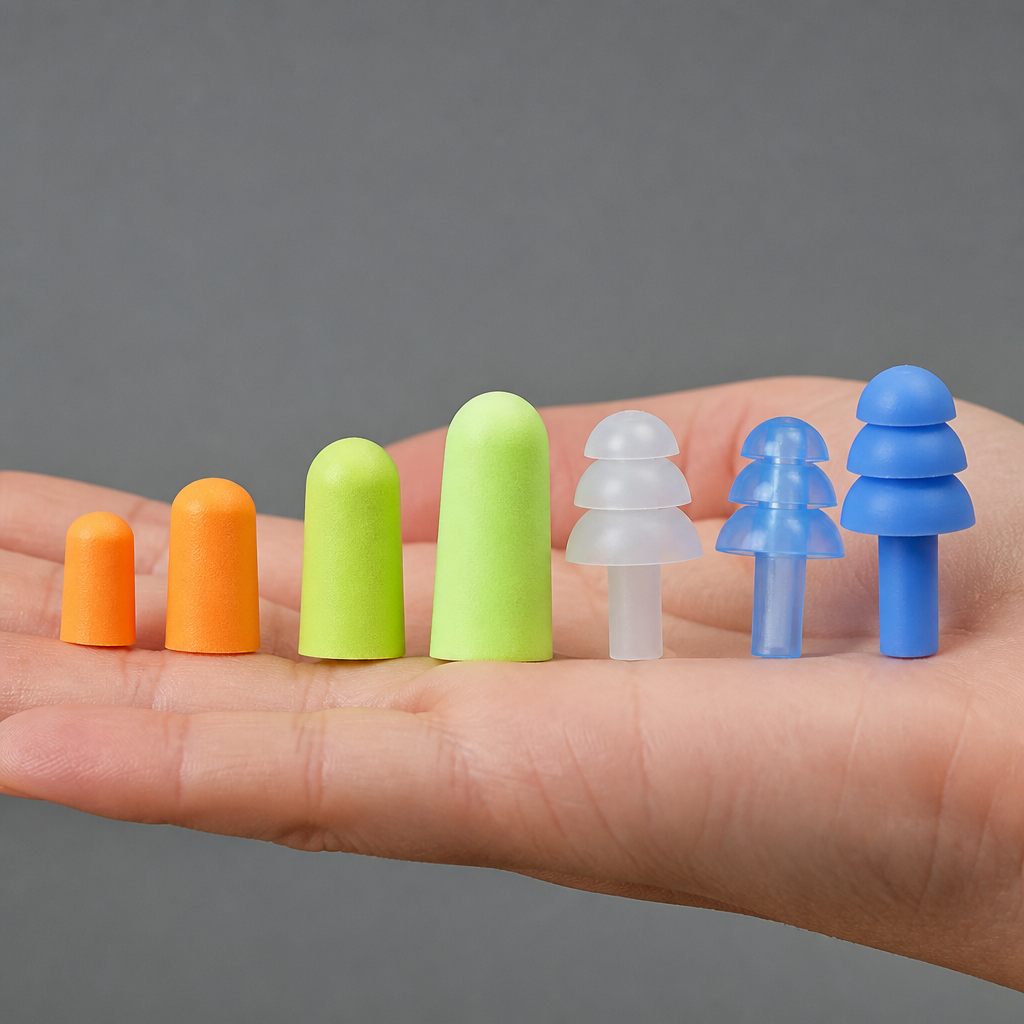
The single most effective intervention for earplugs that will not stay in is matching tip size to canal diameter. This sounds obvious but most people skip it because disposable foam plugs come in one size, and reusable options are often sold as one-size-fits-all. That is a product limitation, not a biological truth.
Insert the earplug with the tip you think is closest to your size. After insertion, gently tug the earplug backward. A correctly sized tip should offer moderate resistance, not slide out immediately but also not require significant force to remove. If it slides free with almost no resistance, go one size up. If removal feels uncomfortable or creates a strong vacuum sensation, go one size down.
Test each ear independently. Asymmetric ear canals are more common than most people realise. Your right ear may take a medium tip comfortably while your left ear needs a small. Using a product that includes multiple tip sizes, such as XS, S, and M options, is the only practical way to address this without spending money on custom moulds.
A properly sized earplug should feel snug without causing a pressure buildup sensation. There should be a noticeable but not uncomfortable reduction in ambient sound immediately after insertion. If the sound reduction feels weak and you can hear clearly without the plug being fully in, the tip is too small. If you feel pain or significant pressure within a few minutes, the tip is too large.
The fit of a hearing protector is critical. A poor fit, regardless of the product’s rated attenuation, means the wearer is not receiving the protection they expect. Sizing is not a secondary concern, it is the primary one.
ATTENU8 includes three pairs of memory foam tips in XS, S, and M with every unit specifically because canal variation between individuals, and between ears on the same person, is the rule rather than the exception. Explore the full ATTENU8 earplug range to see how the sizing system works in practice.
Pro tip: When testing tip sizes, do the test lying down on your side, not sitting upright. A fit that feels secure while you are upright can behave very differently once pillow pressure enters the equation.
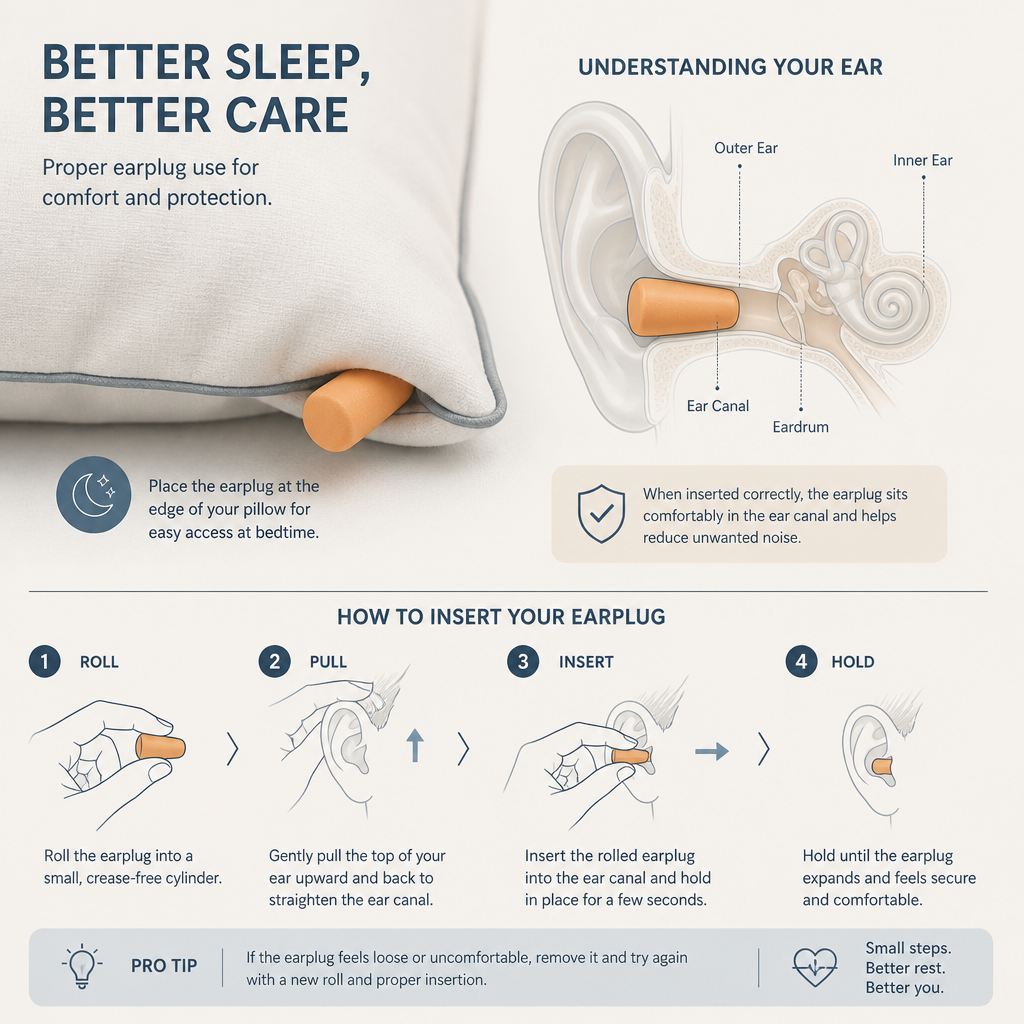
Even the correctly sized earplug falls out if insertion is done poorly. This is the most fixable cause of earplugs falling out at night, and it is almost entirely a technique problem, not an equipment problem.
For memory foam tips, compress the tip between your fingers until it is as narrow as possible before inserting it. Then, reach your opposite hand over the top of your head and gently pull your outer ear upward and slightly backward. This straightens the ear canal and opens it for easier insertion. Insert the compressed tip with a slight rotating motion, pushing it in far enough that only a small portion remains visible. Then hold it in place for 20 to 30 seconds while the foam expands.
The holding step is where most people fail. Releasing the earplug before the foam has expanded means the plug was never anchored. It sits near the entrance to the canal rather than inside it, where the canal walls can grip it. A partially expanded plug has almost no resistance to movement.
A properly inserted earplug should sit with only a small portion visible at the entrance to the ear canal. If you can see most of the plug protruding from your ear, it is not inserted deeply enough. The foam body needs to be inside the canal, not balanced at the opening. When inserted correctly, you should notice an immediate and significant reduction in ambient sound, noticeably more than when the plug was sitting only partially in.
With a metal-bodied earplug like ATTENU8, the concave aluminium shell sits flush against the outer ear, giving you a clear tactile reference for correct positioning. The body does not shift as a whole unit the way an all-foam plug does, which makes maintaining insertion depth through the night considerably more reliable.

Side sleepers face a problem that back sleepers do not. When your ear presses into a pillow, any earplug that protrudes past the outer ear becomes a lever. The pillow pushes against the outer part of the earplug while the canal wall holds the inner part, and over several hours of sustained pressure the earplug slowly works its way out.
A bulky or high-profile earplug design amplifies this problem. The further the earplug extends past the ear, the greater the mechanical advantage the pillow has in pushing it loose. This is why low-profile earplug designs are not just a comfort preference for side sleepers, they are a functional requirement. An earplug that sits flush with the outer ear, or that uses a concave body designed to sit within the ear contour, dramatically reduces the leverage available to pillow pressure.
The ATTENU8 concave aluminium body is specifically shaped to sit within the natural contour of the outer ear rather than protruding from it. Bottom foam tips are included in the kit specifically for side sleepers, allowing the plug to sit closer to flush when lateral sleeping is the priority. For more detail on how sleep position interacts with earplug performance, see the ATTENU8 guide on memory foam versus silicone earplugs for side sleepers.
A softer pillow compresses around the ear rather than pushing against the earplug, which reduces the ejection force significantly. Some side sleepers find that a pillow with a contoured cutout or a pillow designed with a recessed area for the ear solves the problem entirely without changing earplugs. However, this is a workaround, not a fix. The correct earplug, correctly inserted and correctly sized, should not require a special pillow to stay in place.
Not all earplugs behave the same way at night. The type of earplug you choose has direct consequences for how reliably it stays in through movement, pressure, and hours of continuous wear.
| Earplug Type | Stay-in Performance for Sleep | Best Suited For |
|---|---|---|
| Disposable foam (all-foam body) | Poor to moderate. The entire plug can shift as a unit. Foam degrades quickly, losing grip. Requires fresh plug each night for reliable performance. | Occasional use, back sleepers who move minimally. |
| Reusable metal body with memory foam tips | Good to excellent. Rigid outer body anchors position. Memory foam tips conform to canal shape. Tips replaceable independently every 6 to 8 weeks. | Nightly use, side sleepers, anyone needing consistent 30+ dB attenuation. |
| Silicone or acoustic-filter design | Moderate. Fixed silicone shape cannot conform to canal variation. Better for daytime or social use where some ambient sound pass-through is desirable. | Daytime noise management, travel, work environments where situational awareness matters. |
The key difference between a metal-bodied reusable earplug and an all-foam disposable comes down to structural stability. When an all-foam plug shifts, the entire plug moves. When a metal-bodied earplug with a foam tip is correctly inserted, the rigid body holds position while the foam tip maintains the acoustic seal. That separation of structural and sealing functions is what makes the design significantly more reliable for overnight use.
For a deeper look at how noise attenuation figures translate to real-world sleep performance, the ATTENU8 article on why 32 dB is the sweet spot for sleep covers the science behind NRR ratings and what they actually deliver overnight.
Foam tips have a finite lifespan. Memory foam that has been compressed and released hundreds of times loses its elasticity. A tip that no longer rebounds quickly after compression cannot create an adequate seal inside the canal, and a tip without a reliable seal has nothing to hold it in place. This is one of the least-discussed reasons for earplugs that progressively get worse at staying in over time.
The practical indicator is simple: if you compress the tip and it does not spring back to its original shape within a few seconds, it needs replacing. Discolouration, stiffness, or any visible deformation of the foam surface are also clear signals. For nightly use, foam tips typically need replacing every 6 to 8 weeks. This is considerably more economical than replacing the entire earplug, which is the only option with disposable products.
One of the practical advantages of a reusable metal-bodied earplug is that the aluminium body itself does not wear out. Only the foam tips degrade, and they can be replaced independently. This makes the long-term cost lower than continuously buying disposable packs, while also reducing waste. For context on the full sleep environment picture, the ATTENU8 room-by-room guide on sleep environment and noise reduction covers how earplug performance fits into a broader approach to sleep-friendly spaces.
Pro tip: Keep a small note in your earplug case with the date you last replaced the tips. Six to eight weeks goes faster than you expect when you are using them every night, and degraded tips are the silent cause of progressively worsening overnight fit.
This almost always points to a size mismatch on that specific ear. Ear canals are frequently asymmetric, meaning your left and right canals differ in diameter or shape. Try one tip size smaller on the side that keeps losing the plug. If that does not resolve it, that canal may have a curvature that requires a slightly different insertion angle. Adjust the pull direction when opening the canal before insertion.
Movement alone rarely ejects a correctly fitted earplug. What movement does is amplify any existing fit problem. A plug that is marginally too small, barely inserted, or using a worn-out tip will fall out during movement. A correctly sized, properly inserted plug with fresh foam tips should remain in place through normal sleep movement. If you are a very active sleeper and nothing stays in, the focus should be on maximising insertion depth and switching to memory foam tips that conform more completely to the canal wall.
For most people, nightly earplug use is safe provided hygiene is maintained. Clean your earplugs regularly and replace foam tips on schedule. The main risks from nightly use are earwax buildup and minor ear canal irritation, both of which are typically avoided by keeping the earplugs clean and not forcing plugs that feel uncomfortable. If you experience any pain, ringing, or change in hearing, stop use and consult a doctor.
The most common cause is foam fatigue over the course of the night. When you first insert a foam plug, it compresses and expands against the canal walls. Over several hours, as the foam slowly relaxes further, that outward pressure decreases and the grip weakens. With worn-out foam this happens faster. Jaw relaxation during deep sleep also changes the geometry of the ear canal slightly, which can be enough to release a marginally fitted plug. Fresh tips that rebound consistently solve most cases of this gradual slipping.
Not necessarily. Most earplug fitting failures are solved by correct size selection and correct insertion technique, not by custom moulding. Custom earplugs are genuinely useful for people with unusually shaped canals, but they represent a significant expense and a process that takes time. Before pursuing that route, work through the complete checklist: test each ear independently with multiple tip sizes, master the compress-pull-insert-hold technique, check whether your current tips need replacing, and assess whether your sleep position is working against the earplug design. Most people find a standard solution within those four steps.
A low-profile reusable earplug with a rigid outer body and replaceable memory foam tips is the most reliable option for side sleepers. The rigid body prevents the earplug from shifting as a whole unit under pillow pressure, while the memory foam tip conforms to the individual canal shape for a secure seal. The profile of the earplug should sit close to or within the outer ear contour rather than protruding from it, which minimises the lever effect of the pillow over several hours of side sleeping.
Share your own experience with earplugs falling out at night in the comments below, including what worked and what did not, because the more specific the detail, the more useful it is to others dealing with the same problem.
We would love your feedback and any insights you would share with others. What perspective would you add?

