


 0

Most people grab ear plugs exactly once: when a snoring partner or a loud concert forces their hand. That reactive approach means they spend the rest of their lives absorbing noise that chips away at sleep quality, concentration, hearing health, and general wellbeing. Knowing when to use ear plugs proactively is one of the simplest, highest-return habits you can build. Whether you’re a light sleeper, a professional in a loud industry, or someone who just needs to think clearly in a chaotic world, the right pair of ear plugs transforms ordinary noise-saturated moments into manageable ones.
| Key Insight | Explanation |
|---|---|
| 32dB noise reduction covers most daily situations | A well-fitted ear plug delivering around 32dB NRR brings a loud street or snoring partner down to comfortable, sleep-friendly levels. |
| Fit matters more than NRR rating alone | An ear plug with a high NRR that sits loosely in your ear canal delivers a fraction of its rated protection. Memory foam tips that conform to your canal shape are essential. |
| Reusable metal-bodied plugs outperform disposable foam in comfort and hygiene | Disposable foam compresses down and can irritate the canal. A rigid aluminium body with replaceable foam tips maintains shape and is far easier to keep clean. |
| Chronic noise exposure damages more than hearing | Research links prolonged noise exposure to sleep disorders, anxiety, elevated blood pressure, and difficulty concentrating – not just hearing loss. |
| Ear plugs for everyday use need multiple tip sizes | Ear canals vary significantly between people. Having XS, S, and M tip options means you can dial in a seal that is both protective and comfortable enough to wear for hours. |
| Tip replacement beats full replacement | Premium reusable ear plugs require only foam tip replacement every 6 to 8 weeks, not whole-unit replacement, making them far more economical over time. |
| Proactive use beats reactive use | Waiting until noise becomes unbearable means you have already absorbed the damage. Inserting ear plugs before you enter a loud environment is the only approach that actually protects hearing. |
Sleep is the clearest case for ear plug use, and it is where most people first make the switch from doing nothing to doing something. Snoring partners, traffic noise, neighbour activity, and early-morning deliveries all fragment sleep in ways that accumulate over weeks and months. Research published in peer-reviewed literature has linked occupational and environmental noise exposure to measurably worse sleep quality, including more nighttime waking and reduced restorative sleep stages.
The practical test is simple: if you are lying awake or waking repeatedly because of sound, your environment is too loud for your sleep threshold. Ear plugs rated around 32dB NRR bring a loud snorer or a busy street down to a level most light sleepers can sleep through.
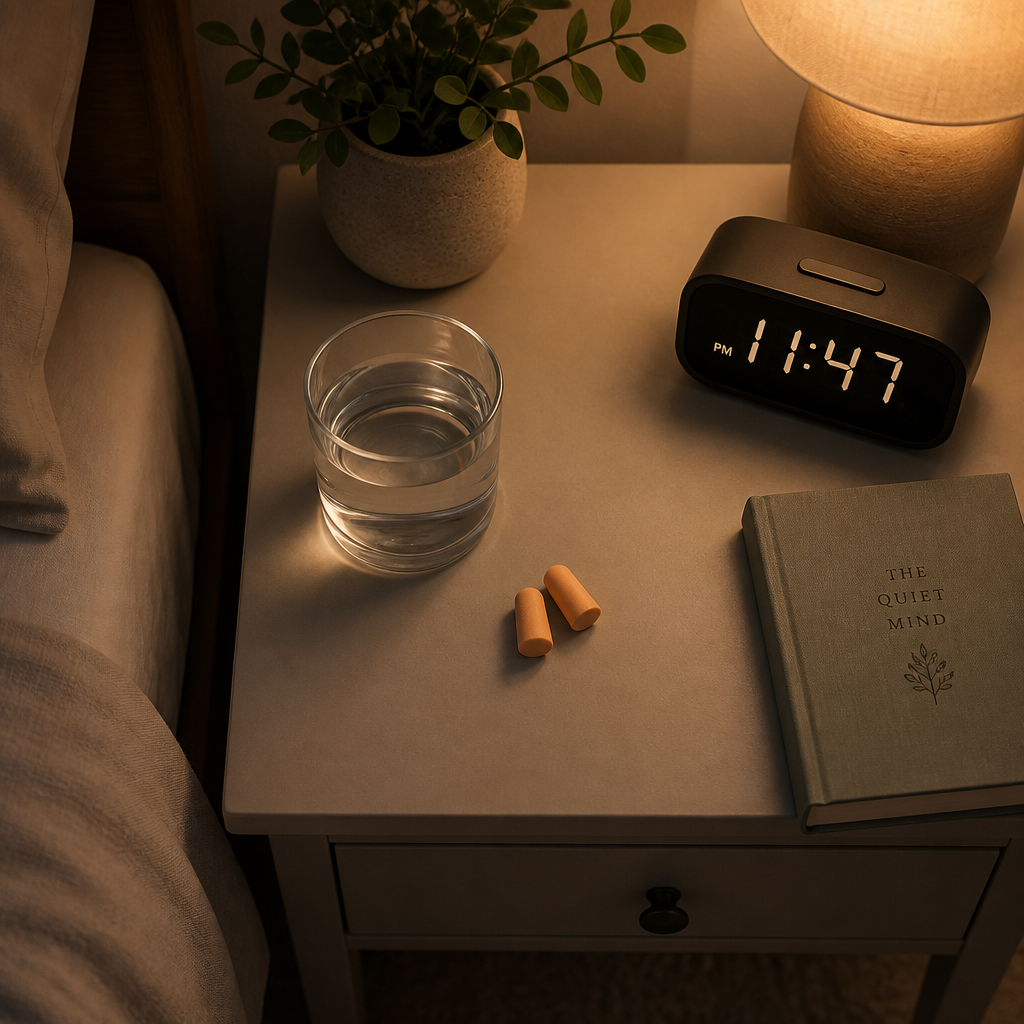
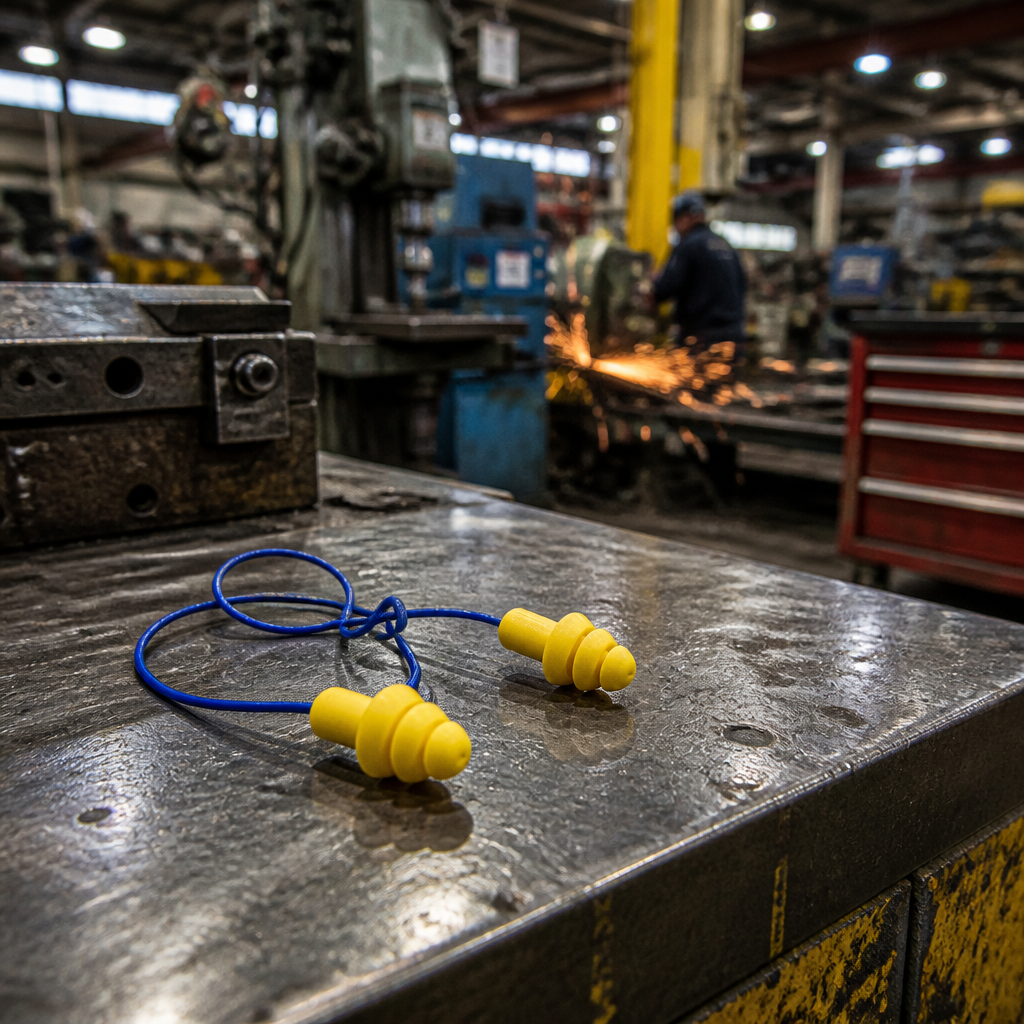
The biggest friction point with sleep ear plugs is comfort during side sleeping. Standard disposable foam expands against the ear canal, which works fine lying on your back but creates painful pressure when you roll onto your side. A metal-bodied plug with a low-profile concave design sits flush against the outer ear rather than protruding, which makes side sleeping far more comfortable. ATTENU8’s aluminium-bodied plugs were specifically designed with this geometry in mind.
Pro tip: Insert your ear plugs before you get into bed, not after you have already been disturbed. The ritual of insertion also signals to your nervous system that sleep is starting, which can marginally speed up sleep onset.
This is not a lifestyle preference. It is a safety requirement. Power tools, pneumatic equipment, heavy machinery, and concrete cutting all generate noise levels that cause permanent hearing damage with repeated exposure. The threshold at which sustained noise begins to cause damage is generally cited at around 85 decibels, and most active construction environments exceed that considerably.
Why disposable foam plugs often fail in this context
Workers in loud environments typically wear hearing protection for entire shifts, sometimes six to eight hours at a stretch. Disposable foam plugs that are rolled down and inserted become uncomfortable within an hour or two, leading workers to partially remove them or wear them loosely, which dramatically reduces their actual protection. A reusable plug with a structured body and correctly sized memory foam tips maintains its seal and its comfort across a full shift.
There is also the hygiene factor. Construction workers handle dusty, oily, and contaminated materials throughout the day. A metal-bodied plug that can be wiped clean between uses is meaningfully more hygienic than a soft foam plug that absorbs whatever is on your fingertips during insertion.
Pro tip: If you work in an environment where you need to communicate intermittently, choose ear plugs with the right NRR for the loudest tasks rather than the average noise level. You can remove them briefly for conversation, but you cannot un-damage hearing that was unprotected during peak-noise moments.
The sustained drone of aircraft engines and the unpredictable noise bursts of trains, buses, and subways are genuinely fatiguing. Cabin noise on commercial aircraft typically sits in the 80 to 85 decibel range for the duration of a flight, which is well above comfortable background levels for extended periods.
Beyond volume, the low-frequency rumble of engines and turbines triggers a physiological stress response in many people, elevating cortisol and reducing the restorative quality of in-flight sleep. Ear plugs for travel address this directly, without the cost and bulk of active noise-cancelling headphones.
For travel specifically, reusable plugs stored in a compact carry case make practical sense. You do not want to be fishing loose disposable foam out of a jacket pocket at 30,000 feet. A premium reusable pair lives in your hand luggage and is ready whenever you need it, including on layovers and during the taxi to the gate.
Open cafes, shared libraries, co-working spaces, and home environments with other people present are genuinely hostile to sustained concentration. Noise forces the brain to allocate cognitive resources to filtering out irrelevant sound, which leaves less capacity for the actual task at hand. For ear plugs everyday use, focus work is one of the most consistent use cases.
The type of noise matters. Speech is more disruptive to reading and writing tasks than ambient music or white noise, because the language-processing parts of your brain try to parse every overheard conversation even when you consciously try to ignore it. Ear plugs that knock back ambient sound enough to make nearby conversations inaudible can therefore have a disproportionate effect on cognitive performance.
Noise is not just an annoyance. It is a measurable tax on cognitive performance, and reducing it has a direct effect on output quality and mental fatigue levels.
A common mistake is reaching for heavy noise-cancelling headphones when a good pair of ear plugs would do the job more simply, more comfortably, and without needing a battery charge. For study sessions lasting two to four hours, ear plugs are frequently the more practical tool.

Live music venues routinely operate at sound levels above 100 decibels, and some nightclubs and festival stages push significantly higher. Hearing damage from a single event at these levels is entirely possible. The tell-tale ringing after a loud concert, called tinnitus, is your auditory system signalling that it has been pushed past its safe limit.
The legitimate concern people raise about wearing ear plugs at concerts is that they will ruin the experience. This concern is valid for single-use foam plugs that reduce all frequencies uniformly and make music sound muffled and distant. However, a well-fitted memory foam tip inside a structured plug body provides more consistent seal geometry, which results in more even frequency attenuation rather than the bass-heavy muffling of loosely fitting foam.
The standard is straightforward: if you want to attend live music events across a lifetime without tinnitus or progressive hearing loss, ear plugs are not optional. The choice is between a slightly adjusted listening experience now and permanent hearing damage later.
Night shift workers, emergency services personnel, and anyone on a rotating roster face a specific challenge: the world around them operates on a daytime schedule. Traffic peaks, neighbours start lawn mowers, delivery drivers ring doorbells, and construction begins at exactly the hours these workers need to sleep.
Noise reduction for daytime sleep is different in character from overnight sleep. Daytime ambient sound levels are higher on average, and the noise events are more varied and unpredictable. Ear plugs rated around 32dB NRR are particularly effective here because they flatten the overall noise floor enough to make the sudden, sharp sounds that cause waking, like a car horn or a door slam, less likely to breach the threshold needed to rouse a sleeping person.
Shift workers also tend to need ear plugs that they can insert and remove repeatedly without the hygiene degradation that comes with disposable foam. A reusable plug that can be kept next to the bed, wiped down between uses, and fitted with fresh tips every six to eight weeks suits this pattern of use far better than single-use alternatives.
For people with heightened sensitivity to sound, including those with anxiety disorders, autism spectrum conditions, misophonia, or sensory processing differences, noise reduction in daily life is not a comfort preference. It is a functional necessity. Exposure to ambient noise that others find unremarkable can trigger genuine physiological stress responses in people with these conditions.
Research has established links between chronic noise exposure and increased anxiety, depression, and difficulty with concentration, and these effects are amplified in individuals who already have heightened sensory sensitivity. Ear plugs do not eliminate environmental awareness entirely at 32dB NRR, but they remove the sharp, unpredictable sound spikes that are most likely to trigger an anxious response.
The key for this use case is comfort over extended wear. If ear plugs are uncomfortable after 20 minutes, they will not be worn consistently. Memory foam tips in the correct size, housed in a rigid body that does not shift with jaw movement or head turning, are essential for people who need to wear them for hours at a time across diverse daily environments.
Open-plan office design was supposed to foster collaboration. In practice, the research literature on office acoustics has consistently shown it frequently creates environments that are worse for both focus work and communication quality than private offices or properly partitioned spaces. The ambient noise of keyboards, phone conversations, HVAC systems, and foot traffic creates a background noise floor that many workers find genuinely exhausting over a full working day.
The office context has unique requirements. You cannot wear ear plugs so effective that you cannot hear your name called or participate in a sudden conversation. You also need something discreet enough that it does not invite constant questions from colleagues. A compact, low-profile ear plug with a modest noise reduction level, or a premium plug that sits nearly flush with the outer ear, works far better than brightly coloured industrial foam that signals “do not disturb” to the entire floor.
ATTENU8’s aluminium-bodied design with its concave profile sits close to the ear and is visually unobtrusive, which matters in professional settings where appearance is relevant. Pair that with the ability to swap between tip sizes to dial in your preferred level of noise attenuation, and you have a practical office tool rather than a blunt industrial instrument.
Gunfire and high-performance engines represent some of the most acutely dangerous noise exposures most recreational users will ever encounter. A single gunshot can reach peak levels well above 140 decibels at the shooter’s ear position, which is above the threshold for immediate, irreversible hearing damage with even brief unprotected exposure.
For shooting sports, ear plugs are typically used in combination with over-ear muffs for maximum protection, with the plugs serving as the first line of defence even if muffs are removed momentarily. For motorsport spectators and participants, the sustained high-frequency noise of engines at race speeds creates cumulative exposure risk across an event that lasts hours.
In both contexts, the durability and reusability of a metal-bodied plug matters. You are not going to stop between sets on the range to find a fresh pair of disposable foam. You need a plug that is ready to go, fits reliably every time, and does not degrade after repeated insertions and removals.
DIY home renovation has a hearing protection problem. Professionals on worksites typically have access to PPE and a site supervisor with enforcement responsibility. The person running a circular saw or angle grinder in their garage on a weekend has neither. Power tools used in enclosed spaces generate noise levels that rival industrial equipment, and the intermittent nature of weekend projects tricks people into thinking the exposure does not add up.
It does. Repeated short exposures to high-level noise without protection accumulate damage over years. A person who does regular home maintenance or renovation projects without hearing protection is making the same error as someone who skips sunscreen on short outdoor stints, because the damage is invisible until it is permanent.
Keeping a premium reusable pair of ear plugs in your tool bag, rather than searching for disposable foam every time you start a project, is the most reliable way to ensure you actually use them. The ease of access removes the most common excuse: that the noise had already started before you found your protection.
Not all ear plugs are built for all situations. The table below compares the three main types across the ten situations covered in this article, so you can match the right tool to your actual use case.
| Situation | Disposable Foam | Reusable Flanged Silicone | Premium Metal-Bodied with Memory Foam Tips (e.g., ATTENU8) |
|---|---|---|---|
| Sleep (nightly use) | Adequate but uncomfortable for side sleepers; degrades quickly | Comfortable but often lower NRR; can feel bulky | Best option: low-profile concave body, consistent seal, washable |
| Industrial / construction | High NRR but hygiene degrades fast; uncomfortable over full shifts | Good for mid-shift; can loosen with movement | Durable, hygienic, maintains seal; tip replacement every 6-8 weeks |
| Travel | Easy but generates waste; loose in pocket | Reusable but often bulkier carry case required | Compact, carry-case ready, reusable across trips |
| Focus / study | Works but uncomfortable after 1-2 hours | Acceptable comfort; limited NRR range | Multiple tip sizes allow comfort tuning for long sessions |
| Concerts / events | Muffled sound quality; poor aesthetics | Reasonable but variable seal quality | Consistent attenuation with better frequency balance than loose foam |
| Shooting range | High NRR; acceptable for occasional use | Lower NRR may not suffice alone | Durable for repeated insertions; pairs well with over-ear muffs |
| Office use | Visible and conspicuous; not appropriate professionally | More discreet; variable fit | Most discreet option; low-profile aluminium body suits office settings |
Yes, provided you keep them clean and use correctly sized tips. The main risks associated with daily ear plug use are ear canal irritation from ill-fitting plugs and wax build-up from blocking the natural migration of cerumen out of the canal. Both risks are manageable: use the correct tip size for your ear canal, keep your plugs clean, and allow your ears regular rest periods during the day. Premium reusable plugs with replaceable memory foam tips are better suited to daily use than disposable foam, which can introduce bacteria from handling and gradually loses its resilience.
For most sleep situations involving snoring, traffic, or urban ambient noise, a plug rated around 32dB NRR is more than sufficient. The practical noise reduction you experience depends heavily on fit, not just the rated number. A 32dB plug with a correct seal will outperform a 35dB plug that sits loosely. Focus on finding the right tip size for your ear canal first, and the NRR rating will take care of itself.
A metal-bodied reusable ear plug is significantly more hygienic than disposable foam for daily users. The aluminium body can be wiped clean after use, and the replaceable memory foam tips are swapped out every six to eight weeks rather than accumulating oils and bacteria through repeated use. The critical hygiene practice is hand washing before insertion, which applies regardless of plug type.
The most reliable indicator is sound. If you insert your ear plugs and nearby speech drops to a low murmur and general ambient noise feels significantly quieter, you have a good seal. If you can still hear conversations clearly or the noise level feels almost unchanged, the plug is either the wrong size for your canal or has not been seated properly. With memory foam tips, allow two to three seconds after insertion for the foam to expand and fill the canal before assuming the fit is final.
Noise reduction, which is what ear plugs provide, works by physically blocking sound waves from reaching the ear canal through a passive acoustic barrier. Noise cancellation, as found in electronic headphones, uses microphones to sample ambient sound and generates an opposing sound wave to cancel it electronically. For sleep, construction, and most daily-use situations, passive noise reduction from a well-fitted ear plug is more reliable, lower maintenance, and battery-free. Active noise cancellation performs better with steady low-frequency sounds like aircraft engines but is less effective against sudden, unpredictable noise events.
Ear plugs do not treat tinnitus, but they can prevent the noise-induced damage that causes and worsens it. For people already experiencing tinnitus, wearing ear plugs in loud environments prevents further deterioration of the underlying hearing sensitivity. Some tinnitus sufferers also find that wearing ear plugs in very quiet environments paradoxically makes tinnitus more noticeable by removing the ambient noise that masks it, so this is worth testing on an individual basis before adopting full-time wear in quiet settings.
Start with the medium size, which fits most adults. If the plug feels like it is sitting at the entrance to the canal rather than seating inside it, or if it falls out easily, try small. If you have discomfort or pressure pain with medium and the plug feels like it is being forced into a canal that is too narrow, try extra small. The goal is a seal that feels snug without pressure or pain, and that does not shift when you move your jaw. ATTENU8 includes all three sizes with each pair so you can test all options.
Have you found a situation where ear plugs made a bigger difference than you expected? Share your experience in the comments below.
If you have spent any time searching for premium ear plugs, you have almost certainly landed on two names: ATTENU8 and Flare Audio. Both ditch disposable foam, both use metal bodies, and both cost considerably more than a box of standard pharmacy ear plugs. But spend more than five minutes comparing them and the differences become sharp fast. ATTENU8 vs Flare Audio is not a close race for every use case. For sleep and high-noise reduction, the gap is meaningful, and this comparison will tell you exactly where it opens up and why.
| Key Insight | Explanation |
|---|---|
| ATTENU8 delivers approximately 32dB noise reduction | This rating meets industrial hearing protection thresholds and is higher than most sleep-focused ear plugs claim. It covers snoring, traffic, and construction noise. |
| Flare Audio ISOLATE is rated SNR-30dB | Strong performance, but ISOLATE is optimised for concerts and loud workplaces, not sleep. The cylindrical body profile creates pressure points for side sleepers. |
| ATTENU8’s concave aluminium body is the key design difference | The concave shape sits flush with the ear canal entrance rather than protruding, making it far more comfortable when pressing against a pillow. |
| ATTENU8 ships with three foam tip sizes, Flare ISOLATE ships with four | Both brands include XS, S, and M. Flare also includes L. Fit matters enormously for both comfort and actual attenuation, so trying all sizes is essential. |
| Tip replacement cost is lower than buying new plugs | ATTENU8 owners replace only the memory foam tips every 6 to 8 weeks. Flare ISOLATE offers replacement tips separately. Both beat the ongoing cost of disposable foam. |
| Flare Audio targets musicians and audiophiles first | ISOLATE’s engineering focus is on preserving sound quality while reducing volume. If you want total silence, that design philosophy works against you. |
| For sleep and high-noise environments, ATTENU8 has a structural advantage | The low-profile body and passive foam seal together outperform filtered or cylindrical alternatives when the goal is maximum noise blocking during horizontal rest. |
This is where most comparisons go wrong: they treat ATTENU8 and Flare Audio as direct substitutes when the brands have built products for meaningfully different primary users.
Flare Audio launched its ISOLATE range with a music and sound-fidelity audience in mind. The original pitch was aimed at concert-goers, musicians, and audiophiles who wanted noise reduction without the muffled, frequency-distorted experience that standard foam ear plugs produce. The solid metal body blocks sound differently from foam or silicone because denser materials attenuate low-frequency noise more effectively. That is a genuine acoustic engineering insight, and it is why Flare built a loyal following among people who attend loud events regularly.
ATTENU8 approaches the problem from the opposite direction. The primary target user is a noise-sensitive sleeper, a light sleeper dealing with a snoring partner, urban noise, or early-morning traffic. Secondary to that is the professional in a loud workplace, such as construction, manufacturing, or military environments, who needs reliable daily wear rather than occasional event use. The concave aluminium body is a direct response to the complaint that cylindrical or protruding ear plugs become painful within an hour when you are lying on your side.
The best ear plug is the one you can actually wear for eight hours. A product with a 35dB rating that digs into your ear canal at 3am is worse than a well-fitted product rated at 30dB that you forget is there.
Understanding this split in design intent is the most useful thing you can know before comparing specs. Both products deliver real noise reduction. But they are optimised for different postures, use durations, and user priorities.
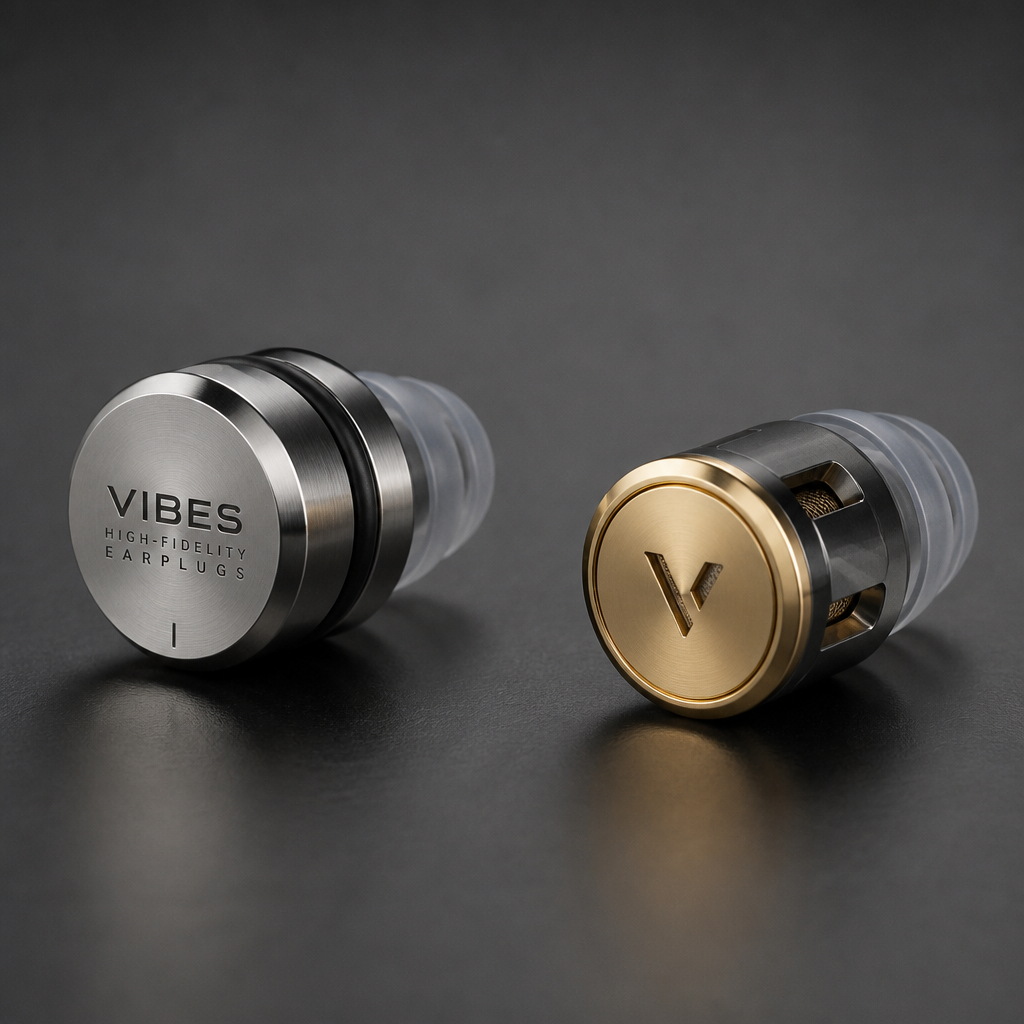
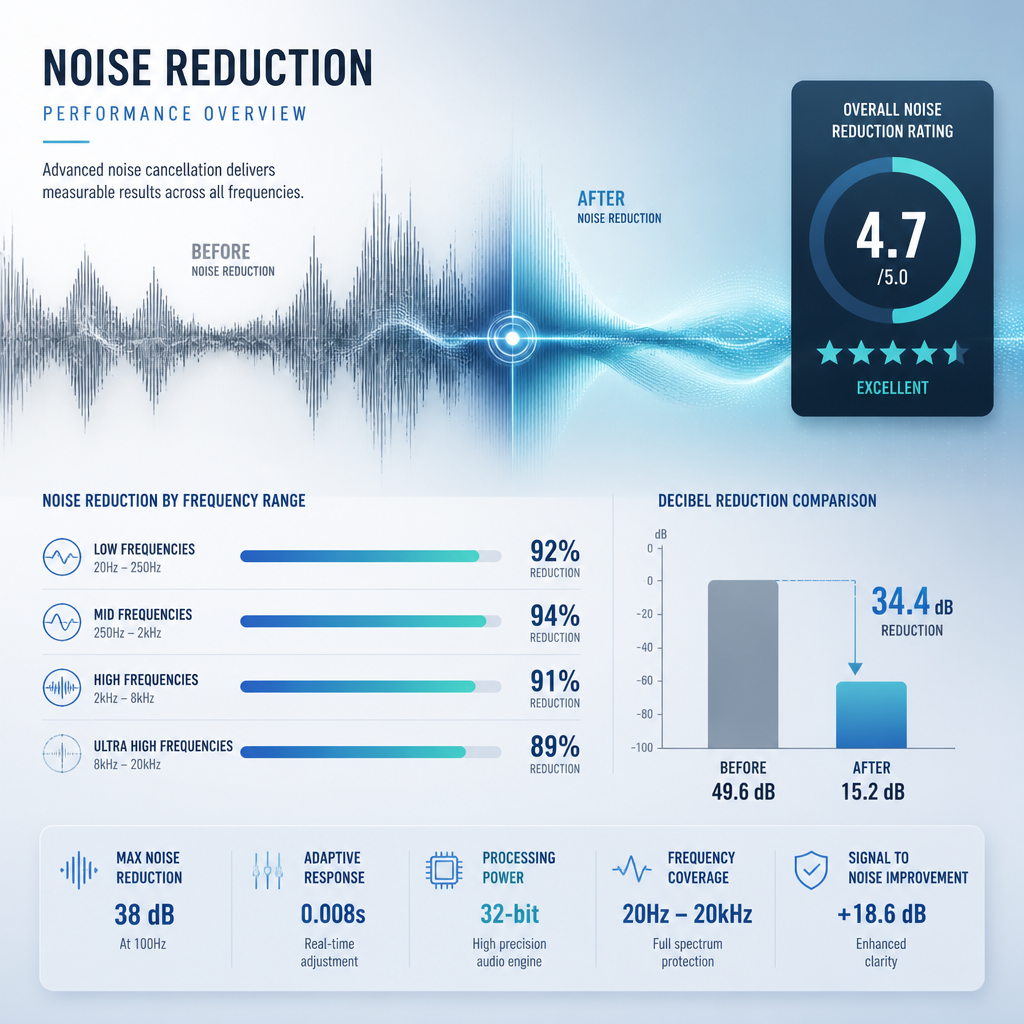
ATTENU8 carries an approximately 32dB noise reduction rating. Flare Audio ISOLATE is CE certified at SNR-30dB. The difference of around 2dB is not the main story here. Both products are genuinely high-performing, and both sit well above the 18 to 27dB range that most lifestyle-oriented reusable ear plugs claim.
A snoring partner typically produces noise in the 50 to 90dB range depending on severity. Urban street noise through a window might sit at 55 to 70dB. At 32dB attenuation, ATTENU8 brings those sounds down to a range most people find tolerable for sleep. Flare Audio at 30dB performs similarly, but the 2dB difference is compounded by a more important variable: the seal.
Any ear plug’s real-world performance depends on how well it seals the ear canal. An imperfect seal, caused by the wrong tip size, incorrect insertion, or the plug shifting during sleep, dramatically reduces effective attenuation. This is where ATTENU8’s three memory foam tip sizes and low-profile body design become operationally significant. A plug that stays seated correctly all night delivers its rated performance. One that shifts when you roll over does not.
Pro tip: When testing ear plugs for sleep, insert them and lie down on each side for at least three minutes. Pressure from a pillow changes the fit significantly. If you notice the plug loosening or creating pressure, try the next smaller foam tip size before assuming the product does not work for you.
Both ATTENU8 and Flare Audio ISOLATE use metal bodies, which immediately separates them from the plastic and silicone options that dominate the reusable ear plug market. Metal bodies do not compress over time, do not absorb odour the way soft materials do, and survive the kind of daily carry abuse that destroys plastic products within months.
ATTENU8 uses a concave aluminium body. The concave geometry is not cosmetic. It creates a shape that sits at the entrance of the ear canal rather than inserting deeply or protruding outward. For a side sleeper pressing their ear against a pillow, this matters more than almost any other specification. A flat or recessed outer surface means the pillow applies pressure to the ear, not to the ear plug body pushing inward.
Flare Audio manufactures ISOLATE from solid aluminium or titanium, both aerospace-grade materials. The titanium Pro version offers a slightly lighter and harder option for users willing to pay a premium. The cylindrical shape is precision-machined and the finish quality is high. The issue for sleep use is geometry, not material quality. A cylinder protrudes from the ear canal entrance. When you lie on your side, that protruding cylinder is what your pillow pushes against, and after an hour or two, the accumulated pressure becomes noticeable.
Earlier versions of Flare ISOLATE developed a reputation as uncomfortable for side sleepers specifically because of this issue. Flare has iterated on the design with each generation to reduce the protrusion and improve the tip attachment, and the current ISOLATE 3 is better than earlier models on this dimension. But the fundamental cylinder geometry has not changed.
Pro tip: If you are a back sleeper, the body shape difference between ATTENU8 and Flare ISOLATE matters far less. Both will sit comfortably when your ear is not pressed against a surface. The concave advantage is specifically for side sleepers and anyone who moves between positions during the night.
Fit is where the ATTENU8 vs Flare Audio comparison resolves most clearly for sleep users. Three specific variables drive real-world comfort during eight hours of horizontal use: tip size range, foam material quality, and outer body profile.
Both brands use heat-reactive memory foam tips, which expand to conform to the ear canal shape after insertion. ATTENU8 includes XS, S, and M sizes. Flare Audio ISOLATE includes XS, S, M, and L. Flare’s four-size range is a marginal advantage for users with larger ear canals, though the practical difference between M and L is small for most people.
The memory foam on both products is soft enough to remain comfortable during extended wear. ATTENU8 recommends replacing tips every 6 to 8 weeks, which is a realistic interval for daily use. Flare sells replacement tips separately for ISOLATE as well. Neither brand locks you into buying complete new units when the foam degrades, which is a meaningful difference from brands that use non-replaceable tips.
Side sleeper performance is the use case that separates these two products most sharply. ATTENU8’s concave body, low profile, and three foam tip options make it the more reliable choice for anyone who spends most of the night with their ear against a pillow. Flare ISOLATE’s cylindrical protrusion has been a consistent complaint in independent reviews, particularly in earlier product generations, and even the improved ISOLATE 3 remains a slightly rigid presence against a pillow.
In practice, the combination of a low-profile outer body and soft memory foam tips means ATTENU8 users are less likely to be woken by their own ear plug at 3am. That is the actual performance metric that matters for a sleep product, not the NRR figure on the box.
The sticker price comparison between ATTENU8 and Flare Audio ISOLATE is not straightforward because pricing varies by region, retailer, and model variant. Flare Audio ISOLATE aluminium versions are listed at around USD $29.95 on their official site, with the Pro Titanium version priced higher. ATTENU8 pricing varies by market.
A more useful comparison is ongoing cost. Both products use replaceable foam tips, which means the metal body is a one-time purchase. The question is how often tips need replacing and what replacement tips cost from each brand.
ATTENU8’s 6 to 8 week replacement interval for tips is a realistic maintenance schedule for daily users. Someone using ear plugs every night for sleep would replace tips roughly six to eight times per year. At that cadence, the annual running cost is a fraction of what regular disposable foam ear plug users spend, and the metal body remains functional indefinitely.
Flare Audio ISOLATE tips are sold separately and the product also ships with four pairs of tips included, which extends the initial stock for occasional users. For daily users, the ongoing tip cost from either brand is the main variable to watch.
The deeper cost argument for both products over disposable foam is waste reduction. Disposable foam ear plugs used nightly generate a meaningful volume of plastic waste per year. Both ATTENU8 and Flare Audio ISOLATE eliminate that almost entirely.
| Feature | ATTENU8 | Flare Audio ISOLATE |
|---|---|---|
| Noise Reduction Rating | Approximately 32dB | SNR-30dB (CE certified) |
| Body Material | Concave aluminium | Cylindrical aluminium or titanium (Pro) |
| Body Profile | Low-profile, concave (flush with ear) | Cylindrical, slight protrusion |
| Foam Tip Sizes Included | XS, S, M | XS, S, M, L (4 pairs) |
| Foam Tip Type | Soft memory foam | Heat-reactive memory foam |
| Tip Replacement Interval | Every 6 to 8 weeks | As needed, replacement tips sold separately |
| Primary Use Case | Sleep, travel, noise-sensitive daily use, industrial | Concerts, loud workplaces, motorsport, events |
| Side Sleeper Comfort | Designed for it | Improved in recent generations, still cylindrical |
| Certification | SNR 32 | CE certified EN 352-2:2020 |
The ATTENU8 vs Flare Audio decision is cleaner than most premium product comparisons once you know what each is actually designed to do.
Side sleepers who have tried ear plugs and given up because of pressure, discomfort, or plugs falling out during the night should try ATTENU8 first. The concave body geometry directly addresses the pillow-pressure problem that makes most ear plugs impractical for this group. Combined with the three tip sizes and approximately 32dB attenuation, ATTENU8 is a purpose-built solution for the specific failure mode that frustrates most people who need ear plugs for sleep.
Construction workers, manufacturing personnel, and military users who need reliable daily hearing protection benefit from the durable aluminium body and high attenuation rating. A metal body that requires only foam tip replacement every 6 to 8 weeks is significantly more practical than products requiring complete unit replacement.
Flare Audio ISOLATE is an excellent product for its intended purpose. If you attend live music regularly and want to protect your hearing without the muffled, frequency-distorted sound that standard foam ear plugs produce, ISOLATE delivers on that promise. The solid metal body does attenuate low-frequency noise more effectively than foam or silicone alternatives, which is the specific quality that makes loud music more comfortable without making it sound dull.
Neither product is ideal for users who want hearing enhancement alongside protection, such as those who need to hear conversation clearly in noisy environments. That is a different category entirely, requiring electronic active protection or acoustic filters rather than passive attenuation. Both ATTENU8 and Flare Audio ISOLATE are passive blocking products and should be evaluated as such.
Both products are designed for regular extended use. The key requirement for nightly use is keeping the foam tips clean and replacing them on schedule. Foam tips that have degraded or accumulated wax can trap bacteria against the ear canal and reduce the effective seal. ATTENU8 recommends tip replacement every 6 to 8 weeks for daily users. The aluminium bodies of both products can be wiped clean with a damp cloth. There is no medical contraindication to nightly ear plug use for most people, but anyone with a history of ear infections or ear canal conditions should consult their doctor before starting regular ear plug use.
Yes, and this is one of Flare Audio’s most defensible product claims. Solid metal bodies attenuate low-frequency sound more effectively than foam or silicone alone because denser materials resist low-frequency vibration transmission more efficiently. This means bass-heavy noise sources such as traffic rumble, bass from music systems, or machinery hum are reduced more effectively by both ISOLATE and ATTENU8 than by equivalent-rated foam ear plugs. For sleep users troubled by low-frequency urban noise specifically, both metal-bodied products are a meaningful step up from standard disposable foam.
ATTENU8 is the stronger recommendation for this use case. Snoring is a mid-to-high frequency noise source that can spike to high volumes unpredictably. ATTENU8’s approximately 32dB rating and low-profile body mean you can wear them comfortably all night without waking from pillow pressure, which is the primary reason people abandon ear plugs for this purpose. Flare Audio ISOLATE will also reduce snoring noise significantly, but the cylindrical body becomes the limiting factor for most side sleepers before the noise reduction rating does.
Start with the medium size included in the pack and insert one ear plug, then tug gently on your earlobe to slightly open the ear canal before rolling the foam tip between your fingers and inserting. If the plug feels loose or falls out when you move your head, try the small. If inserting is uncomfortable or creates excessive pressure, try the extra small. The correct size creates a secure seal you can feel as a slight reduction in ambient sound immediately on insertion. A common mistake is using a tip that is too large and forcing it in, which creates pressure without a better seal and reduces how long you can wear the plugs comfortably.
The Isolate 3 represents the most comfortable version of the ISOLATE line for sleep use. Flare Audio iterated specifically on ergonomics and body shape with each generation to reduce the protrusion and improve how the plug sits in the ear. Independent reviews note that the Isolate 3 is noticeably less rigid against a pillow than earlier models. That said, the cylindrical geometry has not fundamentally changed, and side sleepers who are particularly pressure-sensitive may still find ATTENU8’s concave body more comfortable over a full night.
Flare Audio ISOLATE ships with a carry pouch included in the box. ATTENU8 is a compact product designed to be carried easily, and its durable aluminium body means it survives daily carry without the scratching and deformation concerns that affect plastic alternatives. Check the ATTENU8 product page directly for the most current packaging details, as bundle options can vary by retailer and product version.
Have you tried either ATTENU8 or Flare Audio ISOLATE for sleep or noise protection? Share what worked or did not work for you in the comments below.
Roughly 22 million workers in the United States are exposed to potentially damaging noise levels on the job every single year, and that figure does not even count the millions more who damage their hearing at concerts, sporting events, or through daily headphone use. The unsettling truth about noise-induced hearing loss prevention is that the window to act is always right now, not after you notice the first signs of damage. Once the sensory hair cells in your inner ear are gone, they do not grow back. This guide breaks down exactly what NIHL is, what causes it, and the concrete steps you can take today to protect the hearing you still have.
| Key Insight | Explanation |
|---|---|
| NIHL is 100% preventable and 100% permanent | Damaged inner-ear hair cells do not regenerate. Prevention is the only cure. |
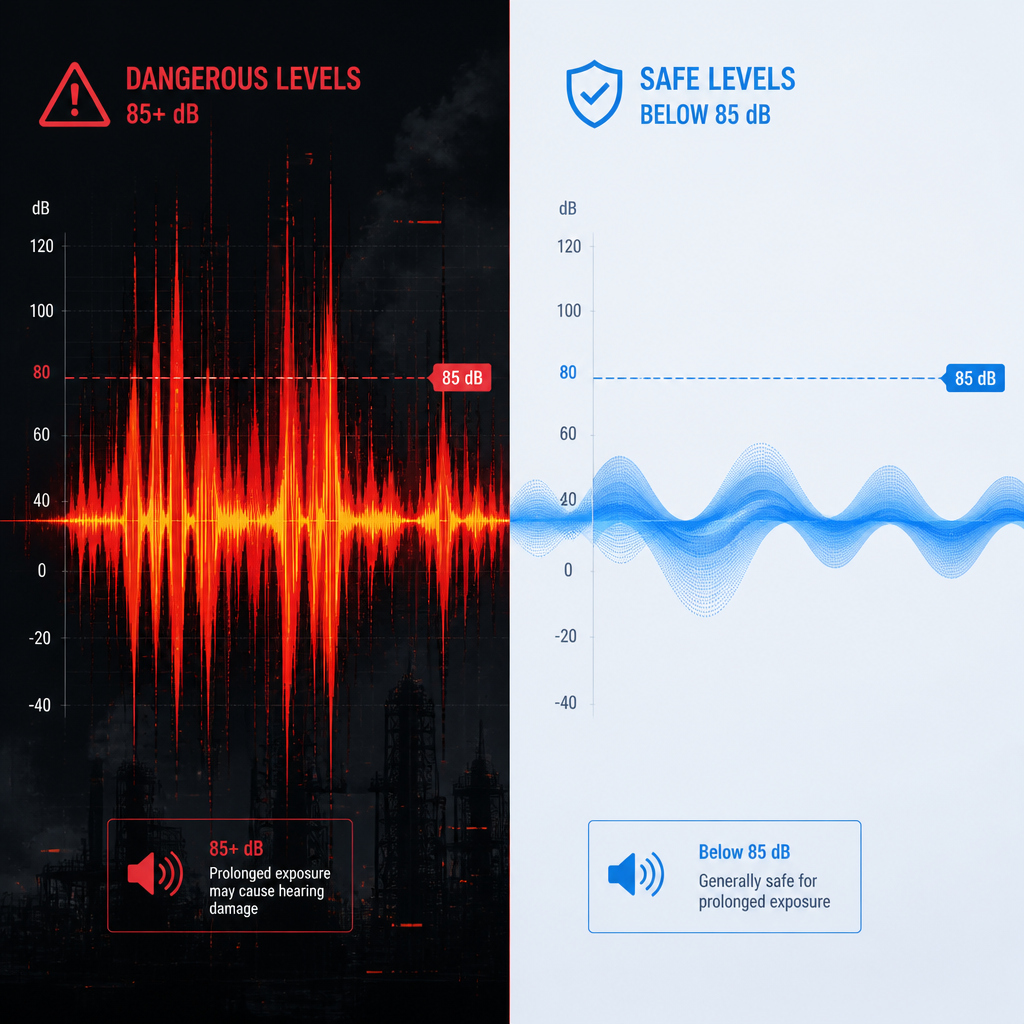
| The 85 dB threshold is the safety ceiling | Habitual exposure above 85 dB will cause gradual hearing loss in a significant number of individuals. At 88 dB, safe daily exposure drops to four hours. |
| Noise damage is cumulative | Each loud exposure adds to a lifetime total. A concert tonight compounds the factory floor from this morning. |
| Tinnitus is an early warning sign | Ringing or buzzing in the ears after noise exposure means hair cells were stressed. Repeated episodes lead to permanent tinnitus and hearing loss. |
| Fit matters more than NRR number alone | A high-rated earplug worn incorrectly provides almost no real-world attenuation. Consistent, well-fitted protection beats any single-use foam plug. |
| Reusable earplugs reduce the barrier to daily protection | When your hearing protection is always in your pocket or bag, you actually use it. Disposable plugs get left behind. |
| Both impulse and continuous noise cause NIHL | A single explosion can cause immediate damage; steady noise at high levels causes the same injury more slowly over time. |
Noise-induced hearing loss (NIHL) is hearing damage caused by exposure to loud sounds, whether that is a single intense event like an explosion or years of steady occupational noise. It can affect people of all ages, and it can arrive quickly or accumulate so gradually that many people only notice it when the damage is already significant.
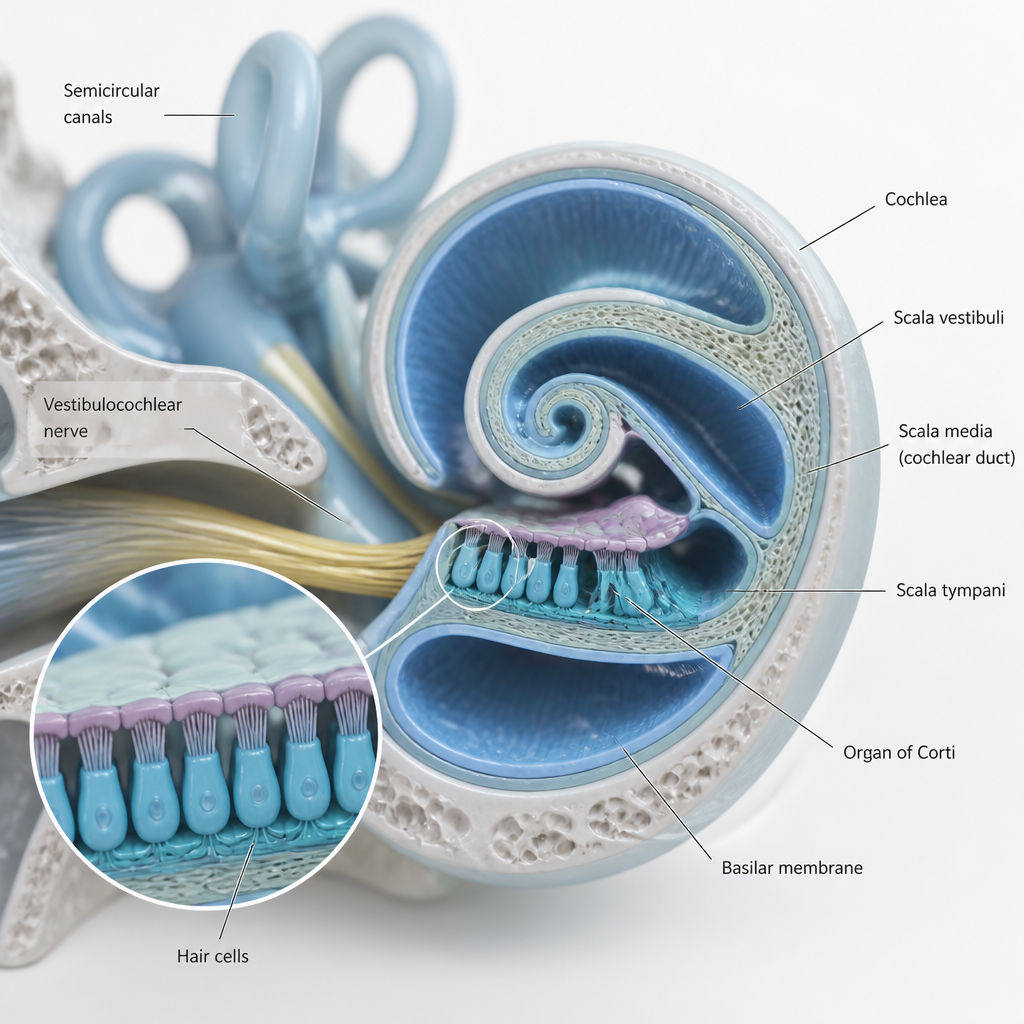
The mechanism is straightforward but brutal. Your inner ear contains tiny sensory hair cells that convert sound-wave vibrations into electrical signals the brain interprets as sound. When those cells are subjected to noise above a safe level, they are physically stressed and eventually destroyed. Because humans cannot regenerate these cells, every episode of damaging noise exposure moves you permanently closer to hearing loss.
What makes NIHL particularly deceptive is that it rarely announces itself with dramatic symptoms at first. The cumulative nature of the damage means that hearing can degrade substantially before a person notices that conversations are harder to follow or that the television volume keeps creeping up.
Understanding the specific NIHL causes is the first step toward avoiding them. The pathophysiology is multifactorial, involving both genetic susceptibility and environmental exposures, but the environmental side is where prevention lives.
Construction, manufacturing, mining, and military service top the list of high-risk occupations. Machinery, power tools, heavy equipment, and weapons fire generate sustained noise levels that sit well above the 85 dB safety threshold. OSHA mandates a hearing conservation programme whenever workplace exposure over an eight-hour period averages 85 dB or greater, yet occupational NIHL remains one of the most common work-related injuries.
The practical risk in these environments is not just the peak noise level but the daily dose accumulated over years. A worker exposed to 90 dB for eight hours a day, five days a week, year after year, is accumulating damage even if no single moment of exposure felt dangerous.
Loud music at concerts, clubs, and sporting events is one of the fastest-growing NIHL causes outside the workplace. A live concert can easily reach 100 to 110 dB at the stage. At that level, safe exposure time without protection is measured in minutes, not hours.
Personal audio devices are the other major recreational driver. Listening at high volume through headphones or earbuds concentrates damaging sound directly in the ear canal. Many listeners exceed safe levels without realising it because the damage builds invisibly over months and years.
A single explosive sound, a gunshot, an industrial blast, or an airbag deploying, can cause immediate and permanent hearing loss. Impulse noise with extremely fast rise times and peak amplitudes over 85 dB causes damage more rapidly than steady-state noise. Military personnel and firearm users face this risk every time they train or operate without adequate hearing protection.
Noise damage is not like a pulled muscle that heals with rest. Every decibel above the safe threshold is a permanent withdrawal from an account you cannot replenish.
The decibel scale is logarithmic, which means small number increases represent enormous jumps in sound energy. Normal conversation sits at roughly 60 to 70 dB. A single very loud noise or long or repeated exposure to sounds at or above 85 dB can cause hearing loss. That 15-decibel gap between comfortable conversation and the danger threshold is narrower than most people assume.
Here is what the exposure limits look like in practice. For unprotected ears, the allowed exposure time decreases by one half for each 5 dB increase in average noise level. That means exposure is limited to 8 hours at 90 dB, 4 hours at 95 dB, and 2 hours at 100 dB. Using a stricter 3 dB exchange rate (the NIOSH recommended standard), every 3 dB increase halves the safe exposure time: at 88 dB the safe limit is four hours; at 91 dB it drops to two hours.
Common everyday sources that regularly exceed 85 dB include lawnmowers, motorcycles, power tools, and heavy traffic. The key insight is that most people underestimate how loud their daily environment is because hearing damage is painless and gradual until it is not.
Pro tip: Download a free sound level meter app on your phone and spend one day measuring the environments you move through. Most people are surprised to discover their morning commute, gym, or workplace already exceeds the 85 dB threshold for extended periods.
The symptoms of NIHL range from subtle early signs to unmistakable permanent impairment. Catching them early is the only way to prevent further deterioration.
The most important early signal is tinnitus after noise exposure. A ringing, buzzing, or roaring sound in one or both ears following a loud event means the hair cells in your inner ear were stressed. If the tinnitus fades after a few hours, that is a temporary threshold shift. Repeated temporary shifts accumulate into permanent damage over time.
Other early symptoms include muffled or distorted hearing immediately after noise exposure, a temporary sensation of fullness in the ears, and the need to ask others to repeat themselves more often than usual. Many people dismiss these signs as normal tiredness, which is exactly why NIHL progresses unnoticed for so long.
As the condition progresses, the damage becomes impossible to ignore. Difficulty understanding speech in noisy environments is one of the clearest functional signs of established NIHL. High-pitched sounds, such as birdsong, alarm tones, and consonants in conversation, are usually the first frequencies lost because the hair cells responsible for high-frequency processing are physically positioned in the most exposed part of the cochlea.
Persistent tinnitus, hearing loss that does not recover after a period of quiet, and the need to significantly increase television or phone volume are all signs that the damage has moved beyond temporary into the permanent zone.
The best ways to protect your hearing are to avoid exposure to loud sounds, move away from the noise, or turn down the volume. When those options are not possible, hearing protectors are the most practical and effective defence available. The strategies below are ordered from most to least impactful.
Consistency matters more than the protection rating on the box. A well-fitted earplug with a moderate Noise Reduction Rating (NRR) worn every single time outperforms a maximum-rated plug used only occasionally or inserted incorrectly. The NRR is calculated under laboratory conditions, and real-world attenuation is always lower than the label figure because fit varies between users.
This is where reusable, precision-fitted earplugs have a clear advantage over disposable foam. ATTENU8’s metal-bodied reusable earplugs are engineered with a concave aluminium body that sits securely in the ear canal, paired with three sizes of memory foam tips (XS, S, M) so every user finds the fit that actually seals. The result is a consistent 32 dB noise reduction in real-world conditions, not just in a lab. Because the body itself is permanent, there is no excuse not to have them on hand.
Pro tip: Keep your earplugs in the same place every day, on your keys, in your jacket pocket, or in your work bag. The single biggest reason people skip hearing protection is that they did not have it with them when they needed it.
Many people think of earplugs only for extreme situations. The reality is that any environment where you need to raise your voice to speak to someone three feet away is likely above 85 dB. That includes many bars, gyms, stadium sports events, and busy construction sites. If you work in one of these environments, you need protection during every shift, not just the loudest ones.
Think of your daily noise exposure as a budget. If you are commuting on a loud train, working in a noisy office, and then attending a concert on the same day, your cumulative dose may exceed a safe threshold even if no single environment felt extreme. Spacing out loud exposures and using quiet recovery periods helps reduce the total burden on your inner ear.
Because NIHL is silent in its early stages, an audiogram is the only reliable way to catch it before the damage is severe. If you work in a noisy environment, annual hearing tests are a reasonable minimum. Any confirmed threshold shift at high frequencies should be treated as a serious warning and trigger immediate changes to your protection habits.
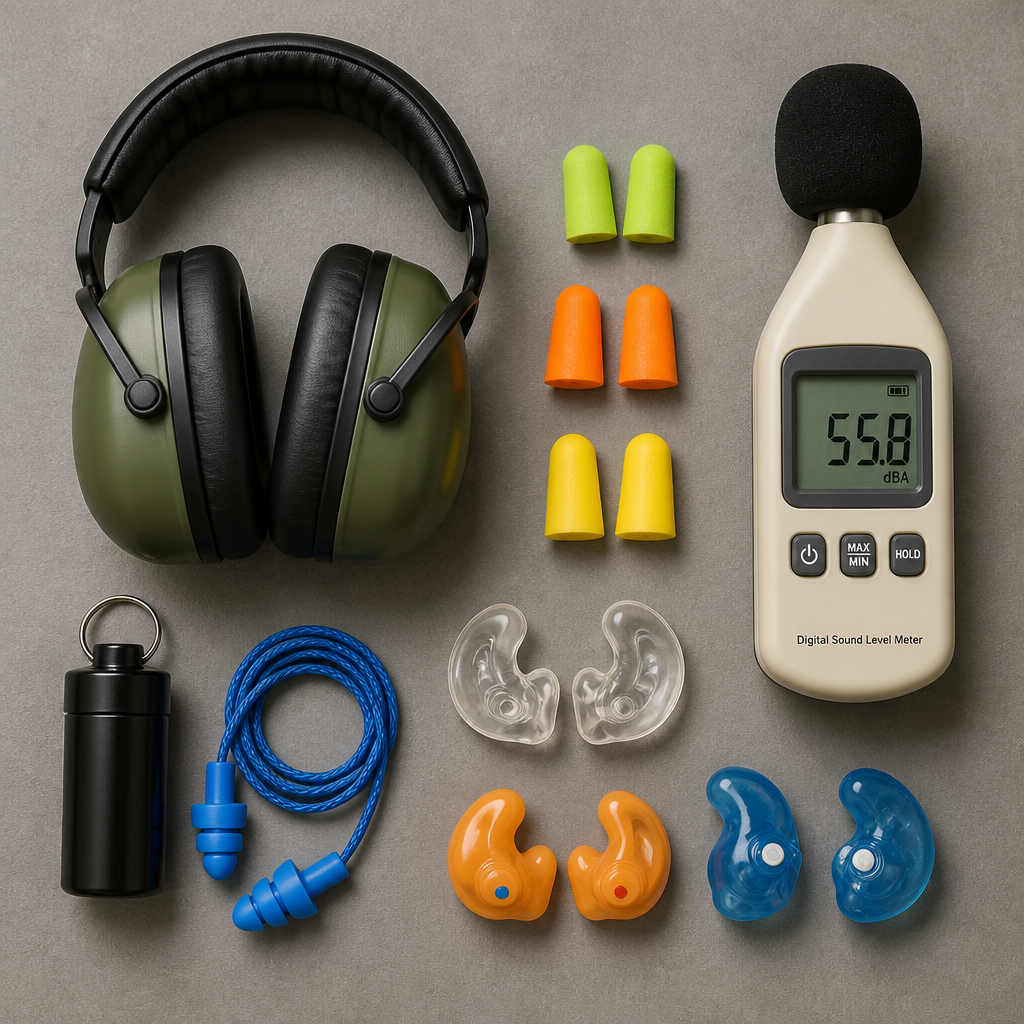
Not all hearing protection is created equal. The choice between disposable foam earplugs, reusable precision earplugs, and over-ear earmuffs depends on the environment, the frequency and duration of use, and the practical likelihood that you will actually wear them consistently.
| Protection Type | Real-World Effectiveness | Best For |
|---|---|---|
| Disposable foam earplugs | High NRR on paper (up to ~33), but real-world attenuation drops significantly with incorrect insertion. Hygiene degrades after one use. Most users insert them too loosely. | Short-term, occasional high-noise events where fit can be carefully optimised |
| Reusable memory foam earplugs with rigid body (e.g., ATTENU8) | Consistent ~32 dB reduction with correct tip size. The rigid aluminium body holds position in the ear canal, making it far easier to achieve a reliable seal than with all-foam plugs. Replaceble tips every 6-8 weeks maintain hygiene without replacing the whole unit. | Daily use in occupational settings, regular travel, sleep, concerts. Ideal for anyone who needs protection often enough that consistency matters. |
| Over-ear earmuffs | Consistent attenuation when worn correctly. Can be combined with earplugs for environments above 100 dB. Bulky and uncomfortable for extended wear or sleep. | Heavy industrial environments, shooting ranges, short-duration extreme-noise work |
The comparison above makes one thing clear: the best hearing protection is the one you will actually use every day. A pair of reusable earplugs that lives in your pocket and takes three seconds to insert is more valuable to your long-term hearing health than the highest-rated muff sitting in your locker.
Most discussions of NIHL focus on daytime exposure, but the connection between noise and sleep is a critical and underappreciated part of the picture. Chronic sleep disruption caused by environmental noise, a snoring partner, street traffic, or shift-work schedules, compounds the physiological stress on the body in ways that make individuals more vulnerable to the effects of any kind of noise exposure.
For light sleepers and noise-sensitive individuals, unprotected sleep in a noisy environment means both poor recovery and, in the case of genuinely loud overnight noise sources, potential additional exposure to damaging sound levels. Protecting your ears at night is not just about sleep quality, though that alone justifies it. It is about reducing the total daily dose of acoustic stress your auditory system has to absorb.
This is one reason the ATTENU8 earplug design specifically addresses side sleepers, including a bottom foam tip profile suited to lying down, so that wearing ear protection to sleep is physically comfortable rather than something you abandon after twenty minutes. An earplug you remove at 2 a.m. because it digs into your ear canal solves nothing. Consistent, comfortable protection through the night does.
For professionals in loud occupational environments, the math is stark. An eight-hour shift at 90 dB already uses up your entire safe daily dose under OSHA’s permissible exposure limit. Any unprotected noise exposure after hours, whether from recreational sources or a noisy sleeping environment, is damage stacked on top of an already maxed-out account.
No. Once the sensory hair cells in the inner ear are destroyed by noise exposure, they do not regenerate. There is currently no clinically proven treatment that restores hearing lost to NIHL. This is why prevention is not just the best strategy, it is the only one that actually works.
It depends on the intensity. A single exposure to an explosive impulse sound above 140 dB can cause immediate and permanent damage. At 100 dB, damage can begin in as little as 15 minutes without protection. At 90 dB, the permissible unprotected exposure under OSHA is eight hours, though stricter standards recommend shorter limits. The key point is that any level above 85 dB carries risk if sustained long enough.
Sounds below 70 dB are generally considered safe for unlimited exposure. Sounds at or above 85 dB begin to carry hearing damage risk with extended exposure. The risk increases sharply with every additional decibel. Normal conversation (60 to 70 dB) is safe; a motorcycle exhaust, power saw, or concert speaker stack is not.
In real-world use, reusable earplugs with a well-designed body, like the metal-bodied ATTENU8 design, are often more effective than disposable foam because the rigid body helps maintain a consistent seal in the ear canal. The NRR of a disposable foam plug is measured under ideal laboratory insertion conditions that most users never replicate. A precision-fit reusable earplug with the right tip size delivers reliable attenuation every time it is worn.
If your sleep environment involves sustained noise above 70 to 75 dB, such as a partner who snores loudly, heavy traffic outside, or industrial equipment nearby, then yes, hearing protection while sleeping is a reasonable and practical precaution. Even if the levels do not reach the damage threshold, the sleep disruption from unprotected noise exposure has measurable health consequences on its own. Comfortable, well-fitted earplugs designed for side sleepers solve both problems at once.
Both are standardised laboratory measurements of how much noise reduction a hearing protector provides, but they use different testing methods. NRR (Noise Reduction Rating) is the standard used in the United States. SNR (Single Number Rating) is the European equivalent. ATTENU8 earplugs carry an SNR 32 rating, meaning they are tested to reduce sound by up to 32 dB under the European CE certification standard. The two figures are not directly interchangeable, but both communicate the same basic idea: the higher the number, the greater the potential attenuation.
For memory foam tips on reusable earplugs, replacement every six to eight weeks is a sensible baseline under regular daily use. Tips that have lost their springback, become compressed, discoloured, or dirty will not form an adequate seal, which directly reduces the noise attenuation you are actually receiving. The advantage of a reusable system like ATTENU8 is that only the tips require replacement, not the entire device, making it far more cost-effective than constantly restocking disposable plugs.
Have you made changes to your hearing protection habits recently, or are you dealing with an environment where consistent protection has been a challenge? Share your experience below.
If you have ever stood in a hardware store comparing a pair of foam ear plugs to a set of bulky earmuffs and felt completely lost, you are not alone. The ear plugs vs earmuffs debate matters more than most people realise, because choosing the wrong type means either tolerating needless noise or wearing something so uncomfortable you simply stop using it. Whether you are a light sleeper fighting your partner’s snoring, a construction worker running a jackhammer all day, or someone flying long-haul every few weeks, the right hearing protection is the one you will actually keep wearing.
| Key Insight | Explanation |
|---|---|
| NRR numbers are not face value | NIOSH recommends derating foam earplug NRR values by 50% to reflect real-world fit. A plug rated 33 dB may deliver closer to 16.5 dB for most users in practice. |
| Ear plugs win for sleep | Earmuffs are impractical for most sleep positions, especially side sleeping. Low-profile ear plugs with soft memory foam tips are the only realistic option for overnight use. |
| Earmuffs are easier to use correctly | Correct insertion technique is critical for ear plugs to hit their rated NRR. Earmuffs sit over the ear and are harder to misfit, making them more consistent for casual or supervised workplace use. |
| Glasses reduce earmuff effectiveness significantly | Thick-framed glasses can reduce earmuff NRR by 9 to 11 dB by breaking the seal around the ear cup. Ear plugs are unaffected by eyewear. |
| Dual protection is recommended above 100 dB | OSHA and NIOSH recommend wearing both ear plugs and earmuffs simultaneously when noise exposure exceeds 100 dBA TWA or when a single protector cannot reduce exposure adequately. |
| Reusable ear plugs cut long-term cost and waste | Premium reusable ear plugs with replaceable foam tips cost more upfront but generate far less waste and expense for daily users compared to bulk disposable foam plugs. |
| Fit determines performance more than NRR rating | Multiple studies show that fit quality, not the printed NRR number, is the strongest predictor of actual noise reduction achieved. Multiple tip sizes (XS, S, M) are essential for a proper seal. |
Before comparing ear plugs to earmuffs, it helps to understand what the numbers actually mean. Every hearing protector sold in the United States carries a Noise Reduction Rating (NRR), measured in decibels. A higher NRR indicates greater potential noise reduction. The key word is “potential.”
The NRR is derived under laboratory conditions where a trained experimenter fits the hearing protector, not the person who will actually be wearing it. Real-world performance is consistently lower. NIOSH recommends applying a derating factor: 25% for earmuffs, 50% for formable foam ear plugs, and 70% for all other ear plug types. That means a foam ear plug with an NRR of 33 dB is expected to deliver roughly 16.5 dB of real-world protection for the average user. The best-rated earmuffs, with NRR values around 30 to 31 dB, derate to approximately 22 to 23 dB.
On paper, the highest-rated foam ear plugs beat the best earmuffs. In practice, once derating is applied, well-fitted earmuffs often deliver more consistent noise reduction for most users because the fit is harder to get wrong.
OSHA uses its own more conservative formula: (NRR minus 7) divided by 2. So a protector rated 33 dB delivers an estimated 13 dB of effective protection by OSHA’s calculation. Neither formula is perfect, but both point to the same truth: fit and consistency matter more than the number on the box.
Pro tip: If you are evaluating hearing protection for a workplace, use the NIOSH derating formula to estimate real-world protection levels rather than relying on the printed NRR. It gives a more honest picture of what workers will actually experience.
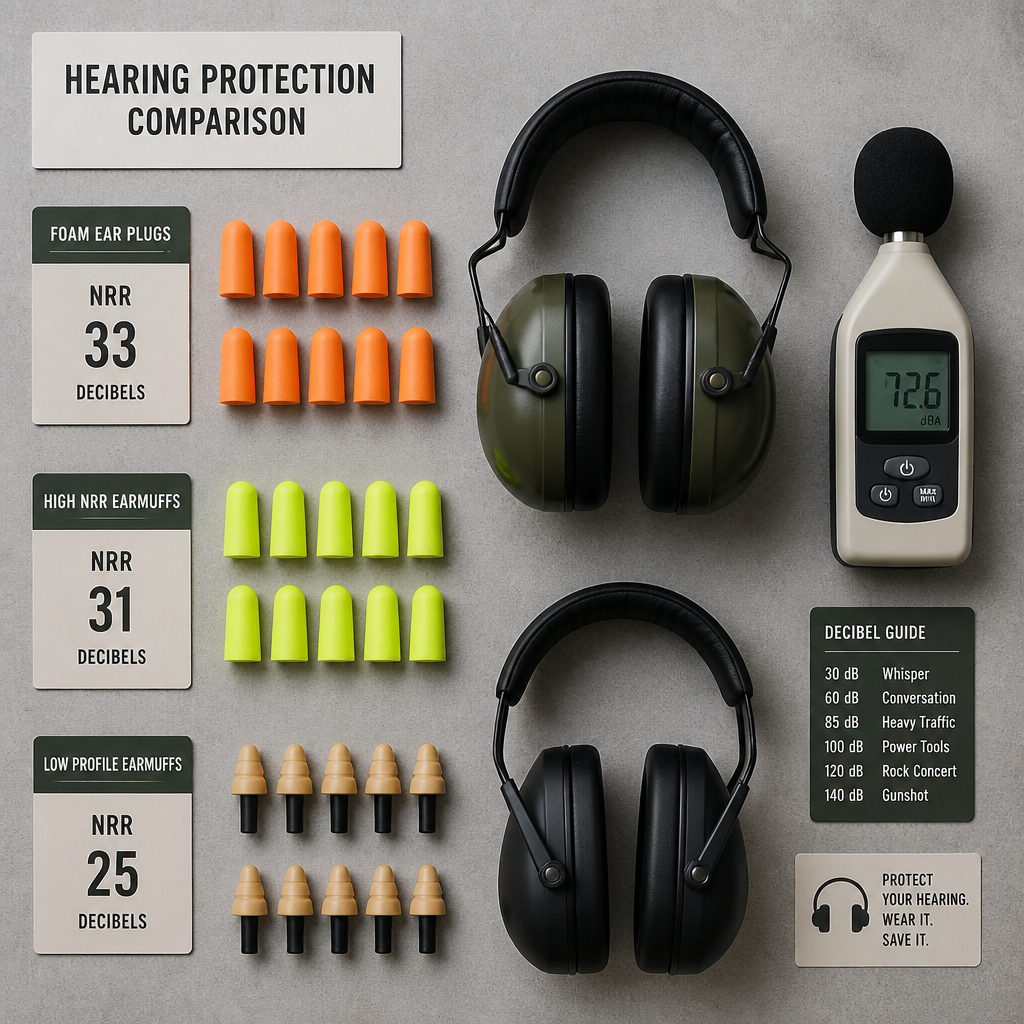
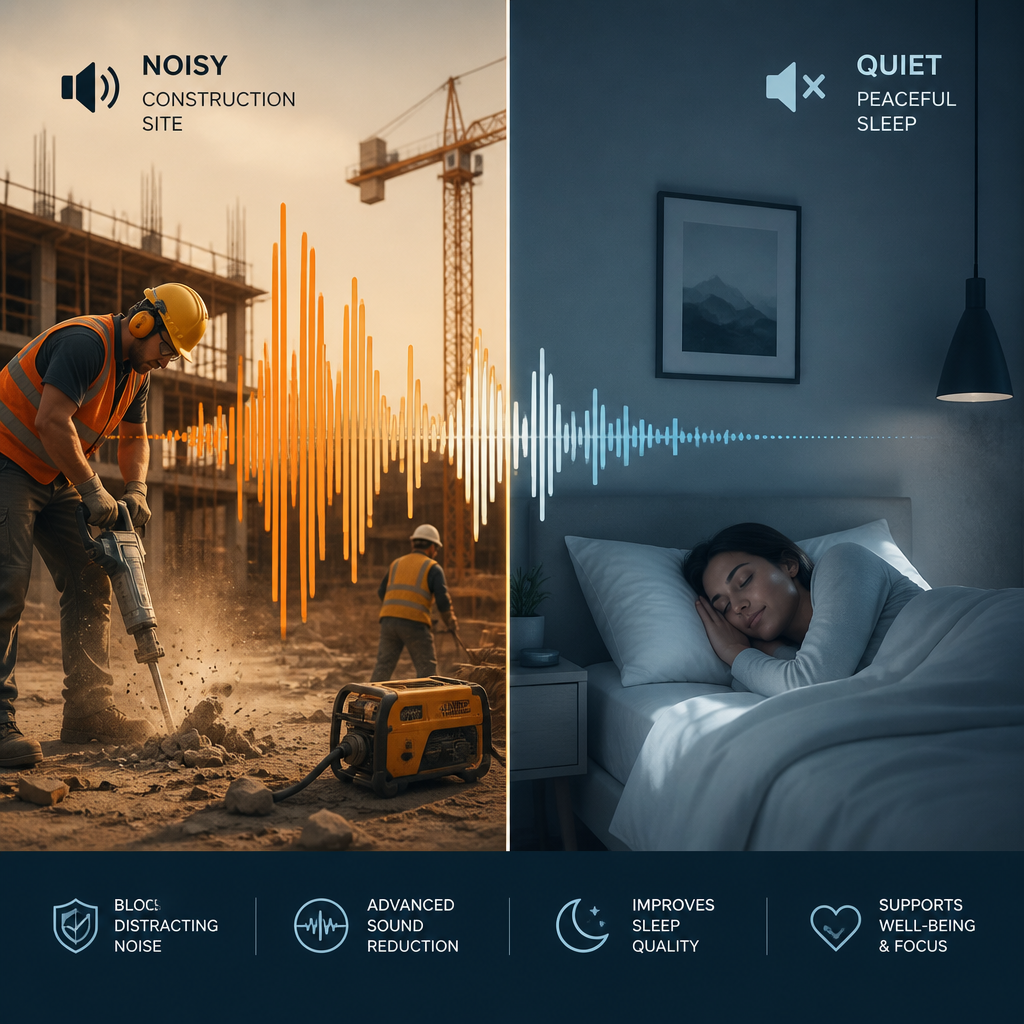
Ear plugs fit inside the ear canal itself, which gives them several structural advantages that earmuffs simply cannot match. They are compact, lightweight, unaffected by heat, and compatible with virtually every other piece of personal protective equipment including hard hats, safety glasses, face shields, and respiratory masks.
When fitted correctly, ear plugs provide strong attenuation across a wide frequency range. They are particularly effective at blocking low-frequency noise when seated optimally in the canal. They keep ears cool, which matters significantly for anyone working outdoors in summer or in high-heat industrial environments. They travel well in a pocket, a case, or a kit bag.
For sleeping specifically, ear plugs are the only type of hearing protection that works in any sleep position, including on your side. No earmuff design is genuinely comfortable with a standard pillow pressing against the ear cup through the night.
The weakest point of any ear plug is the insertion step. Foam ear plugs require rolling, compressing, and holding in place while they expand into the canal. Get this wrong and the NRR drops sharply. Workers with dirty or greasy hands face a real hygiene risk: inserting plugs with contaminated hands can push dirt and bacteria into the ear canal. Single-use disposable foam plugs are most vulnerable here.
This is where the choice of ear plug type matters. Premium reusable ear plugs with a rigid metal or hard polymer body, like those made by ATTENU8, sidestep the dirty-hands insertion problem because the handle sits outside the ear rather than requiring deep finger contact. The memory foam tips do the sealing work without requiring the user to touch the part that enters the canal directly.
Earmuffs cover the entire outer ear with padded cups sealed against the head by an adjustable headband. Their biggest advantage is consistency: they are harder to wear incorrectly than ear plugs, which makes them a sensible default for workplaces where supervisors need to confirm hearing protection compliance at a glance.
Earmuffs are quick to put on and take off, which is useful when workers move frequently between loud and quiet areas. They provide visible confirmation that hearing protection is being worn, which matters for site supervisors managing large teams. For workers who have ear canal irregularities or find any in-canal device uncomfortable, earmuffs are a practical alternative.
The clamping pressure of the headband is a genuine comfort problem for all-day wear. Earmuffs trap heat around the ear, which becomes a real issue in warm environments. They are also susceptible to seal-breaking. Safety glasses with thick temples have been shown to reduce earmuff NRR by 9 to 11 dB by breaking the cup seal. Even a baseball cap worn underneath the headband can cost around 5 dB of protection.
Earmuffs are entirely impractical for sleeping, travel in confined spaces like aircraft seats, or any context where the user needs to lie down. Their bulk also makes them incompatible with many helmets used in construction, military, and motorsports settings.
Pro tip: If your team wears safety glasses with thick frames alongside earmuffs, test the combined NRR with the actual glasses in place. The sealed laboratory NRR figure on the box may be significantly optimistic for your real working conditions.
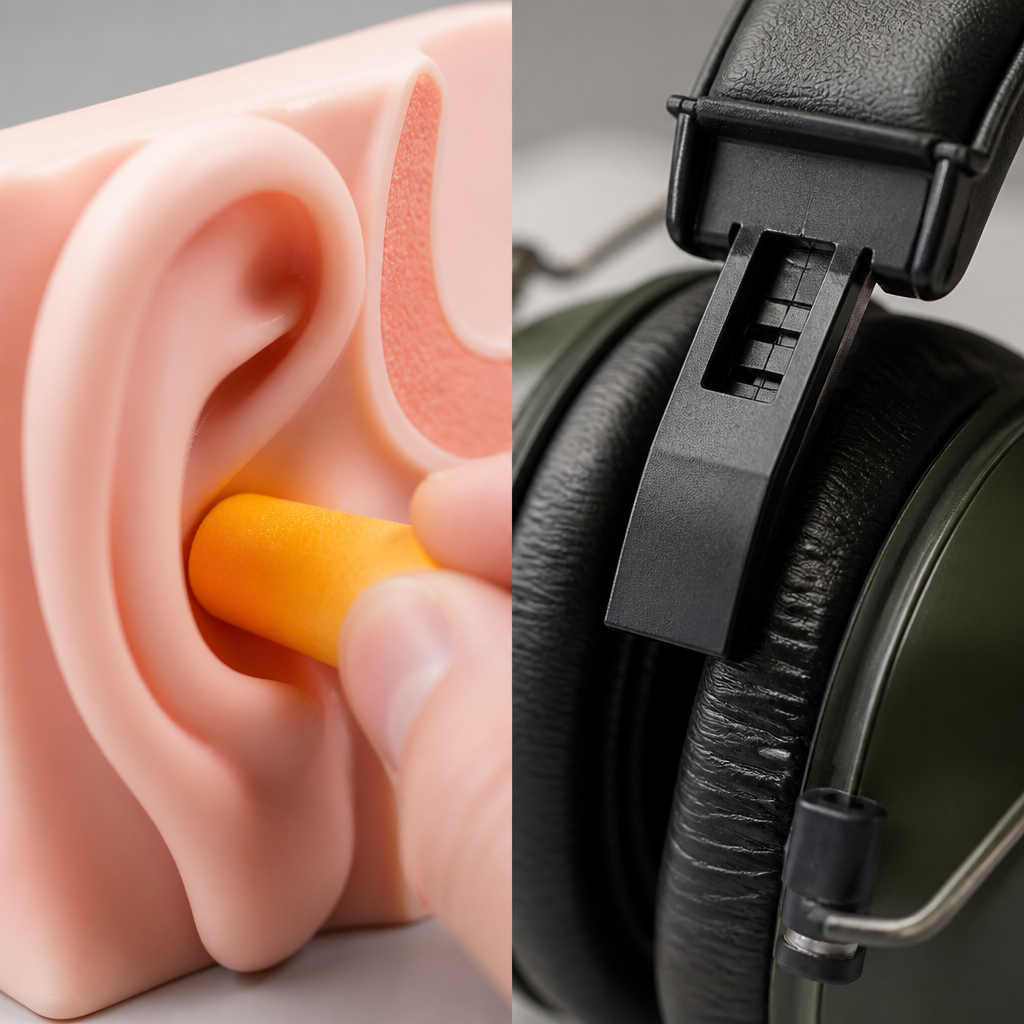
The answer for sleeping is unambiguous: ear plugs. No earmuff is comfortable to sleep in unless you use a specially shaped travel pillow with a cutout for the ear cup, which is a workaround that most people abandon quickly. For side sleepers especially, earmuffs are a non-starter with any standard pillow.
For sleeping, the goal is not maximum industrial-grade noise reduction. Snoring from a partner typically registers between 55 and 65 dB, well within the range that quality ear plugs handle comfortably. Most sleep-focused hearing experts suggest an effective NRR in the range of 24 to 27 dB is sufficient for blocking disruptive bedroom noise, while still leaving the user able to hear critical alerts like alarms.
The more important variable for sleep is physical comfort. Soft memory foam tips that conform to the specific shape of the ear canal are far better than firm pre-moulded silicone plugs for overnight use. A plug that creates pressure points will wake a light sleeper even if the noise does not. Multiple tip sizes, covering at least XS, S, and M, are essential because ear canal diameter varies significantly between adults.
ATTENU8’s metal-bodied reusable ear plugs are designed with exactly this use case in mind. The concave aluminium body keeps the contact point minimal, and the three included memory foam tip sizes allow users to match the tip to their canal rather than forcing a one-size-fits-none compromise. The result is a seal that blocks approximately 32 dB without the discomfort that makes people give up on ear plugs by 3 a.m. You can see the full fit guide at ATTENU8’s fit page.
For occupational settings, the choice between ear plugs and earmuffs depends heavily on the noise level, the other PPE required, and how frequently the protector needs to be removed.
OSHA’s permissible exposure limit (PEL) is 90 dBA over an 8-hour work shift. For every 5 dBA increase above that level, the safe exposure time is halved. A hearing conservation program is required when workers face 85 dBA or above. These thresholds set the floor for protection requirements, not the ceiling for smart practice.
In environments where workers move in and out of noisy areas frequently, where supervision needs visual confirmation of compliance, or where workers lack the training to insert ear plugs correctly and consistently, earmuffs are a pragmatic choice. Construction site supervisors often prefer earmuffs for exactly this reason.
When workers are in continuous loud environments, wearing hard hats, respirators, or welding masks, ear plugs are the only compatible option. Military personnel in particular favour in-canal protection because it works under helmets and does not interfere with headsets. Ear plugs also keep ears cooler in hot industrial environments, which directly affects compliance throughout a shift.
OSHA and NIOSH recommend using ear plugs and earmuffs together when noise exposure exceeds 100 dBA or when a single protector alone cannot bring exposure to a safe level. The combined NRR is not simply additive. The general rule is to add approximately 5 dB to the higher-rated of the two protectors when both are worn simultaneously.
The table below compares the three main hearing protection approaches across the key decision factors most users actually care about.
| Factor | Ear Plugs (Reusable, Memory Foam) | Earmuffs | Ear Plugs + Earmuffs Combined |
|---|---|---|---|
| Rated NRR (best available) | Up to 33 dB | Up to 30-31 dB | Highest-rated + approx. 5 dB |
| Real-world NRR (NIOSH derating) | Approx. 16.5 dB (foam, 50% derate) | Approx. 22-23 dB (25% derate) | Highest real-world + 5 dB |
| Suitable for sleeping | Yes, ideal | No, impractical | No |
| Compatible with glasses | Yes, no interference | Reduced by 2-11 dB with glasses | Reduced by glasses on muff side |
| Compatible with hard hats and helmets | Yes | Limited, helmet-mounted versions only | Yes (ear plugs component) |
| Comfort for all-day wear | High with correct fit and soft tips | Moderate, heat and pressure issues | Low, not designed for extended wear |
| Ease of correct use | Requires technique and right tip size | Easier, harder to misfit | Requires both techniques correctly |
| Best use case | Sleep, travel, all-day industrial use | Intermittent work exposure, supervised teams | Extreme noise above 100 dBA |
Most of the ear plugs vs earmuffs conversation assumes you are choosing between disposable foam plugs and over-ear muffs. There is a third option that changes the calculation significantly: premium reusable ear plugs with replaceable tips.
Disposable foam ear plugs cost very little per pair and are widely available. For occasional use, they make sense. For daily users, the economics shift quickly. The environmental cost is also real: disposable plugs used every night create substantial ongoing plastic and foam waste compared to a reusable design.
Reusable ear plugs with a durable metal or hard polymer body and replaceable soft tips address the main weaknesses of both disposable plugs and earmuffs. You get the comfort and portability of in-canal protection without the hygiene risk of reusing foam plugs that have been rolled and compressed repeatedly with bare fingers. The body stays clean; only the foam tips are replaced, typically every six to eight weeks for a daily user.
ATTENU8 builds this model around a concave aluminium body that is designed to last, paired with memory foam tips that users swap out on a regular schedule. This sits in a different category from budget disposables and from fashion-focused ear plug brands: it is engineering-first hearing protection that happens to be comfortable enough to sleep in. You can read detailed product specs at the ATTENU8 product page or check answers to common fit and hygiene questions on the ATTENU8 FAQ page.
Pro tip: When comparing the long-term cost of reusable ear plugs with replaceable tips against bulk disposables, factor in the time spent inserting foam plugs correctly each time. A poor insertion from a rushed or incorrect technique effectively drops the NRR to near zero, making even cheap protection expensive if it is not working.
On paper, the highest-rated foam ear plugs have a slightly higher NRR than the best earmuffs. In practice, once NIOSH derating is applied, well-fitted earmuffs typically deliver more consistent real-world noise reduction because users are more likely to fit them correctly. Ear plugs beat earmuffs when insertion technique is mastered and tip size is correctly matched to the user’s ear.
Yes, reusable ear plugs with clean, regularly replaced tips are safe for nightly use. The main risks with disposable foam plugs used nightly are hygiene-related: repeated reuse of foam plugs that are not cleaned introduces bacteria into the ear canal. With a reusable metal-bodied design where tips are replaced on a regular schedule, this risk is effectively managed.
Yes, and this is the correct approach when noise exposure exceeds 100 dBA. Wearing both together provides greater protection than either alone. The combined benefit is not simply the sum of both NRR values: OSHA and NIOSH calculate it as the higher-rated protector’s value plus approximately 5 dB.
Almost always, this is an insertion problem. Foam plugs need to be rolled tightly, inserted deep into the canal, and held in place for several seconds while they expand. If the tip is not the right size for your canal, even correct insertion will not create a proper seal. Trying a smaller or larger tip size and slowing down the insertion process resolves this in most cases.
It depends on what other PPE you are wearing. If the job requires a hard hat, safety glasses, and a respirator, ear plugs are more compatible. If the team moves in and out of noisy zones frequently and supervision needs to confirm protection is being worn, earmuffs are practical. For noise above 100 dBA, both together is the correct answer regardless of workflow.
Ear plugs are significantly better for air travel than earmuffs. They are compact, fit under a travel pillow without discomfort, and do not interfere with headrests or neck pillows. Soft memory foam tips provide effective attenuation of the consistent drone of aircraft cabin noise without the bulk or heat of over-ear muffs.
For daily users, every six to eight weeks is a reasonable replacement interval for memory foam tips. The foam compresses and loses its ability to fully expand and seal over time. A tip that no longer springs back to shape after being rolled is no longer delivering its rated noise reduction, regardless of how it looks.
Have you tried both ear plugs and earmuffs in your own noise situation? Share what worked (or did not) in the comments below.
Most people who switch to reusable ear plugs replace them far too soon, not because the product failed, but because they never cleaned them properly. If your ATTENU8 ear plugs are feeling sticky, inserting slower, or smelling off after a few weeks, a dirty maintenance routine is almost certainly the cause. Knowing how to clean ear plugs correctly means understanding that the aluminium body and the foam tips are two separate materials that need two separate approaches. Treat them the same way and you will either damage the foam or under-clean the metal. This guide covers exactly what to do, how often, and what to avoid.
The ear canal is warm, slightly moist, and produces wax. Every time you insert an ear plug, the foam tip picks up earwax, skin oils, and dead skin cells. Left on the surface of porous foam, that material becomes a bacterial culture sitting directly against your ear canal. The aluminium body accumulates sebum and surface grime that, over time, makes the plug feel unpleasant to handle and harder to grip for insertion.
A common mistake is treating the metal body as the only part that needs attention and ignoring the foam entirely between tip replacements. In practice, users who maintain a consistent ear plug hygiene routine report two clear benefits: the foam tips retain their expansion speed longer, meaning insertion is quicker and more reliable, and they experience fewer episodes of ear irritation or blockage.
The cleaning routine itself takes under two minutes per day. There is no reasonable argument for skipping it.
| Key Insight | Explanation |
|---|---|
| Use different cleaning methods for each component | The aluminium body tolerates isopropyl alcohol wipes. The memory foam tips do not. Alcohol degrades the foam’s cellular structure and accelerates breakdown. |
| Daily wipe is non-negotiable | A dry lint-free cloth wipe of the foam tips after each use removes surface oils before they bond into the foam. This is the single most effective thing you can do. |
| Deep clean the metal body weekly | Daily users should deep clean the aluminium body once per week. Occasional users can do this every two weeks. The concave shape collects oils that daily wiping alone misses. |
| Replace foam tips every 6 to 8 weeks | ATTENU8 recommends replacing foam tips every 6 to 8 weeks for daily users. Good cleaning habits extend performance within that window but do not replace it. |
| Never store ear plugs loose | Leaving them on a nightstand or in a pocket exposes the foam to dust and debris. A closed case also prevents accidental compression that causes premature deformation. |
| Appearance is not a reliable hygiene indicator | Foam tips can harbour bacteria well before they look visibly dirty. Set a calendar reminder for tip replacement rather than relying on how they look. |
| Clean your ears before inserting plugs at night | Wiping your ear canal area with a warm washcloth before insertion removes excess earwax and oils that would otherwise transfer to the foam, extending tip life noticeably. |
A daily cleaning routine for reusable ear plugs does not require special equipment or significant time. The goal is to remove surface contamination before it bonds to the material and to keep the aluminium body free of oils that make the plug harder to handle.
After each use, remove the foam tips from the aluminium body. Use a dry, lint-free cloth to wipe the outer surface of each foam tip. Do not rub hard. You are lifting surface oils and loose earwax, not scrubbing. Then take a dry cotton swab and run it around the inside of the aluminium concave housing to remove any visible residue.
Once or twice a week, replace the dry cotton swab with one that has been lightly touched against an isopropyl alcohol wipe. This step is for the aluminium body only. Wipe the exterior surface and the interior channel of the metal housing, then leave it to air dry for thirty seconds before reattaching the foam tips.
Pro tip: Keep a small tin or case with two dry cotton swabs and a single-use alcohol wipe in your travel bag. This makes the daily cleaning routine possible even when you are away from home, which is exactly when ear plug hygiene tends to slip.
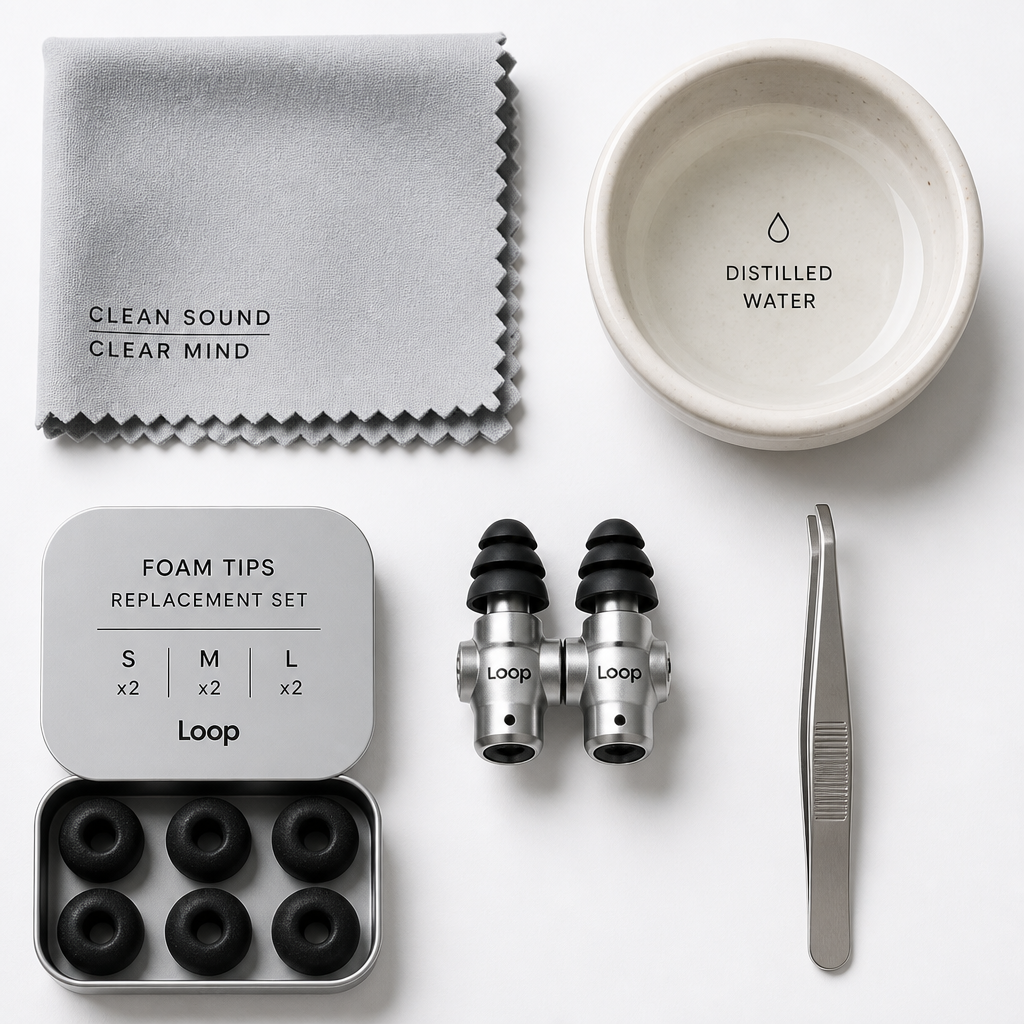
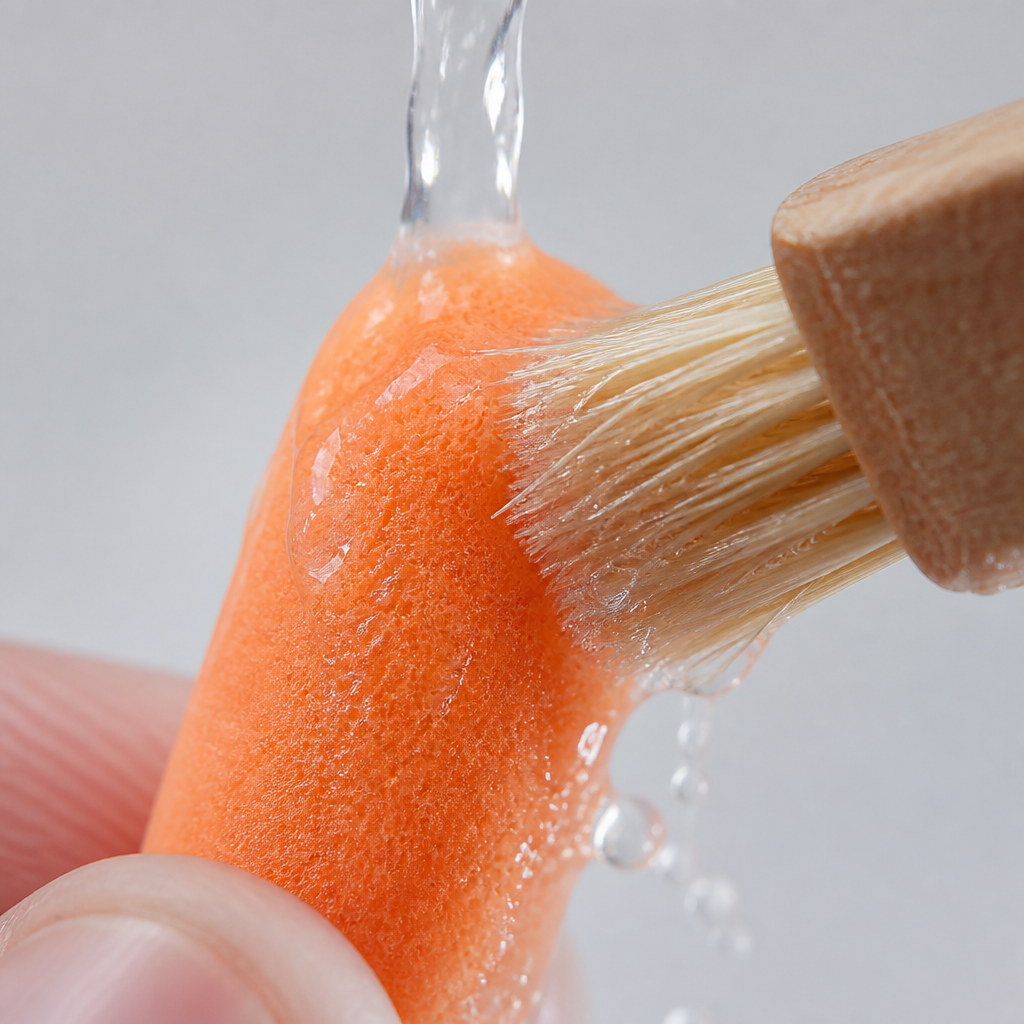
The aluminium body of a premium reusable ear plug is the component built to last years, not weeks. That durability only holds if you remove the cumulative buildup that daily wiping does not fully address. A deep clean of the metal body should happen once per week for daily users and once per two weeks for occasional users.
Isopropyl alcohol at 70% concentration is the correct choice. It disinfects effectively, evaporates quickly, and does not corrode aluminium. Apply it with a lint-free cloth or a cotton swab. Do not submerge the aluminium housing in water. While aluminium itself does not rust, extended moisture exposure can affect any internal mechanics of the assembly and will certainly saturate any residual foam fibres inside the housing.
The concave shape of the aluminium body is designed to sit flush against the outer ear. That curve also collects oils at its edges. Pay specific attention to the lip of the housing when doing a deep clean. A cotton swab gives you the precision to reach that edge without soaking the surrounding components.
Avoid abrasive materials, including rough cloths and stiff brushes. Scratching the surface of the aluminium does not affect its function, but it creates micro-grooves that trap dirt more easily and make future cleaning harder. Soap and water are not ideal for the metal housing because the risk of trapping moisture inside the assembly is real and the benefit over alcohol is minimal.
Pro tip: After a deep clean, hold the aluminium housing up to a light source and look inside the channel. If you can see residue you missed, use a fresh cotton swab. If it comes away clean, you are done. This visual check takes five seconds and keeps you honest about the standard of your cleaning.
Memory foam tips are porous. That porosity is exactly what makes them comfortable and effective at sealing against the ear canal, but it also means contamination works into the material rather than sitting entirely on the surface. This creates two rules that cannot be broken: do not use alcohol on foam, and do not submerge foam in liquid.
For daily maintenance, a dry lint-free cloth is sufficient. Remove the tip from the aluminium body first. Hold the tip gently between two fingers, do not compress it fully, and use the cloth to wipe the outer surface in a light rolling motion. This lifts surface earwax and oil without pushing it further into the foam structure.
For a slightly deeper clean of the foam surface, a cloth that is barely damp with plain water and mild soap can be used. The emphasis is on barely damp. You want surface moisture only. After wiping, allow the tip to air dry completely before reinserting it into the aluminium housing or placing it back in a storage case. Inserting a wet ear plug can cause ear irritation and create conditions for bacterial growth.
Alcohol degrades the foam’s cellular structure and accelerates the very breakdown you are trying to prevent. Alcohol wipes are appropriate for cleaning the metal body of the ear plug, not the foam tip. This distinction matters more than it might seem. Users who clean the entire plug, metal and foam together, with the same alcohol wipe end up with foam that hardens and loses its slow-expansion behaviour in a matter of weeks rather than the expected 6 to 8 weeks.
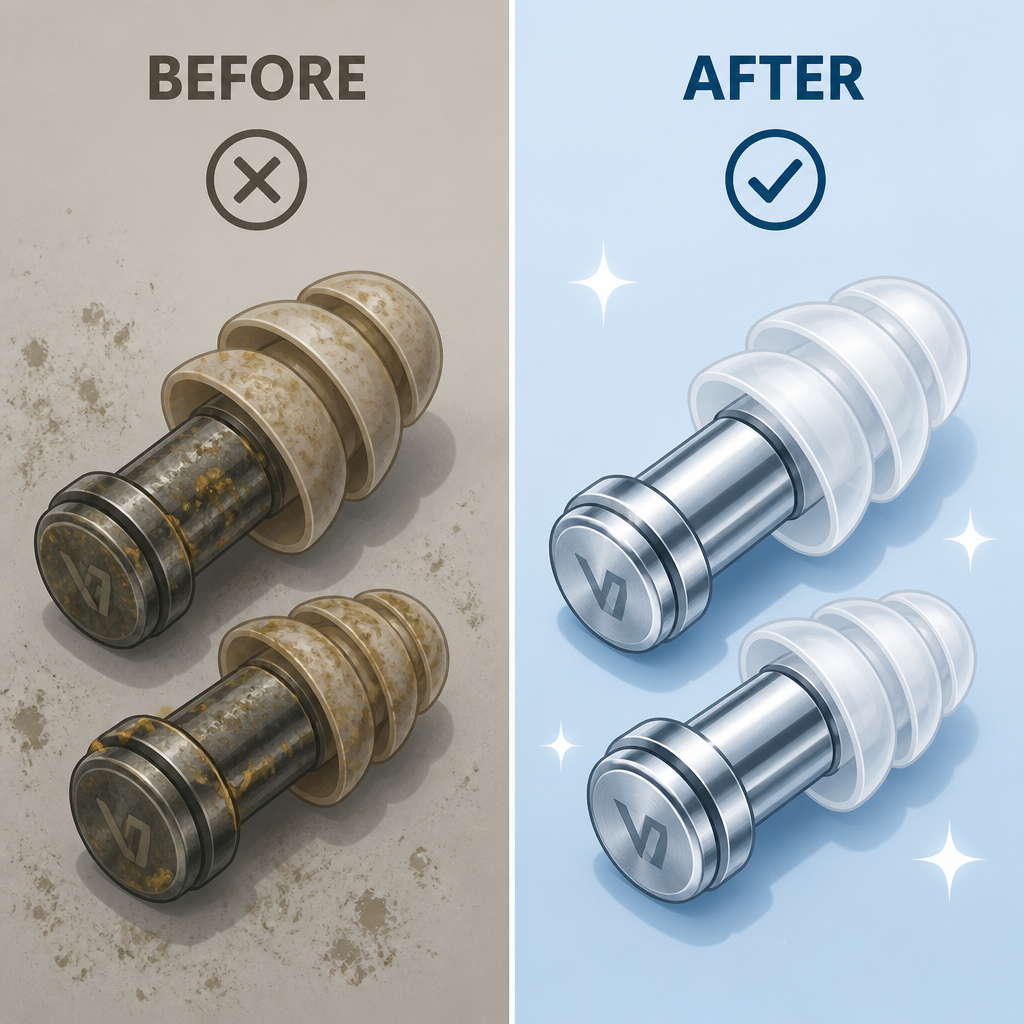
Good cleaning habits extend the useful life of foam tips within their service window, but they do not make foam last indefinitely. ATTENU8 recommends replacing foam tips every 6 to 8 weeks for daily users. The three available sizes, XS, S, and M, allow you to stock replacements cheaply without guessing which size you need.
Earwax is yellow to brown and accumulates on the outer surface of the foam over time. Light surface discoloration after a few weeks is normal and manageable with gentle cleaning. Dark discoloration that penetrates into the foam, or visible debris that cannot be wiped off, is a clear signal to replace. You cannot fully sterilise porous foam, and using heavily soiled tips introduces bacteria directly into the ear canal.
This is the most practical test. If you are noticing sounds that the ear plugs used to block, and you have ruled out changes in your environment, the foam tips are the most likely culprit. Put in a fresh set. If the blocking performance improves noticeably, the old tips were overdue for replacement.
The same logic applies to insertion feel. A foam tip that no longer expands slowly and evenly after compression is not sealing reliably. That inconsistent seal is both a comfort problem and a noise reduction problem. Appearance is not a reliable hygiene indicator for porous foam. Set a six-week calendar reminder rather than waiting until you can see the problem.
Pro tip: Keep a spare set of foam tips in your travel bag or nightstand so you can do an immediate like-for-like comparison when you suspect your current tips have degraded. The comparison removes any doubt about whether cleaning or replacement is the right call.
The way you store your ear plugs between uses has a larger impact on foam tip lifespan than most users realise. Temperature extremes, compression, and dust exposure between uses all accelerate the degradation that cleaning is trying to slow down.
Store reusable ear plugs in their provided case or a small, breathable container after every single use. Room temperature storage in a bedroom nightstand is ideal. The case protects the foam from dust and accidental compression from objects sitting on top of the tips. A closed case also keeps the aluminium body from picking up pocket lint and surface grime that makes daily cleaning harder.
Never store foam tips in sealed plastic bags or humid bathroom drawers. Moisture trapped against foam accelerates bacterial growth and material breakdown. The bathroom is the worst possible storage location for ear plugs despite being the most convenient one for many users.
Avoid storing ear plugs in car glove compartments where temperature fluctuations can be extreme. Heat degrades foam elasticity, and one sustained period of high heat can reduce tip life significantly. When travelling, the small travel tin with a dry cotton swab mentioned earlier is the right approach: compact, clean, and protective.
Reusable ear plug maintenance is not complicated. It is consistent. The users who get the most life out of their foam tips are the ones who wipe the tips clean and put them back in a case every single time without exception, not the ones who do a deep clean once a month and otherwise ignore them.
Dirty hands transfer oils, bacteria, and debris to foam tips before they even reach your ear canal. Wash or sanitise your hands before handling ear plugs. This is especially relevant for professionals using ear plugs in construction, manufacturing, or industrial environments where hands carry heavy contamination. It is a ten-second step that meaningfully extends both hygiene and tip life.
Not all cleaning approaches deliver the same results. The table below compares the three methods most commonly used by reusable ear plug owners, measured against the criteria that matter for ATTENU8 ear plugs specifically.
| Cleaning Method | Best Used For | Risk and Limitation |
|---|---|---|
| Dry lint-free cloth wipe (daily) | Foam tips after every use. Fast, zero moisture risk, sufficient for surface oil and earwax removal. | Does not disinfect. Does not address cumulative buildup on the aluminium body. |
| Isopropyl alcohol wipe (weekly) | Aluminium body only. Disinfects effectively, evaporates quickly, no corrosion risk on metal. | Must never contact foam tips. Alcohol degrades cellular foam structure rapidly and shortens tip life. |
| Mild soap and barely damp cloth | Foam tip surface cleaning when a dry wipe is insufficient. Useful for removing stubborn buildup. | Requires complete air drying before reuse. Risk of over-saturating the foam if too much water is used. Not suitable for the aluminium housing due to moisture retention risk. |
You can use a barely damp cloth with a small amount of mild soap to clean the surface of the foam tips, but you should not submerge them in water or run them under a tap. Saturating the foam pulls moisture into the cellular structure, which is difficult to fully remove and creates conditions for bacterial growth. Always allow the tips to air dry completely before putting them back in your ears or your storage case.
ATTENU8 recommends replacing foam tips every 6 to 8 weeks for daily users. With consistent cleaning after every use, most users reach the higher end of that range reliably. If you notice the foam is no longer expanding slowly after compression, or you can hear more than you used to, replace the tips immediately regardless of where you are in the 6 to 8 week window.
No. Alcohol wipes are appropriate for the aluminium metal body only. Using an alcohol wipe on the memory foam tips degrades the foam’s cellular structure, causing the foam to harden and lose its slow-expansion behaviour much earlier than it should. Keep your cleaning method strictly separated: alcohol for the metal, dry cloth for the foam.
Pack a small tin with two dry cotton swabs and a single-use alcohol wipe. After each use on the road, wipe the foam tips with a dry cotton swab and clean the aluminium body with the alcohol wipe. Keep the ear plugs in their case between uses rather than loose in a bag. This maintains the same standard of care as your home routine without requiring any extra bulk in your luggage.
Yes. Foam ear plugs sit directly against the ear canal and pick up earwax, skin oils, and bacteria with every use. If those contaminants are not removed consistently, the ear plug reintroduces them into the ear canal on the next use. Ear infections, irritation, and blockage are all documented outcomes of poor ear plug hygiene. A daily wipe-down routine is the most straightforward way to prevent this.
Correct cleaning, specifically the dry cloth method for foam tips and alcohol wipe for the aluminium body, does not reduce noise performance. What does reduce performance is incorrect cleaning. Using alcohol on the foam tips causes them to harden and deform, which degrades the ear canal seal that the noise reduction rating depends on. Maintain the tips correctly and replace them on schedule, and the noise reduction performance holds for the full life of the aluminium body.
ATTENU8 supplies foam tips in XS, S, and M. The right size is not just about comfort preference. It is about fit in the ear canal, which determines both the noise reduction seal and the likelihood of the tip dislodging during sleep. If you are unsure of your size, the size that gives you a slow, even expansion feeling after compression is the correct one. The ATTENU8 product page has guidance on selecting between sizes if you need to reassess after your initial purchase.
Have a maintenance tip or cleaning routine that has worked well for your ATTENU8 ear plugs? Share it in the comments below, because real-world experience from daily users often reveals things a guide like this cannot fully anticipate.
If you fly regularly, you already know that aircraft cabin noise is not just annoying, it is genuinely damaging over time. Ear plugs for travel are one of the most underrated items in any frequent flyer’s kit, yet most people still grab a crumpled foam pair from the flight attendant and wonder why they wake up with sore ear canals and a ringing head. This guide cuts through the noise, literally, to explain what actually matters when choosing ear plugs for flights, why the standard disposable option falls short, and what a premium reusable pair built for comfort can do for your sleep, your hearing, and your overall travel experience.
| Key Insight | Explanation |
|---|---|
| Cabin noise peaks at takeoff and landing | Sound levels inside a cabin can reach up to 105 dB at takeoff and landing, dropping to around 85 dB during cruising. Both levels are at or above the threshold where prolonged exposure risks hearing damage. |
| Real-world noise reduction is lower than the label | In practice, ear plugs deliver roughly 50 to 75 percent of their rated NRR or SNR figure. A pair rated at 32 dB will realistically deliver 16 to 24 dB of reduction, which is still significant but not what the box implies. |
| Fit matters more than NRR rating | An ear plug that fits poorly will leak sound no matter how high its rated figure. Multiple tip sizes, like XS, S, and M foam tips, make a meaningful difference in achieving a proper seal. |
| Ear plugs help with pressure pain, not just noise | Properly inserted ear plugs slow the rate of pressure change in the ear canal, giving the Eustachian tube more time to equalize. This is why many travelers report less ear pain during descent when wearing plugs. |
| Disposable foam is wasteful and inconsistent | Cheap foam plugs are single-use and degrade quickly with body heat and moisture. Reusable metal-bodied plugs with replaceable foam tips maintain consistent performance across hundreds of flights. |
| Side sleepers need low-profile bodies | Bulky ear plugs push against the seat headrest or cabin pillow and create pressure pain on the outer ear. A compact, concave body design stays flush with the ear and does not dig in when you tilt your head. |
| Premium reusable plugs cost less per use over time | When you replace only the foam tips every 6 to 8 weeks rather than the entire device, the per-flight cost drops well below that of disposable alternatives, even budget ones bought in bulk. |
Most travelers treat in-flight noise as background ambience. It is not. Sound levels inside a standard aircraft cabin can reach up to 105 decibels during takeoff and landing, and settle at roughly 85 decibels during cruise altitude. Eighty-five decibels is the precise threshold at which extended exposure begins to carry a real risk of hearing damage, and it is also the level at which OSHA guidelines recommend hearing protection for workers exposed for eight hours or more.
A long-haul flight can easily exceed that eight-hour window. Add multiple flights per week for a frequent business traveler and the cumulative exposure becomes significant. This is not a theoretical risk dressed up for marketing purposes. It is the reason flight crew members are considered an occupational group with above-average rates of noise-induced hearing loss.
Beyond the pure decibel count, there is the fatigue factor. Continuous low-frequency rumble from engines forces your brain to work harder to filter and process sound, even when you are not consciously listening. That is why a long flight without ear protection leaves many people feeling drained in a way that goes beyond jet lag. Good ear plugs for travel do not just protect your hearing, they reduce cognitive load and make rest genuinely possible.
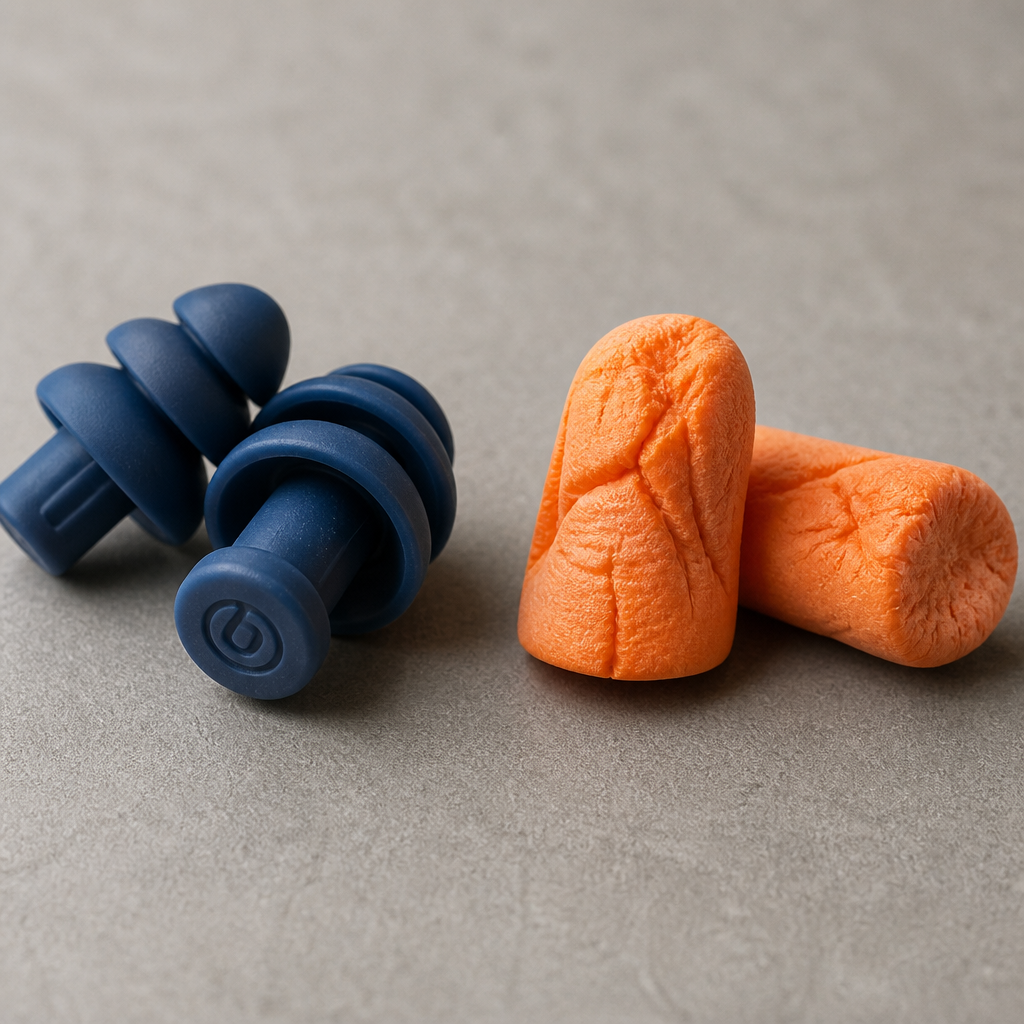
Not all ear plugs are designed with travel in mind. A pair optimized for a shooting range or a factory floor has very different engineering priorities from one designed to get you through a 14-hour flight. Here is what actually separates the useful from the mediocre when you are 35,000 feet in the air.
The NRR (Noise Reduction Rating) used in the United States and the SNR (Single Number Rating) used in Europe are both useful reference points, but treat them as relative comparisons rather than absolute guarantees. Real-world reduction is typically 50 to 75 percent of the rated value because lab conditions assume a perfect fit that most users never achieve. A pair rated at 32 dB NRR will realistically deliver 16 to 24 dB of effective reduction. That is still enough to bring peak cabin noise from 105 dB down to a manageable 80 to 90 dB range.
Foam earplugs typically achieve NRR ratings of 30 to 33 dB, while silicone alternatives usually fall in the 20 to 26 dB range. The key differentiator is not material alone but how well the design ensures a consistent seal in the specific geometry of your ear canal.
A common mistake is grabbing a one-size product and assuming it will work. Ear canals vary considerably between individuals, and an oversized tip creates discomfort while an undersized one creates leaks. Products that include multiple tip sizes, such as XS, S, and M soft memory foam options, allow you to match the fit to your anatomy rather than stretching or compressing the plug to compensate.
Pro tip: Always test your fit at home before a trip, not in your seat mid-boarding. Insert both plugs, snap your fingers next to each ear, and check that the sound is equally muffled on both sides. Uneven attenuation almost always means one plug is not seated correctly.
This is where travel-specific design separates itself from general-purpose hearing protection. Trying to sleep against a headrest or a window with a plug that protrudes several millimetres from your ear creates constant pressure on the outer ear, making sustained wear painful. A low-profile, concave body that sits flush with the ear canal opening eliminates that problem and makes overnight flights genuinely restful.
The market for ear plugs for flying broadly falls into three categories, each with a distinct set of trade-offs. The right choice depends on how often you fly, how long your typical routes are, and what you most need from the product.
| Type | Best For | Key Trade-offs |
|---|---|---|
| Disposable foam plugs (e.g., 3M, Flents) | Occasional travelers, short domestic routes, emergency backup | Cheapest upfront. NRR up to 33 dB. Single-use, environmentally wasteful, inconsistent fit, degrades with body heat and moisture during a long flight. Harder to use correctly, need to be rolled tight and held in place while expanding. |
| Filtered silicone plugs (e.g., Alpine FlyFit, Loop Quiet 2) | Travelers who need some ambient awareness, moderate noise reduction | Reusable. Typically 17 to 24 dB SNR. Pressure-regulating filter variants slow ear canal pressure change during altitude changes. Lower overall attenuation than foam. Silicone can cause irritation for some users on very long flights. |
| Premium metal-bodied plugs with memory foam tips (e.g., ATTENU8) | Frequent flyers, light sleepers, long-haul travelers, noise-sensitive individuals | Highest durability. Approximately 32 dB noise reduction with soft memory foam tips. Concave aluminium body sits flush for side-sleeping comfort. Multiple tip sizes (XS, S, M) for a precise seal. Only the foam tips need replacing every 6 to 8 weeks, not the entire device. |
The filtered silicone category is genuinely useful for travelers who need to hear announcements or conversations during a flight but want to take the edge off engine noise. The trade-off is a measurably lower noise reduction figure, which makes them a poor choice for anyone trying to sleep through a full overnight route.
For frequent flyers prioritising sleep quality and long-term hearing health, the premium reusable category offers the best overall value proposition once you account for the cost of replacing disposable plugs across dozens of trips per year.
The pair of ear plugs you bring on every trip should be chosen with the same care as your travel pillow or noise-cancelling headphones. Poor fit means poor protection, and poor protection accumulates into real hearing damage over years of regular flying.
Ear pain during flights is caused by the change in cabin pressure that occurs during takeoff and, more noticeably, during descent. As the aircraft descends and cabin pressure increases, a pressure difference builds between the air in your middle ear and the environment outside your eardrum. For most people, the Eustachian tube handles this automatically. For others, particularly those with any degree of congestion, the tube does not open fast enough and the result is sharp, throbbing pain.
Standard ear plugs help by slowing the rate at which pressure changes reach the ear canal, giving the Eustachian tube more time to equalize. Research published in The Laryngoscope found that travelers who used earplugs during flights experienced significantly less ear pain than those who did not. This is a secondary benefit that is rarely highlighted in marketing but matters enormously to anyone who has ever gripped their armrests during a rapid descent.
Pro tip: Insert your ear plugs before the cabin doors close, not just before landing. Pressure changes begin as soon as the aircraft climbs through the first few thousand feet, and starting with the plugs already seated means your Eustachian tube gets the full benefit of the slowed pressure gradient throughout the ascent.
The argument for disposable foam plugs is simplicity: buy a bulk pack, use one per flight, throw it away. In practice, this approach has several problems that compound the more you travel. A foam plug that has been sitting in a carry-on pocket absorbs lint, moisture, and skin oils, which degrade its expansion speed and seal quality. Using a dirty or deformed plug effectively means wearing a product that performs well below its rated NRR.
Reusable metal-bodied ear plugs with replaceable foam tips address this directly. The aluminium body, being non-absorbent and wipeable, maintains its structural integrity indefinitely. Only the foam tips, which are the component that actually contacts the ear canal and forms the acoustic seal, are replaced on a regular schedule. Replacing tips every 6 to 8 weeks rather than discarding the entire device dramatically reduces per-use cost and environmental waste.
For anyone flying more than twice a month, the economics are clear. The upfront investment in a quality pair of reusable ear plugs returns its cost within a relatively short time compared to ongoing disposable purchases, and the consistency of performance over each flight is significantly higher. Consistent performance is the real metric: a premium plug that delivers 24 dB of real-world attenuation reliably on every flight is worth more than a theoretically higher-rated disposable that varies wildly based on insertion and degradation.
There is also the hygiene dimension, which frequent flyers rarely think about until they develop ear canal irritation. Memory foam tips that are replaced on schedule maintain a level of cleanliness that a reused, degraded foam plug from the bottom of a bag simply cannot match. For travelers with sensitive skin or any history of external ear issues, this is not a minor consideration.
Even the best ear plugs for flying deliver poor results if inserted incorrectly. Most people, including experienced travelers, do not roll and insert foam-tipped plugs correctly, which is why so many first-time users of quality ear plugs report being surprised by how much better they work when used properly.
With memory foam tip plugs, the process is straightforward but requires a moment of patience. Compress the foam tip gently between your fingers until it is narrow enough to enter the canal comfortably. With your other hand, reach over your head and gently pull the top of your ear upward and backward to straighten the canal. Insert the plug with a slow, gentle rotating motion and hold it in place with light finger pressure for 20 to 30 seconds while the foam expands to fill and seal the canal. Releasing too early before the foam has fully expanded is the most common reason for a poor seal.
If you need to press hard to insert the plug or if you feel discomfort after the foam has fully expanded, the tip is too large. Drop to the next smaller size. If the plug feels loose, shifts when you move your jaw, or falls out, the tip is too small. Getting this right on the first flight you use a new pair is worth the few minutes of experimentation because a correctly fitted plug will still be comfortable six hours later.
Ear plugs work best as part of a deliberate in-flight sleep setup rather than as a last-resort grab when noise becomes intolerable. Pair them with an eye mask, set your seat recline before insertion (so you are not fumbling with controls while wearing plugs), and avoid caffeine in the hours before your intended sleep window. The noise reduction ear plugs provide is most effective for sleep when the other environmental variables, light and physical comfort, are also managed. ATTENU8’s concave aluminium body design is particularly well suited to window seats with a pillow pressed against the side of the head, where protruding plugs would otherwise dig into the outer ear.
If you find yourself on a long-haul route where a window seat is not available, the low-profile body still performs better than conventional cylindrical or T-shaped plugs against an airline headrest. Aisle-seat travelers who cannot lean against the window particularly benefit from a plug that does not shift or dislodge when they tilt their head to rest on a travel pillow.
Yes, wearing well-fitted ear plugs for the duration of a long-haul flight is safe for most adults. The key is choosing plugs made from skin-safe materials and ensuring the foam tips are clean and replaced on a regular schedule. If you experience any pain, remove the plugs, check that the tip size is appropriate, and reinsert. Pain is almost always a sign of incorrect sizing or a hygiene issue with degraded tips, not a sign that ear plugs themselves are harmful.
Yes. Ear plugs slow the rate at which cabin pressure changes reach the ear canal, giving the Eustachian tube more time to equalize the pressure difference across the eardrum. Research published in The Laryngoscope found that travelers who used earplugs during flights reported significantly less ear pain than those who did not. This effect is most pronounced during descent, which is when the pressure change is fastest and most people experience discomfort.
For sleep on long-haul flights or for travelers who are sensitive to noise, aim for an NRR of at least 28 to 33 dB, or an SNR of around 25 to 32 dB. Remember that real-world attenuation is typically 50 to 75 percent of the rated figure, so a 32 dB NRR plug will realistically deliver 16 to 24 dB of effective reduction in-flight. That is enough to bring peak cabin noise from the 100 dB range down to levels that allow genuine sleep and substantially reduce hearing fatigue.
ATTENU8 uses a premium aluminium body with a concave profile designed specifically for low-profile wear, making them better suited for side-sleeping against a headrest or pillow. The memory foam tips deliver approximately 32 dB of noise reduction, which is higher than the 24 dB SNR offered by products like the Loop Quiet 2. Unlike competitors that use silicone tips throughout, ATTENU8 uses soft memory foam tips in three sizes (XS, S, M) that conform precisely to individual ear canal geometry for a more consistent seal. The tips are replaced every 6 to 8 weeks rather than replacing the entire device, which reduces long-term cost and waste.
Yes, and this is one of the practical advantages of investing in a quality reusable pair. A premium ear plug designed for noise reduction and comfort during travel, particularly one with a low-profile body for side-sleeping, performs equally well for blocking out street noise, a snoring partner, or early morning disturbances at home or in a hotel. Keeping a single high-quality pair for all noise-sensitive situations is more cost-effective and means you always have a broken-in, correctly sized pair available when you travel.
Every 6 to 8 weeks under regular use is the standard guidance, though this varies depending on usage frequency and how well you clean the tips between uses. Signs that tips need replacing sooner include a loss of elasticity (the foam no longer springs back fully after compression), visible discoloration, or a noticeable drop in the quality of the seal. Tip replacement is the only maintenance a metal-bodied plug requires, which is one of the core reasons premium reusable designs are more practical for frequent travelers than either disposable foam or full-silicone alternatives.
They serve different purposes. Noise-cancelling headphones are excellent for the mid-range frequencies where music and conversation sit, but they are bulkier, require battery power, and do not allow you to sleep comfortably against a headrest or pillow. Ear plugs deliver passive broadband noise reduction across all frequencies including low-frequency engine rumble, require no power, and are small enough to carry in any pocket. For sleep specifically, ear plugs outperform headphones because they allow natural head positioning and do not create a seal that breaks when a headphone slips. Many experienced long-haul travelers use both: headphones during waking hours for entertainment, ear plugs for sleep.
Have you found a specific tip size or insertion technique that works best for you on long flights? Share your experience in the comments, we read every one.
You love your partner. You do not love the noise they make at 2am. If you have ever lain awake at night listening to a sound that sits somewhere between a freight train and a chainsaw, you already know that snoring is not just an annoyance – it is a genuine threat to your health, your relationship, and your ability to function the next day. Finding the right ear plugs for snoring partner situations is one of the most practical steps any couple can take, and yet most people waste months trying products that fall out, hurt their ears, or barely dent the noise. This guide cuts through the confusion and tells you exactly what works.
| Key Insight | Explanation |
|---|---|
| 32 dB or higher noise reduction is the target for snoring | Loud snoring commonly reaches 60-80 dB. You need meaningful noise reduction, not token attenuation, to actually sleep through it. |
| Fit matters more than the stated NRR number | An earplug rated at 33 dB that does not seal properly in your ear canal will perform worse than a well-fitted 28 dB earplug. The rating assumes a perfect fit. |
| Disposable foam is a short-term fix with real long-term costs | If you need ear plugs every night, buying disposable pairs adds up fast and creates a lot of waste. Reusable options are more economical after the first few weeks. |
| Side sleepers need low-profile designs | Bulky or protruding ear plugs press painfully into your ear canal when your head is on a pillow. Profile and softness matter as much as noise reduction rating. |
| Memory foam tips outperform rigid silicone for overnight comfort | Memory foam conforms to the shape of your individual ear canal, creating a seal without sustained pressure. Rigid tips cause soreness over a full night. |
| Multiple tip sizes are non-negotiable for a proper fit | Ear canals differ considerably between people. Ear plugs that include XS, S, and M tip options give you the best chance of achieving the seal you actually need. |
| Ear plug hygiene is the most overlooked factor in long-term use | Reusable ear plugs with replaceable tips eliminate the hygiene problem that makes people abandon daily use. Replace tips every 6-8 weeks, not when they feel disgusting. |
Sleep disruption from a snoring partner is not just about the noise level in the moment. The real damage comes from the pattern. Snoring is irregular – it surges, pauses, and surges again – which means your brain never fully habituates to it the way it might with steady background noise like a fan. Each unexpected peak pulls you out of deeper sleep stages, even when you do not fully wake up.
Research consistently shows that people who sleep next to heavy snorers suffer disrupted sleep architecture, meaning they spend less time in the slow-wave and REM stages that govern physical recovery and memory consolidation. The non-snoring partner can end up chronically sleep-deprived while the snorer sleeps through their own noise entirely. That imbalance creates real friction in relationships over time.
The practical answer that couples turn to, before considering separate bedrooms, is ear plugs. And that is a reasonable first step, provided you choose the right type. Early research suggests that wearing noise reduction earbuds or ear plugs to bed can help improve sleep quality and reduce daytime tiredness, which reinforces what most chronic non-sleepers already know from experience.
The non-snoring partner often carries the full sleep debt while the snoring partner feels completely rested. Solving the noise problem is not a luxury – it is a matter of basic daily function.
Ear plugs work through passive noise isolation: they physically block sound waves from reaching your eardrum by creating a seal in the outer ear canal. The effectiveness of that seal is measured by the Noise Reduction Rating (NRR) in the US, or the Signal-to-Noise Ratio (SNR) in Europe. These two systems use different test methodologies, so a European product rated at 27 dB SNR is not directly comparable to a US product rated at 27 dB NRR.
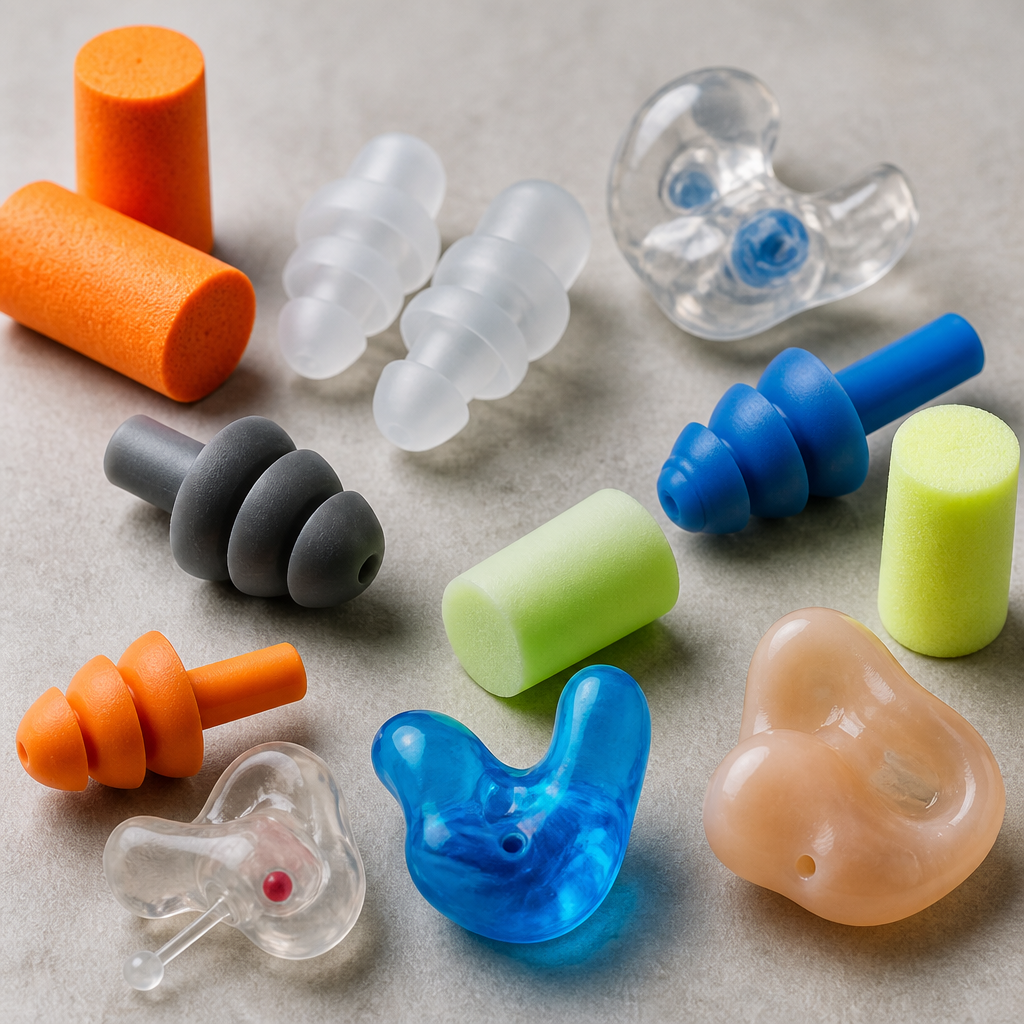

For snoring specifically, you want to be looking at products with an NRR of at least 30-32 dB. Snoring commonly sits between 60 and 80 decibels at close range – a sound level comparable to a busy restaurant or heavy traffic. Dropping that to a manageable background murmur requires serious attenuation, not the modest reduction that cheap wax or low-grade foam can provide.
The single biggest predictor of real-world performance is whether the ear plug creates a complete seal in your specific ear canal. No seal means no meaningful noise reduction, regardless of what the packaging claims. This is why so many people try cheap disposables, find they “don’t work,” and give up on ear plugs entirely – when the actual problem was a poor fit, not the concept itself.
Ear canals are not standardised. They differ in diameter, length, and shape between individuals. Ear plugs that come in multiple tip sizes, particularly XS, S, and M options, address this directly. A product that forces you to use a single size is always going to leave a significant portion of users with an imperfect seal and disappointing results.
Pro tip: When inserting foam-tipped ear plugs, roll the tip between your fingers to compress it, then hold it in place for 20-30 seconds while it expands. Releasing it too early is the most common reason foam ear plugs fail to seal properly.
The material and shape of the ear plug body affects comfort as much as the tip. Soft, floppy bodies compress easily against pillow pressure but can work their way out during the night. Rigid bodies hold their position but can feel hard and uncomfortable over hours of side sleeping. A structured body made from a smooth, low-friction material like aluminium holds its position reliably while remaining comfortable enough to wear through a full night.
If you need ear plugs every single night to sleep next to a snoring partner, the choice between disposable and reusable is not just about preference – it is about economics and hygiene. Here is a direct comparison of the three main approaches couples use.
| Approach | Best For | Main Drawbacks |
|---|---|---|
| Disposable foam ear plugs (single-use, high NRR) | Maximum noise reduction on a tight budget, short-term or occasional use | Ongoing cost adds up; wasteful; can feel dirty after one use if you try to reuse them; no size options mean poor fit for many people |
| Silicone or wax reusable ear plugs (mouldable) | People with very small ear canals or sensitivity to foam; occasional travellers | Wax picks up debris quickly; silicone tips wear out and harden; noise reduction is often lower than foam; can be hard to insert correctly every time |
| Premium reusable ear plugs with replaceable memory foam tips (structured body) | Nightly use over months and years; people who want consistent fit and hygiene; eco-conscious buyers | Higher upfront cost; requires tip replacement every 6-8 weeks; needs cleaning |
In practice, anyone using ear plugs nightly will find that disposables become expensive and wasteful very quickly. A pair of premium reusable ear plugs with replaceable memory foam tips costs more upfront but delivers consistent performance night after night without the recurring expense of constantly buying new boxes. The hygiene argument is equally strong: memory foam tips that are replaced on a regular schedule stay clean in a way that a crumpled, reused disposable foam plug simply cannot.
ATTENU8 ear plugs take this approach further with an aluminium body that holds its shape night after night, paired with soft memory foam tips in three sizes (XS, S, M) that are replaced every 6-8 weeks. The result is roughly 32 dB of noise reduction from a product that is genuinely built for long-term, nightly use – not a one-time purchase that you quietly abandon after two weeks because it hurts.
Pro tip: If you are switching from disposables to reusable ear plugs, give yourself at least a week to adjust. Your brain is accustomed to the exact feel of your old plugs, and a new product will feel strange for the first few nights even when it is performing better. Most people who abandon reusable ear plugs do so in the first three days – before the adjustment period ends.
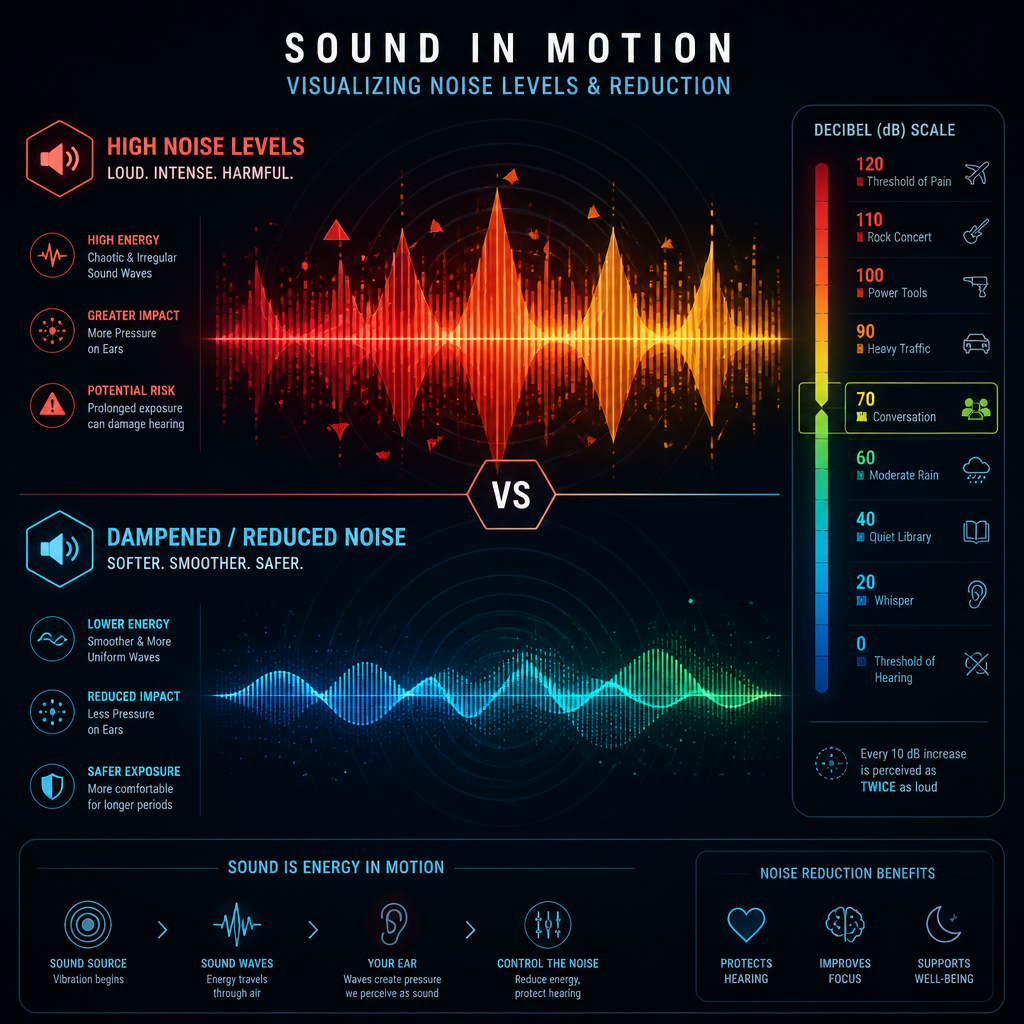
Ear plugs are the most direct solution, but how you use them and what else you pair them with determines whether they actually solve the problem. Here is what works consistently across different snoring situations.
Ear plugs reduce the absolute level of sound reaching your eardrum, but they do not produce silence. What remains after a well-fitted 32 dB ear plug is a muffled version of the snoring, still identifiable as a pattern. The most effective approach is to pair ear plugs with a consistent background sound – a fan, a white noise machine, or a rain sound from a speaker in the room – so that the reduced snoring is masked by neutral, non-intrusive audio. The combination works better than either solution alone.
The key is that the background sound should be constant and predictable. Your brain stops registering constant, patterned sound relatively quickly. It cannot stop registering the irregular peaks and troughs of snoring in the same way, which is why the masking strategy works.
A common and underrated approach is to fall asleep before your partner. Snoring typically becomes louder as the snorer enters deeper sleep, so if you are already in a deeper sleep stage yourself when the noise peaks, you are less likely to be roused by it. Ear plugs combined with an earlier sleep time relative to your partner can make a significant difference even when the snoring itself is quite loud.
Encouraging your partner to sleep on their side rather than their back also reduces snoring intensity for most people. Snoring is typically worse when someone sleeps on their back because the tongue and soft palate are more likely to partially obstruct the airway in that position. This is not always a solvable problem – some people roll back during the night regardless – but it is worth trying as a first line approach.
If your partner’s snoring is very loud, involves gasping or complete pauses in breathing, and leaves them feeling unrefreshed despite adequate sleep time, that is a pattern that warrants a conversation with a doctor rather than a better pair of ear plugs. Sleep apnea is a medical condition, not just a loud habit, and it has real health consequences for the snorer. No ear plug solves the underlying problem on that side of the bed.
Most people who share a bed with a snoring partner sleep on their side, partly because facing away from the source of noise provides a tiny reduction in perceived volume. But side sleeping creates a specific problem for ear plug users: the ear that is resting on the pillow is compressed. Bulky, protruding ear plugs dig into the cartilage of the outer ear and create a pressure point that makes it impossible to stay comfortable through the night.
The design of the ear plug body matters enormously here. Products with a large outer housing – including most consumer-grade earbuds and many silicone ear plugs – are not practical for side sleeping. You need an ear plug that sits flush with or just inside the ear canal opening, without a significant protrusion that catches the pillow.
A concave aluminium body, like the one used in ATTENU8 ear plugs, solves this directly. The shape is designed to sit cleanly in the ear without protruding outward, which means the pillow pressure is distributed across the smooth curved surface rather than a hard angular edge. Combined with soft memory foam tips that do not resist compression in the same way rigid silicone does, the result is an ear plug you can actually wear for eight hours on your side without waking up with a sore ear.
Pro tip: If you wake up with a sore outer ear after wearing ear plugs, the problem is almost always the body shape rather than the tip. Switching to a lower-profile design with a smooth curved housing will usually solve this without any sacrifice in noise reduction performance.
For most snoring situations, you want an NRR of at least 30-32 dB. Snoring can reach 60-80 dB at close range, and ear plugs in this range will reduce it to a level that most people can sleep through, especially when paired with some background sound masking. Products below 25 dB NRR are unlikely to make a meaningful difference against loud snoring.
A well-fitted reusable ear plug with quality memory foam tips can match or exceed the real-world performance of disposable foam plugs. The stated NRR of disposables is often slightly higher on paper, but disposables are frequently inserted poorly, which collapses their effective performance. A reusable product you know how to use correctly, every night, will outperform a disposable you rush into place half-asleep.
For most people, wearing ear plugs nightly is safe provided you keep them clean and replace tips or whole plugs regularly. The main risks are wax buildup (because ear plugs can push wax inward over time) and irritation or infection from dirty ear plugs. Using reusable ear plugs with replaceable tips and keeping them clean manages both risks. If you experience pain, itching, or a feeling of fullness that does not clear, see a doctor.
Disposable foam plugs are the most likely to migrate out during the night, especially if they were not inserted correctly or if your ear canal is on the larger side. Reusable ear plugs with a structured body and a correctly sized tip hold their position much more reliably. If you find your ear plugs regularly out by morning, the first thing to try is a different tip size rather than a different product entirely.
The feeling of occlusion, where your own voice and internal sounds become amplified, is a real issue for some people. Starting with a slightly lower-attenuation product and building tolerance gradually can help. Some people also find that pairing ear plugs with a familiar background sound in the room reduces the sense of isolation because there is still something to hear, just at a lower level. If the anxiety is specifically about not hearing a smoke alarm or baby, that concern is valid and worth weighing against the sleep deprivation being caused by the snoring.
Start with the medium size if you have no prior information about your ear canal size. Insert the tip, hold it in place, and note whether you feel a seal forming – a slight pressure change as you release, or a noticeable reduction in ambient sound. If the medium feels loose or falls out easily, move to small. If it feels like it will not seat properly, try the medium from a different brand before assuming you need larger. Most people find that one ear is slightly different from the other, and this is completely normal.
Have you found a combination that actually works for sleeping next to a snoring partner? Share what made the difference for you in the comments – your experience is exactly what other couples need to hear.
Most people reach for whatever ear plugs are cheapest at the pharmacy and wonder why they wake up at 3am to their neighbour’s music or a snoring partner. The material of the ear plug tip is almost never discussed on the packaging, yet it is the single factor that determines whether you get a real acoustic seal or an expensive placebo. Memory foam ear plug tips are not the default choice simply because they are traditional. They are the default choice because no other material reliably conforms to the irregular geometry of a human ear canal. Silicone flanges and wax putty both have real-world limitations that become obvious the moment you actually try to sleep on your side for eight hours or stand on a noisy construction site for an entire shift.
| Key Insight | Explanation |
|---|---|
| Memory foam expands to fill the ear canal | Unlike silicone flanges, memory foam conforms to the individual contours of each ear canal after insertion, producing a custom-like acoustic seal without custom-moulded tooling. |
| Silicone creates pressure points during side sleeping | Flanged silicone tips are rigid enough to transmit pillow pressure directly into the ear canal. Most side sleepers report discomfort after 3-4 hours, compared to 6-8 hours with memory foam. |
| Wax plugs have significantly lower noise reduction ratings | Wax and moldable silicone putty seal at the entrance of the ear canal rather than inside it, which produces lower NRR figures and leaves low-frequency noise like traffic and snoring poorly attenuated. |
| Foam tip size matters as much as material | A correct-size memory foam tip that fully expands inside the canal outperforms an oversized silicone flange that creates a partial seal at the wrong point. Multiple tip sizes are not a marketing add-on. They are an acoustic requirement. |
| Memory foam softness reduces cumulative ear fatigue | Memory foam is considerably softer than silicone, which matters over long wear periods such as overnight sleep or a full work shift. Harder materials build up pressure-related discomfort that foam does not. |
| Foam tips degrade and require replacement; the ear plug body does not | With a reusable metal-bodied design like ATTENU8, only the foam tips are replaced every 6-8 weeks. The aluminium body is permanent. This is more cost-effective and less wasteful than discarding entire ear plugs. |
| Real-world NRR is always lower than lab-rated NRR | Lab NRR figures assume perfect insertion. With memory foam and a correct insertion technique, real-world attenuation is closer to the rated value than with any other tip material because the seal is more consistent. |
The ear canal is not a uniform tube. It bends, narrows, and widens in ways that differ from person to person and even between your left and right ear. A rigid tip material that relies on a fixed shape, such as a flanged silicone tip, can only seal properly when its geometry happens to match the canal geometry closely enough. That match is inconsistent across a population of users.
Memory foam works through a different mechanism entirely. You compress the tip between your fingers, insert it while compressed, and the foam then slowly expands against the canal walls. This expansion-based seal conforms to the precise contours of the individual ear canal, filling small gaps that any fixed-shape tip would leave open. Those gaps are where noise enters. Closing them is the entire job of an ear plug tip.
The expansion also creates a distributed, low-pressure contact across the full circumference of the canal rather than concentrated pressure at a few contact points. This is why memory foam tips are more comfortable during extended wear. The pressure is spread over a larger surface area at lower intensity per square millimetre, rather than a silicone flange pressing firmly at two or three discrete points.
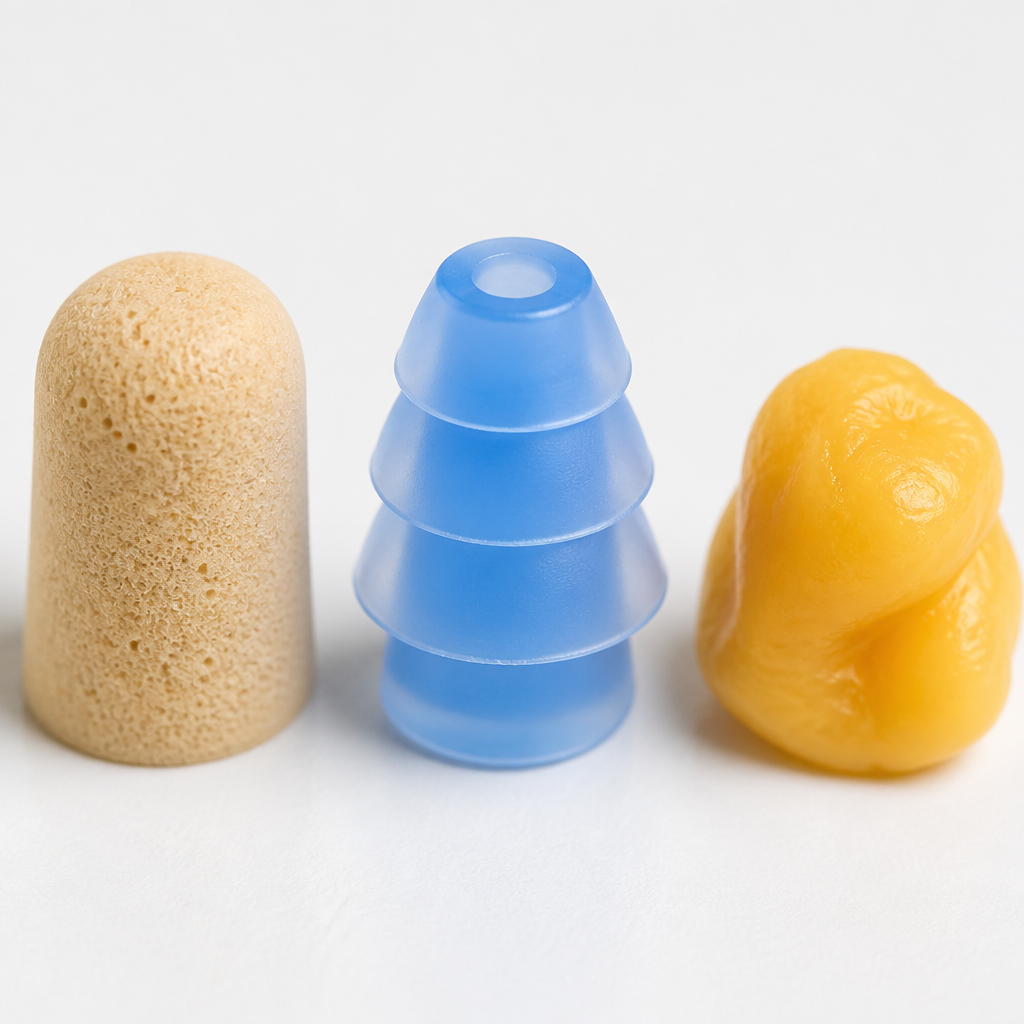
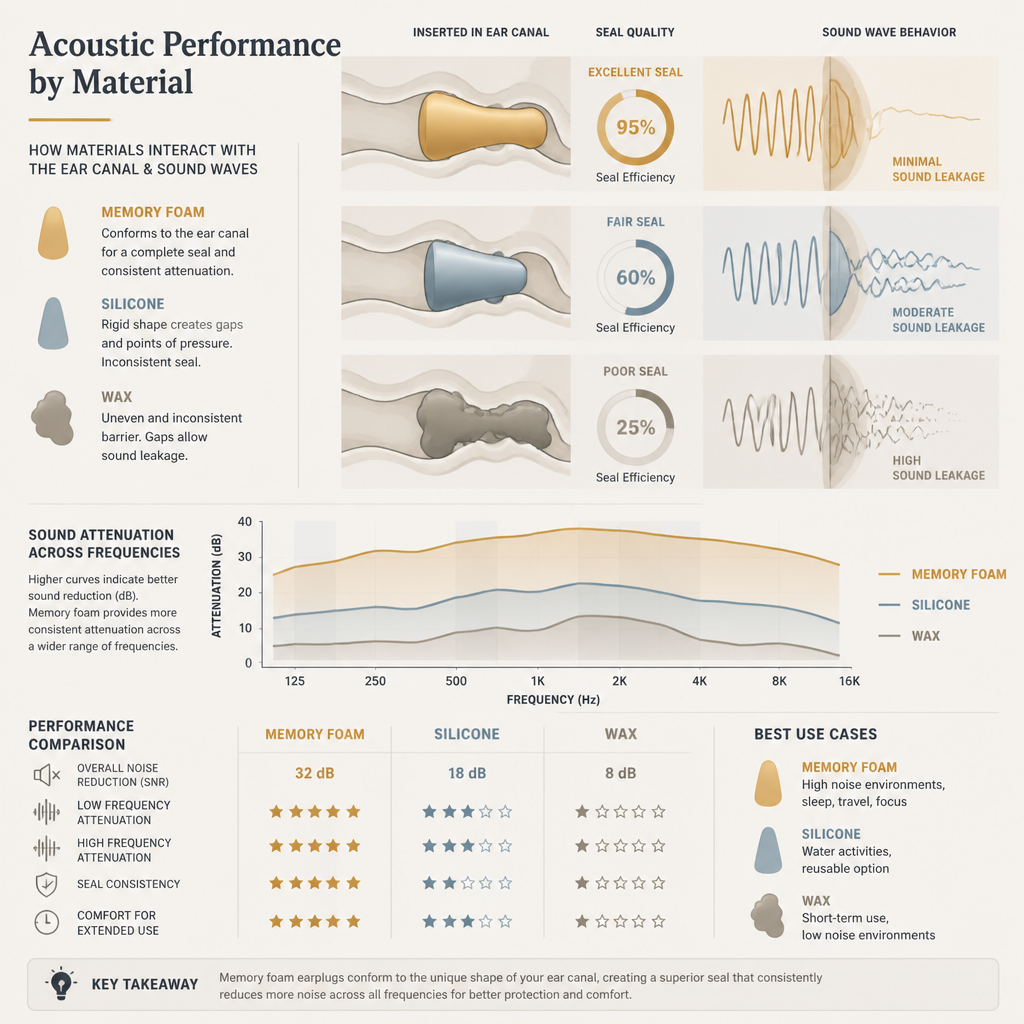
Pro tip: After inserting a memory foam tip, press gently on your tragus (the small flap of cartilage at the front of your ear opening) and speak aloud. If your voice sounds hollow and enclosed rather than open and external, the foam has fully expanded and the seal is complete. If you still hear your voice externally, the tip needs to be reinserted deeper.
The slow expansion rate of quality memory foam also gives you time to position the plug correctly before the foam locks in place. Cheaper foam tips expand too fast, locking in before you can adjust the depth. This is why foam formulation quality varies considerably between products, and why the tip material specification matters even within the category of foam.
Silicone ear plug tips are durable and easy to clean. Those are real advantages. The problem is that a clean, durable tip that does not seal properly provides no meaningful hearing protection. Durability is only a virtue if the underlying performance justifies repeated use.
Flanged silicone tips can provide a seal, but the fit is less consistent depending on ear shape and tip size. Because silicone does not expand to match the shape of the ear, tips that feel secure at first insertion can loosen as you move, talk, or shift position during sleep. Memory foam maintains its expanded seal even as the ear canal shifts slightly with jaw movement or head rotation.
This inconsistency has a direct acoustic consequence. Every time a silicone tip loses partial contact with the canal wall, low-frequency noise bleeds through the gap. Low-frequency sounds, specifically traffic rumble, bass from music, and snoring, are exactly the noise profile that most light sleepers and noise-sensitive individuals are trying to block.
Silicone’s firmness becomes a genuine problem during side sleeping. When your ear presses against a pillow, the ear plug body transmits pressure directly into the ear canal through the rigid silicone tip. Most side sleepers report discomfort after 3-4 hours with flanged silicone, compared to 6-8 hours with memory foam. For anyone trying to get a full night of sleep, that difference is decisive.
This is not a minor comfort issue. Discomfort during sleep causes micro-arousals even when they do not fully wake you, reducing sleep quality even if you technically stayed asleep. An ear plug that causes you to remove it at 2am has not protected your sleep.
The goal of an ear plug tip is not to be close to the right shape. It is to become the right shape. Only expanding foam reliably achieves that in a population with varying ear canal geometry.
Wax ear plugs have one genuine advantage: they sit at the entrance of the ear canal rather than inside it, which means they create no inward pressure on the canal walls. For people who find any in-canal insertion uncomfortable, wax is more tolerable. That is where the list of advantages ends.
Wax and moldable silicone putty seal at the canal entrance rather than inside the canal, which produces lower NRR figures and leaves low-frequency noise poorly attenuated. This matters enormously when the noise you are trying to block is a snoring partner or low-frequency traffic rumble, both of which require substantial attenuation in the 125-500Hz frequency range. Surface seals at the canal entrance do not produce that attenuation.
Wax also deforms inconsistently. The material softens with body heat, which can cause it to lose its moulded shape over the course of a night. A tip that has shifted position at 4am is not providing the same protection it provided at 11pm. Memory foam maintains its expanded shape once set, and does not flow or deform under body heat.
Wax is a reasonable short-term option for light, occasional noise. It is not a serious solution for consistent high-attenuation hearing protection, whether for sleep, professional noise environments, or travel.
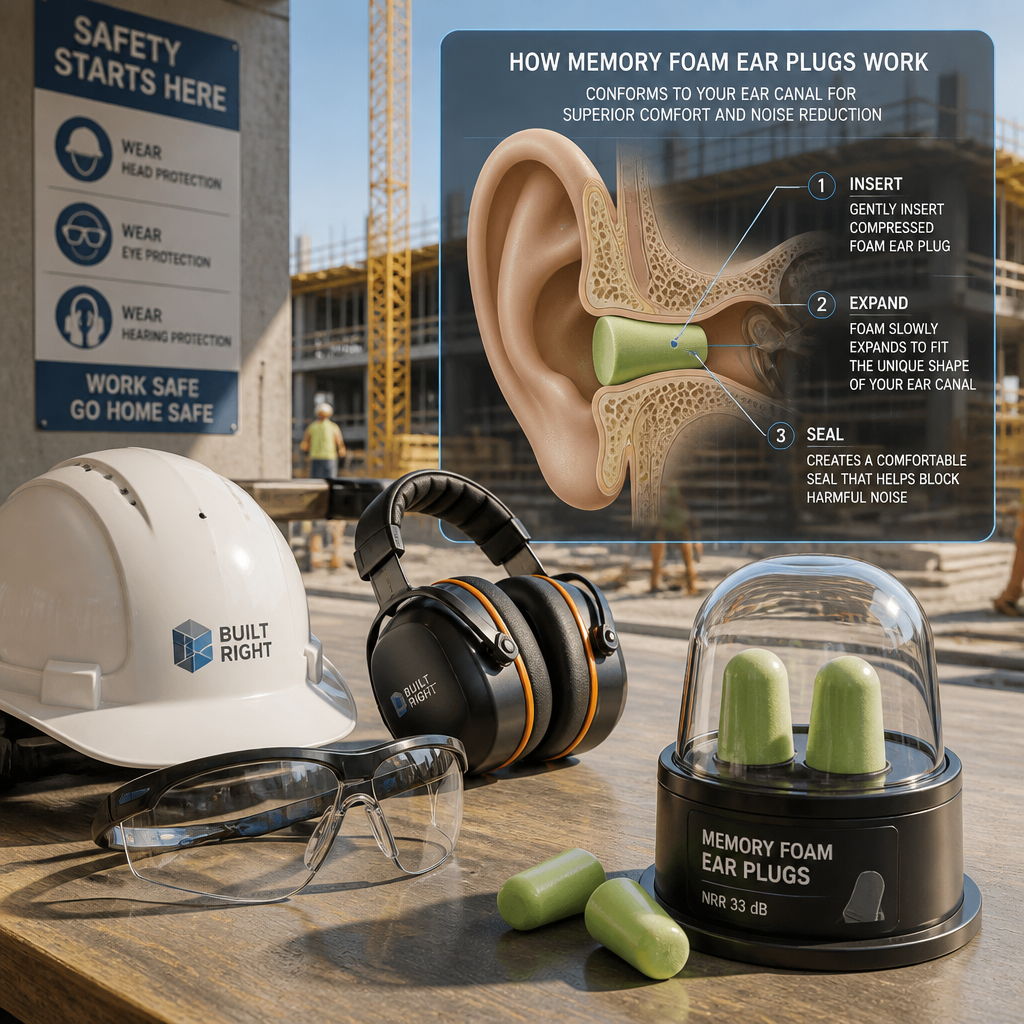
Pro tip: If you have been relying on wax ear plugs for sleep and they are not working well enough, the issue is almost certainly not the brand. It is the fundamental limitation of a surface seal. Switching to a well-fitted memory foam tip with proper insertion depth will produce a noticeably different result the first night you use it correctly.
The table below compares the three main ear plug tip materials across the factors that matter most to people using ear plugs for sleep, travel, or occupational hearing protection.
| Factor | Memory Foam | Flanged Silicone | Wax / Moldable Putty |
|---|---|---|---|
| Seal mechanism | Expands to fill full canal contour | Fixed flanges press against canal wall | Surface seal at canal entrance |
| Noise reduction consistency | High, consistent across ear shapes | Moderate, varies with ear canal geometry | Low to moderate, limited by depth of seal |
| Comfort for side sleeping | Excellent (6-8 hours) | Poor (pressure after 3-4 hours) | Good (no inward pressure) |
| Low-frequency attenuation | Strong | Moderate | Weak |
| Reusability | 6-8 weeks per tip (with metal body) | Long-term with cleaning | Short-term, degrades quickly |
| Cleanability | Limited (porous material) | Easy (non-porous, washable) | Single-use or very short-term |
| Fit adjustment | Self-adjusts via expansion | Requires correct size selection | Manually moldable at insertion |
Sleep is where material choice produces the most obvious real-world difference. The conditions of sleep, specifically lying still for 6-8 hours, changing position multiple times, pressing one ear against a pillow, and tolerating the plug at low consciousness levels, expose every weakness of silicone and wax that is less apparent during brief daytime use.
Selecting the right ear plug for sleep is not just about grabbing the highest NRR number. Comfort in a side-lying position, material softness, and whether the plug stays sealed as you move all matter more than raw decibel reduction numbers. A plug rated at a high NRR that causes you to pull it out at 2am provides zero protection for the rest of the night.
High-quality memory foam for ear plug tips is engineered to be noticeably softer than standard foam. It compresses with less force and expands slowly, so there is minimal rebound pushing against the ear canal wall when you are lying on your side. This slow, low-pressure expansion is what makes memory foam tolerable for hours rather than minutes.
In practice, a foam tip that expands too aggressively creates the same pressure problem as a firm silicone flange. Foam quality varies, and not all foam ear plugs use the same formulation. The tips on ATTENU8 ear plugs are specifically soft memory foam, designed to maintain a seal without creating the hard pressure points that wake side sleepers before their alarm does.
Ear canals are not standardised. Offering a single foam tip size and expecting it to work for every user is acoustically unrealistic. A tip that is too small will not expand to fill the canal. A tip that is too large will not insert deeply enough for a proper seal. ATTENU8 ships with three sizes of soft memory foam tips (XS, S, and M) precisely because the correct size is an acoustic requirement, not a preference. Finding the right size on the first night eliminates the guesswork that causes most new users to abandon ear plugs prematurely.
Construction workers, manufacturing personnel, and military operators face a different set of requirements than light sleepers. Hearing protection must remain effective over long shifts, withstand physical activity, and maintain its seal even when the wearer is sweating or moving frequently. Memory foam handles all of these conditions better than the alternatives.
For professionals who wear ear protection for hours at a stretch, the memory foam tip material reduces the cumulative pressure discomfort that builds over a shift with harder silicone or rigid stem designs. An ear plug that feels fine at 8am and becomes painful by noon is a liability, not protection. Workers will remove it, defeating its purpose entirely.
The ATTENU8 design addresses the professional context specifically. The aluminium body serves as an insertion handle and anchoring structure, while the replaceable memory foam tip creates the acoustic seal. A disposable foam plug in a tool belt pocket degrades before it is even inserted. An aluminium-bodied plug in a carry case does not. The combination of a durable body with a high-performance foam tip produces hearing protection that holds up to the demands of an actual work environment rather than just a lab test.
For noise environments requiring approximately 32dB reduction, which covers most construction and manufacturing settings, this design is genuinely viable. The foam tip provides the seal; the metal body provides the consistency of insertion and the longevity that disposables cannot offer.
One legitimate criticism of memory foam ear plug tips is that they degrade over time. Foam compresses and expands repeatedly with use, gradually losing elasticity and its ability to form a complete seal. This is a real limitation, and dismissing it would be dishonest.
The ATTENU8 approach addresses this limitation directly rather than ignoring it. The aluminium body is permanent and does not wear out. Only the memory foam tips are replaced, at a recommended interval of every 6-8 weeks. This means you replace the component that actually degrades while keeping the component that does not. The alternative, buying new disposable foam ear plugs every few weeks, replaces the entire product including the parts that were still functional.
This also has a comparison advantage over the memory foam vs silicone debate. Silicone tips last longer without requiring replacement, which is a genuine advantage. But the relevant question is not which tip lasts longer in isolation. It is which tip provides better acoustic performance per dollar and per unit of user effort. Memory foam tips that are replaced on schedule maintain their performance. Silicone tips that last longer but provide a less consistent seal may technically outlast the foam, but they also underperform on every night that the fit is not right.
A common mistake is to assume that because silicone is more durable, it is the better long-term investment. Durability only has value when the product is performing its function. An ear plug tip that lasts two years but provides inconsistent noise reduction is not a better investment than one replaced every 6-8 weeks that seals correctly every time.
Yes, for most users and most use cases. Memory foam expands to conform to the individual shape of each ear canal, creating a more consistent acoustic seal than fixed-shape silicone flanges. Silicone can provide a good seal when the tip size happens to match the canal geometry closely, but this consistency is lower across a general population. For sleep, construction noise, and traffic, memory foam’s expanding seal outperforms silicone flanges in practice.
Memory foam ear plug tips maintain their expansion properties for approximately 6-8 weeks of regular use before the foam begins to lose elasticity and the seal becomes less consistent. On a reusable design like ATTENU8, only the tips are replaced at this interval. The metal body is permanent. You can tell a tip needs replacing when it no longer feels like it fully expands against the canal wall, or when noise that was previously blocked starts to come through at familiar volume levels.
Wax ear plugs sit at the entrance of the ear canal rather than inside it, which means there is no inward pressure on the canal walls. This makes them more comfortable for people sensitive to in-canal insertion. The trade-off is that a surface seal at the canal entrance cannot achieve the same attenuation as a deep in-canal seal. Low-frequency noise in particular, including snoring and traffic, requires substantial attenuation in frequency ranges that a surface seal does not reliably cover.
Memory foam is the best ear plug tip material for side sleepers. Silicone flanges are firm enough to create pressure points when your ear presses against a pillow, and most side sleepers report discomfort after a few hours. Memory foam compresses under pillow pressure without creating hard pressure points, which is why memory foam ear plug users can comfortably wear them for a full night. Wax sits outside the canal and avoids in-canal pressure, but provides significantly less noise reduction than in-canal foam.
It matters more with disposables, not less. Disposable foam ear plugs use a basic open-cell foam that degrades quickly and loses its seal after a single use. Silicone disposables are rare. The comparison becomes most relevant when you move to reusable ear plugs, where you are choosing a tip material that will be your daily noise protection for weeks at a time. With a reusable system using replaceable memory foam tips, you get the acoustic advantages of foam combined with the economic and environmental advantages of a durable body.
Yes. Ear canal geometry varies considerably between individuals, and even between a person’s left and right ear. A tip that is too small will not expand to fully contact the canal walls. A tip that is too large will not insert to the correct depth. Both produce a partial seal rather than a full one, reducing real-world noise attenuation substantially. ATTENU8 includes XS, S, and M tip sizes specifically because correct sizing is an acoustic requirement. Try all three sizes and confirm the seal using the tragus-press check described earlier in this article.
Have you switched from silicone or wax to memory foam ear plug tips, and noticed a difference in how much noise actually gets through? Share what you experienced below, because real-world comparisons from different environments are useful to others making the same decision.
Noise-induced hearing loss does not announce itself. It builds across years of unprotected exposure to jackhammers, concrete saws, and compressors, until one day you realize you are asking people to repeat themselves constantly. Construction sites routinely generate sound levels above 90 dB, and sustained exposure above 85 dB causes permanent auditory damage. Choosing the right ear plugs for construction workers is not a minor purchasing decision. It is a long-term investment in your hearing health, and the type of plug you choose, how it fits, and how consistently you wear it all determine whether you are actually protected or just going through the motions.
| Key Insight | Explanation |
|---|---|
| Real-world attenuation is lower than the label | Most users achieve only 50 to 70 percent of the labeled NRR in actual field conditions. Proper insertion technique closes most of that gap. |
| 32dB NRR is a strong protection threshold for most construction environments | Sites running jackhammers, grinders, and compressors typically peak between 95 and 110 dB. A 32dB-rated plug brings perceived exposure down to a manageable level when worn correctly. |
| Disposable foam plugs are a hygiene and consistency liability | Dirty hands contaminate disposable foam plugs on every insertion, and workers who rush insertion on a busy site consistently under-seat the plug, reducing effective protection. |
| Memory foam tips outperform standard foam for long shifts | Slow-rebound memory foam conforms to irregular ear canal shapes and reduces pressure fatigue across multi-hour wear, making it the practical choice for full-day industrial work. |
| Tip replacement beats full product replacement | Premium reusable plugs with replaceable foam tips, replaced every 6 to 8 weeks, maintain consistent hygiene and attenuation without the cost of buying new plugs constantly. |
| Ear canal size variation is a real fit problem | A single-size plug leaves a significant proportion of workers with a poor seal. Products offering XS, S, and M tip sizes dramatically improve fit consistency across a workforce. |
| Durable body materials matter in industrial environments | Plastic-bodied reusable plugs crack, warp, and degrade in dirty, high-temperature environments. Metal-bodied plugs survive tool belt and pocket carry without structural failure. |
Walk onto any active construction site and you will find a predictable pattern. There is a box of disposable foam ear plugs somewhere near the site entrance, workers grab them in the morning with hands covered in grease or dust, roll them quickly between two fingers, and shove them in. The plug never fully seats. The seal is inconsistent. By mid-afternoon, the plug has either fallen out, been pulled out because of discomfort, or become so compressed and dirty that it is no longer providing meaningful attenuation.
This is not a worker discipline problem. It is a product design problem. Disposable foam plugs were designed for controlled environments with trained users inserting them under supervision, not for fast-moving job sites where workers are putting them in one-handed while carrying equipment. The insertion process for a foam plug, done correctly, requires clean hands, a full roll-down, canal stretching, and a 20 to 30 second hold. That sequence rarely happens in practice.
The consequence is real. High-frequency hearing loss, particularly the kind that begins around 4 kHz, develops slowly and asymptomatically. Workers do not realize the damage is accumulating until it becomes noticeable in conversation. By that point, it is irreversible. Choosing ear plugs for construction workers that are designed to be inserted correctly every time, not just in ideal conditions, is the only approach that delivers consistent protection.
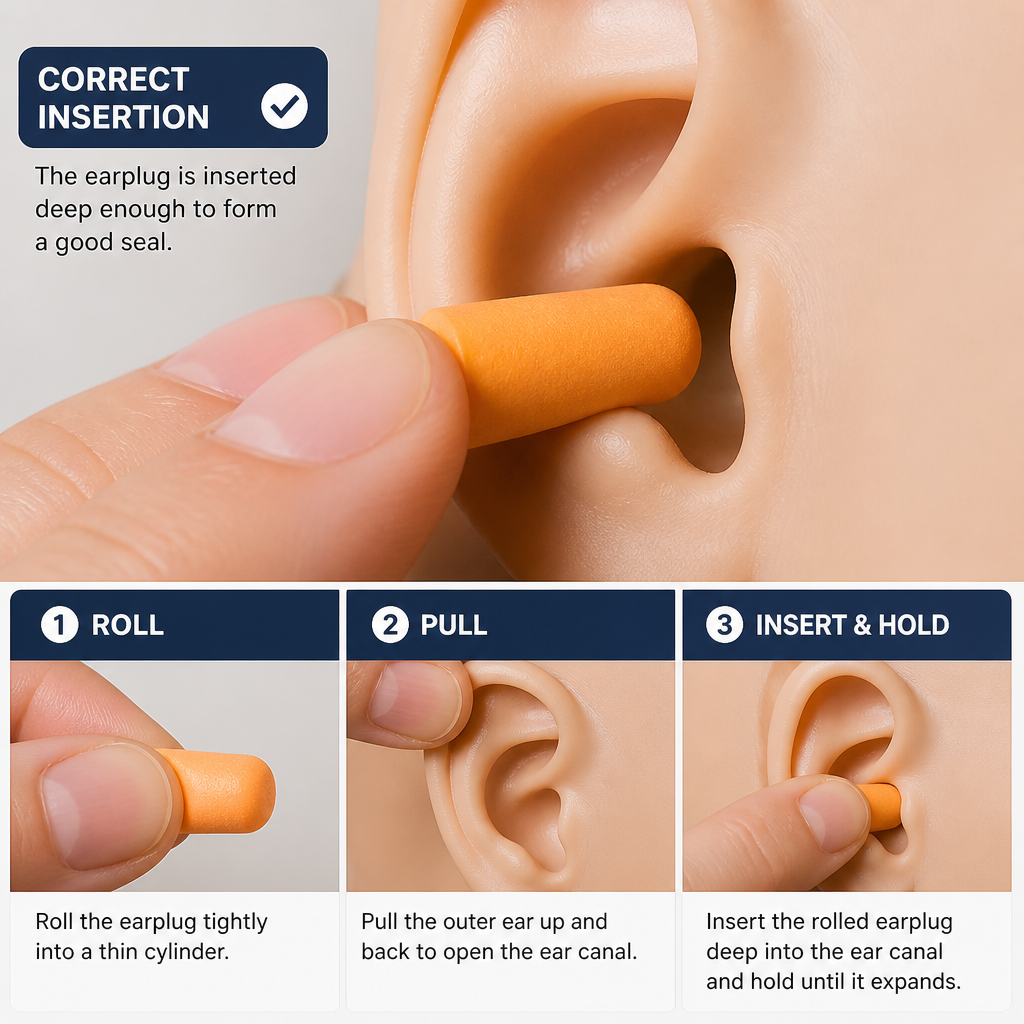

Pro tip: If you manage a crew, look at the plugs people are actually wearing at the end of the day, not what is in the box. A plug that has been worn for 8 hours should show compression and slight discoloration. A clean, barely-compressed plug was not worn properly, if at all.
The Noise Reduction Rating, or NRR, is a standardized laboratory measurement of how much sound a hearing protection device blocks under controlled conditions. In the United States, it is governed by ANSI standards and appears on every certified hearing protection product. A higher NRR means more attenuation in ideal conditions. But the gap between ideal conditions and a real job site is significant, and understanding it changes how you evaluate products.
To estimate real-world noise exposure with ear plugs in place, safety professionals typically halve the NRR value and subtract it from the ambient noise level. So an NRR 33 plug used on a site running at 100 dB would reduce effective exposure to roughly 83 to 84 dB, not 67 dB as the raw number might suggest. The derating accounts for insertion variability, fit inconsistency, and user behavior. Under poor insertion technique, effective protection can drop to as little as 50 percent of the labeled NRR.
A 32dB NRR rating, the level delivered by ATTENU8’s metal-bodied reusable ear plugs, is a serious industrial-grade specification. Properly worn, it brings a 105 dB grinding environment down to around 89 dB effective exposure, and a 95 dB site down to roughly 79 dB. That difference is not trivial. Every 3 dB reduction cuts the sound energy in half. The critical factor, as always, is consistent correct insertion, which is where plug design either helps or hinders you.
The NRR is measured in a lab under ideal insertion conditions. In real industrial settings, most users achieve only 50 to 70 percent of the labeled NRR. Fit consistency is what separates protection from false confidence.
Not all ear plugs are the same product with different branding. The material, design, and fit mechanism each make a meaningful difference in how well a plug works across a full working day in a dirty, demanding environment.
Disposable foam plugs are the most common type on construction sites because they are cheap and available in bulk. Products in this category, including polyurethane foam designs, can achieve high NRR ratings of 33 dB or above in laboratory conditions. The problem is that they require clean, dry hands and careful technique on every insertion, they degrade in hygiene terms quickly in industrial environments, and they create ongoing waste and cost. They are appropriate for occasional use or as backup protection, not as the primary hearing protection strategy for workers logging 8 to 10 hour shifts five days a week.
Reusable silicone and multi-flanged plugs address the hygiene problem by being washable. They do not require a roll-down technique, which makes insertion faster and more consistent. The trade-off is that rigid flanged designs do not conform to irregular ear canal shapes as effectively as foam, and workers with non-standard canal anatomy often report poor seals. NRR ratings for this category typically sit between 23 and 27 dB, which is adequate for moderate noise environments but may fall short for the loudest construction tasks.
This is the category where design sophistication closes the gap between laboratory performance and real-world protection. A rigid metal body, such as the concave aluminium construction used in ATTENU8 ear plugs, protects the foam tip from compression damage during storage and carry. The memory foam tip conforms to the individual ear canal shape and maintains that seal across hours of wear. Tip replacement every 6 to 8 weeks keeps hygiene consistent without replacing the entire product. Multiple tip sizes, typically XS, S, and M, solve the fit problem for workers with non-standard anatomy. This is the right choice for professionals who need reliable, daily hearing protection in manufacturing and construction.
Pro tip: When issuing ear plugs to a crew, provide at least two tip size options. Forcing every worker into a medium-sized tip is the single fastest way to ensure a significant proportion of them are getting a poor seal, even if they do not realize it.
| Factor | Disposable Foam (e.g. GOL-SIV NRR 33) | Reusable Silicone (e.g. Klein Tools 605036) | Premium Metal-Bodied Memory Foam (e.g. ATTENU8) |
|---|---|---|---|
| NRR Rating | Up to 33 dB (lab conditions) | 25 dB typical | 32 dB |
| Insertion Consistency | Poor. Requires careful technique every time. | Moderate. No roll-down needed but flanges vary by canal shape. | High. Memory foam conforms and self-seals with light pressure. |
| Hygiene Over Time | Single use. Disposed after each wear. | Washable but plastic body degrades over time. | Replaceable foam tips every 6 to 8 weeks. Metal body is cleanable and durable. |
| Long-Shift Comfort | Pressure buildup after 2 to 3 hours is common with dense foam. | Flanges can cause discomfort during extended wear. | Soft memory foam reduces pressure fatigue across full-day shifts. |
| Durability in Industrial Environments | Single use. No durability consideration. | Plastic bodies crack under rough handling or high temperatures. | Aluminium body survives tool belt and pocket carry without damage. |
| Long-Term Cost | Low unit price but high cumulative cost at daily use volumes. | Medium. Body lasts but buying new pairs periodically adds up. | Higher upfront cost, lower running cost due to tip-only replacement. |
| Fit Options | Typically one size. Workers with small or large canals get poor seals. | Some corded options come in limited sizes. | XS, S, and M tip sizes included. Covers the full range of canal anatomy. |
A 32dB NRR specification is not a marketing number. It corresponds to the level of attenuation required to bring serious industrial noise sources within acceptable daily exposure limits. Concrete saws, pneumatic drills, and heavy demolition equipment regularly produce sound levels between 100 and 115 dB. Without protection, a worker can suffer hearing damage in under a minute at the highest end of that range.
With a correctly seated 32dB plug, those same exposures are reduced by roughly 16 dB in real-world conditions after derating, bringing a 110 dB exposure down to roughly 94 dB. That shifts the allowable daily exposure time from seconds to hours. It is the difference between working safely and systematically destroying your hearing over a career. The key word, again, is correctly seated. A 32dB plug worn poorly delivers far less than a 25dB plug worn properly.
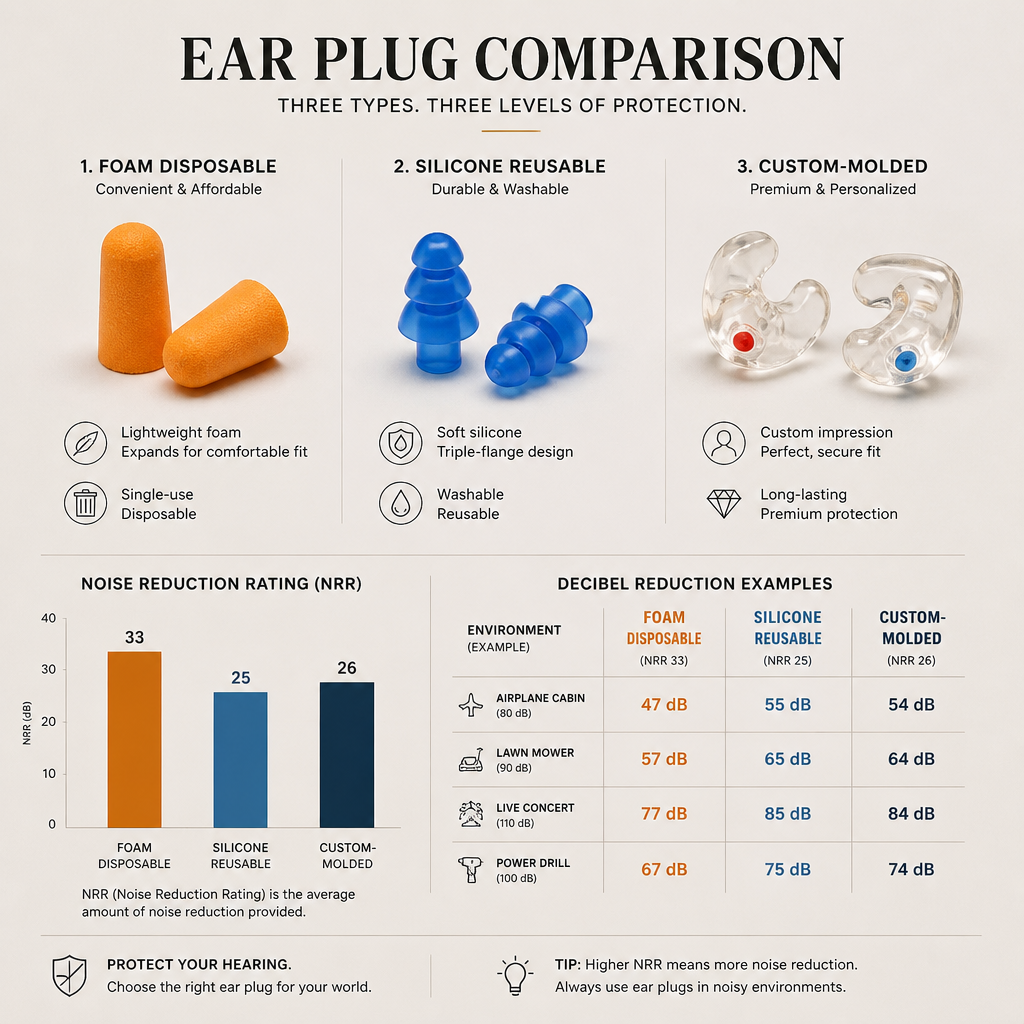
This is why industrial ear plugs rated at 32dB need to be paired with a design that supports consistent insertion. Memory foam tips that conform automatically, multiple size options that match the wearer’s anatomy, and a body design that makes correct insertion the path of least resistance are not premium features. They are functional requirements for the protection to work as rated.
Manufacturing environments present a different noise profile from construction sites. Where construction noise is episodic, manufacturing noise is often continuous. A factory press running at 90 to 95 dB for an 8-hour shift creates a different type of exposure burden than intermittent demolition work. The cumulative effect of that steady drone is what drives the high-frequency hearing loss pattern typical of long-tenure manufacturing workers.
Continuous noise exposure at moderate levels is in some ways more insidious than peak noise on a construction site. Workers on a demolition site know the noise is extreme and generally wear protection. Workers on a press floor that runs at 90 dB often rationalize that the noise is not bad enough to bother with plugs, particularly if they have habituated to it over months or years. The auditory damage accumulates regardless of subjective perception.
For hearing protection in manufacturing, long-shift comfort is non-negotiable. A plug that causes ear canal pressure or discomfort after two hours will not be worn consistently, no matter how well it performs in a laboratory. Memory foam tips that distribute pressure evenly and do not create a tight rigid seal are the right design for this context. The ability to replace tips regularly rather than discard and replace full plugs also matters in manufacturing settings where hygiene standards are often more formalized.
Workers who spend extended periods on a factory floor also benefit from plugs that can be inserted and removed easily without contaminating the foam. A metal-bodied plug with a smooth, easy-grip exterior allows for quick removal during communication and re-insertion without touching the foam tip itself, which is a genuine hygiene and convenience advantage over disposable foam that gets handled directly on every insertion.
Insertion technique is the single biggest variable in real-world hearing protection performance. It matters more than the NRR difference between a 30dB plug and a 33dB plug, because poor insertion on the higher-rated plug will deliver less actual protection than correct insertion on the lower-rated one. Every industrial worker who uses ear plugs should know this sequence.
For memory foam tip plugs like those on ATTENU8’s system, the process is straightforward. Reach over the top of your head with the opposite hand, grasp the top of your ear, and pull gently upward and backward to straighten the ear canal. Insert the plug with a slight twisting motion and gentle forward pressure until the foam tip is flush with the entrance to the ear canal. Release your ear. You should notice a meaningful reduction in ambient sound within a few seconds as the foam expands and seats against the canal walls.
The most common mistake is under-insertion, pushing the plug in just far enough to feel resistance but not far enough to create a proper seal. This leaves a gap around the foam tip that allows sound to pass freely. The second most common mistake is inserting without straightening the canal first. The adult ear canal curves, and inserting without pulling the ear straight means the plug is sealing against a curve rather than seating properly. Both mistakes are easy to fix once a worker is aware of them.
Pro tip: A simple insertion check costs nothing. After inserting both plugs, cup your hands over your ears and press lightly. If the sound level changes noticeably when you add that extra seal, your plugs are not seated properly and need to be reinserted.
Most active construction environments run between 90 and 110 dB depending on the equipment in use. An NRR of 25 dB provides adequate protection at the lower end of that range. For sites running heavy equipment, concrete cutting, or demolition work, an NRR of 32 to 33 dB is the appropriate specification. Always apply the real-world derating factor: treat the effective protection as roughly half the labeled NRR to account for insertion variability in field conditions.
For workers wearing ear plugs every day, reusable plugs are the better choice on every practical measure. They reduce daily waste and cost, they can be maintained hygienically rather than replaced with dirty hands, and premium reusable designs with replaceable foam tips maintain consistent attenuation without requiring the purchase of entirely new plugs every few weeks. Disposable foam plugs are best suited to occasional use, visitors to a site, or as emergency backup.
Foam tips on reusable ear plugs should be replaced every 6 to 8 weeks under regular daily use. The foam gradually loses its slow-rebound properties, becoming either too soft to create an adequate seal or too compacted to expand properly. Discoloration and a change in texture are the visible signs. On ATTENU8’s system, the metal body lasts indefinitely while only the foam tips require periodic replacement, which is both the economical and hygienic approach.
Yes. Using ear plugs under ear muffs is called dual protection and is recommended for extremely loud environments such as those involving explosive tools, some heavy demolition equipment, or powered industrial machinery at close range. The combined attenuation is not simply additive, but the combination does provide meaningfully higher protection than either device alone. For most standard construction and manufacturing environments, a well-fitted 32dB plug is sufficient without the added bulk of ear muffs.
Discomfort after extended wear is usually caused by one of three things: the wrong tip size creating excess pressure, incorrect insertion causing the plug to press against the canal walls at the wrong angle, or foam that is too dense for your canal anatomy. The solution is to start by trying a smaller tip size, then check your insertion angle. If you are using rigid flanged silicone plugs, switching to a softer memory foam tip design typically eliminates pressure discomfort during long shifts. A plug that hurts will not be worn. Comfort and protection are not competing priorities.
For metal-bodied plugs with foam tips, the correct approach is to clean the metal body with a damp cloth and mild soap, keeping the foam tip as dry as possible. Foam tips should not be submerged in water or cleaned with chemical solvents. If a foam tip has accumulated significant contamination, replace it rather than attempting to clean it. This is why the 6 to 8 week replacement cycle exists. The metal body can be fully cleaned without concern about damage to the structural component.
Have you found a particular insertion method or ear plug design that works best for your work environment? Share your experience in the comments.
If you wake up more than once a night but can’t pinpoint why, noise is the most likely culprit you’re underestimating. Research consistently shows that sounds as low as 30 decibels can pull you out of restorative sleep stages, and most urban bedrooms sit well above that threshold. The question of whether ear plugs improve sleep isn’t really a debate anymore. Multiple randomized controlled trials confirm they work. What matters now is understanding exactly how they work, which types deliver genuine noise reduction for better sleep, and what separates a pair that stays comfortable all night from one you’ll pull out at 2am.
| Key Insight | Explanation |
|---|---|
| Noise below 40dB can still disrupt sleep | The WHO’s nighttime noise threshold sits around 40dB. Sounds below this level still cause measurable arousals in light sleepers, meaning even a “quiet” room may be too loud. |
| Ear plugs protect REM sleep specifically | A polysomnographic study found that earplugs improved REM sleep time and reduced arousals in noisy environments, protecting the sleep stage most responsible for memory consolidation and mood regulation. |
| Earplugs outperform pink noise machines for noise cancellation | A seven-night laboratory study published in SLEEP found earplugs mitigated nearly all effects of environmental noise on sleep architecture, performing better than pink noise across most conditions. |
| Fit is more important than the NRR number | A plug rated 32dB that seals properly outperforms a 33dB plug that shifts during the night. Multiple tip sizes, like XS, S, and M memory foam options, are what make a consistent seal possible. |
| Disposable foam plugs accumulate significant annual cost | Used nightly, single-use foam plugs become a recurring expense. Reusable plugs with replaceable tips eliminate the waste and lower the long-term cost substantially. |
| Non-pharmacological sleep aids have no dependency risk | Multiple ICU studies categorize earplugs as a “nonpharmacologic sleep-promoting adjunct,” meaning they improve sleep without the tolerance or withdrawal risks associated with sleep medication. |
| Side sleepers need a low-profile design | Protruding ear plugs create pressure against a pillow that wakes side sleepers. A low-profile, metal-bodied design with a concave form reduces this significantly. |
The evidence base for ear plugs and sleep quality is more robust than most people realize. Studies don’t just rely on self-reported sleepiness scales. Several use polysomnography, the gold standard for measuring sleep, recording actual brain activity to track which sleep stages a person enters and how often they’re disrupted.
A randomized controlled trial published in Critical Care found that earplugs and an eye mask improved REM sleep time and reduced arousals in ICU patients, a population exposed to some of the most relentless nighttime noise imaginable. The same study noted these tools failed to significantly improve total sleep time or N3 deep sleep in that extreme environment, which is an honest finding worth acknowledging. But for the kind of moderate noise a light sleeper faces at home, the protective effect is substantially stronger.
The most directly relevant laboratory study for everyday sleepers appeared in the journal SLEEP. Twenty-five healthy adults underwent seven nights of polysomnographic monitoring under different noise conditions. Environmental noise reduced N3 deep sleep, and earplugs mitigated nearly all of those effects. They only started to fall short at the highest noise level tested, 65 dBA, which exceeds what most bedrooms ever reach. For typical urban or suburban noise, the protection was comprehensive.
Earplugs are more effective than pink noise in mitigating the effects of nighttime environmental noise on sleep architecture, preserving both REM sleep and deep sleep stages across most real-world noise levels.
Separately, a 2021 study published on PubMed concluded that earplugs and eye masks are effective in improving sleep quality in patients undergoing frequent nighttime assessments, and the authors specifically noted this strengthens the evidence for non-pharmacological sleep-promoting approaches. The consistency across multiple independent research teams and settings is what makes this a reliable finding rather than a one-off result.
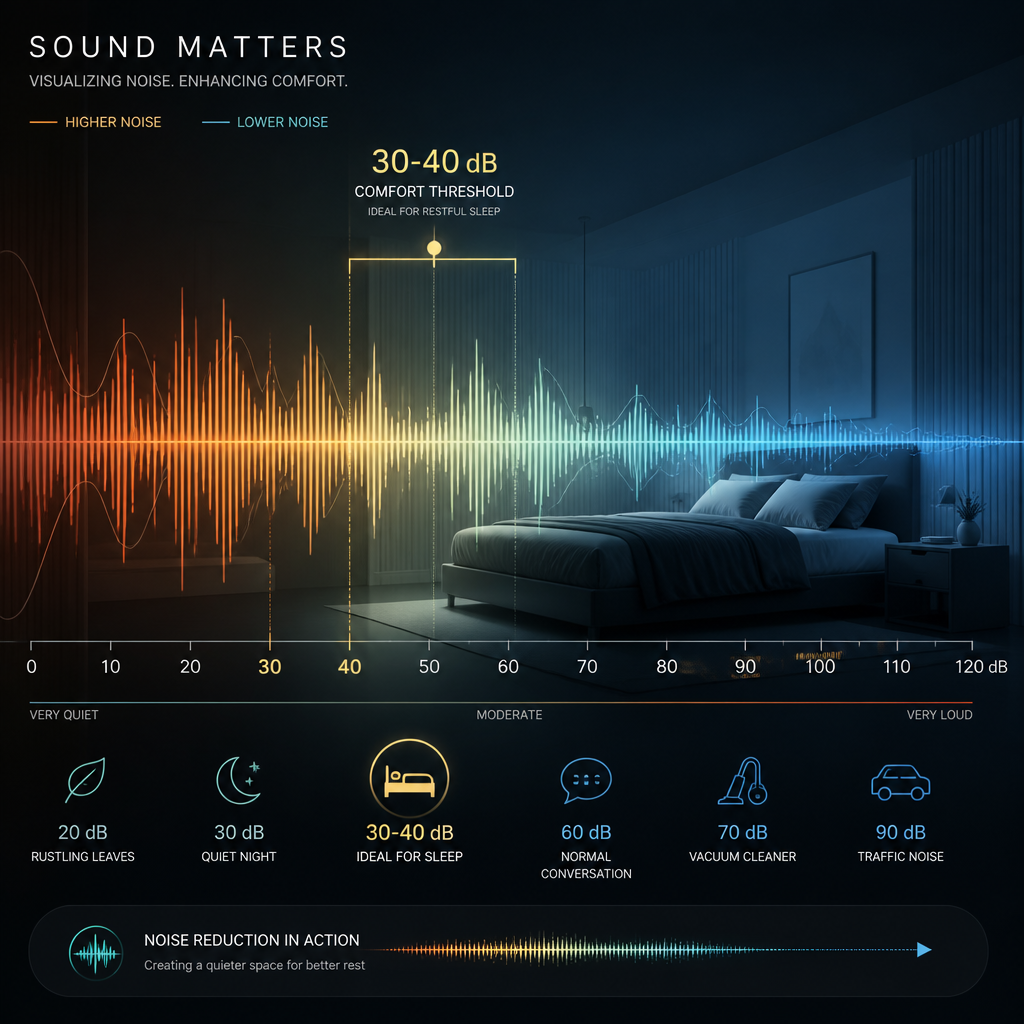
To understand why ear plugs help, you need to understand what noise actually does to sleep architecture. Sleep isn’t a single state. It cycles through light sleep (N1, N2), deep slow-wave sleep (N3), and REM sleep roughly every 90 minutes. Each stage serves a different biological purpose, and different noise types attack different stages.
Even if a noise doesn’t fully wake you, it can cause a microarousal, a brief shift to a lighter sleep stage that you won’t remember in the morning. A night with 20 microarousals feels like poor sleep even if you technically stayed in bed for eight hours. This is exactly the mechanism behind why light sleepers feel exhausted despite apparently sleeping through the night.
REM sleep, which governs emotional processing, creativity, and memory consolidation, is disproportionately affected by intermittent noise like traffic surges, distant sirens, or a partner’s snoring. Research shows that even moderate environmental noise at peak levels of 45 to 65 dBA reduces N3 deep sleep. The cascade effect means that if you’re knocked out of N3, you cycle back through lighter stages before reaching REM again, compressing your total REM time by morning.
Pro tip: If you wake up feeling foggy or emotionally flat despite a full night’s sleep, disrupted REM is often the cause. Blocking noise with a well-fitting pair of ear plugs is the simplest first step before exploring other interventions.
Most people assume they need genuinely loud noise to disrupt sleep. The research says otherwise. Sounds as low as 30 decibels have been shown to affect rest, and the WHO placed its nighttime noise threshold at around 40dB for building facades. A ticking clock, a distant TV, light street traffic: these are all capable of causing measurable sleep disruption in noise-sensitive individuals, and none of them would register as “loud” during waking hours.
Not all ear plugs deliver the same experience during sleep. The type of material, the form factor, and whether the plug requires a hard insertion process all affect comfort over an eight-hour period. Below is a direct comparison of the three main approaches.
| Type | Noise Reduction | Sleep Comfort |
|---|---|---|
| Disposable foam (single-use) | High NRR on paper, but fit varies each insertion and plugs expand unevenly, reducing real-world attenuation | Can cause ear canal pressure and soreness after a few hours. No tip-size options mean poor fit for narrower or larger canals |
| Reusable metal-bodied with memory foam tips (e.g., ATTENU8) | Consistent 32dB attenuation with a stable seal due to firm body and sized foam tips (XS, S, M) | Low-profile concave design reduces pillow pressure. Memory foam tips conform to the ear canal shape and stay put through the night |
| Acoustic filter plugs (e.g., Loop, Flare) | Lower attenuation, typically designed to preserve sound quality rather than maximize noise reduction. Better suited for concerts than sleep | Comfortable for short durations. Less suited for extended wear due to rigid body and higher insertion depth requirements |
The design priorities are fundamentally different between sleep-focused ear plugs and acoustic/concert plugs. If you’re buying ear plugs primarily for sleep, maximum noise reduction and all-night comfort matter far more than preserved audio fidelity. A product designed to let you hear music clearly at a concert is solving the wrong problem for a light sleeper in a noisy bedroom.
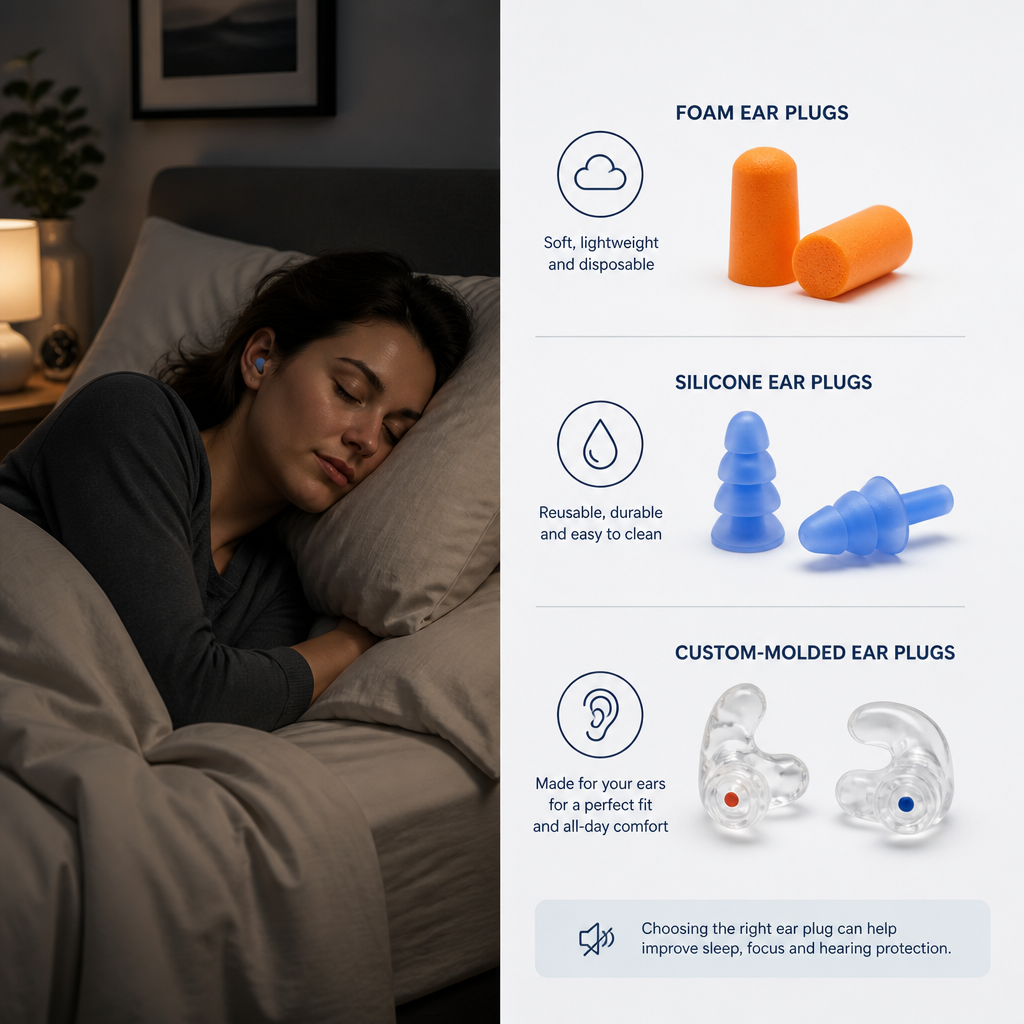
Numbers on packaging can feel abstract. Here’s what 32dB attenuation translates to in practice. Heavy urban traffic outside a closed window typically registers at around 65 to 70dB inside a bedroom. A snoring partner produces roughly 50 to 60dB. With 32dB of noise reduction, that traffic comes down to the 33 to 38dB range, sitting comfortably below the critical 40dB threshold where sleep disruption becomes consistent.
For snoring, 32dB reduction takes a 55dB snore to approximately 23dB, roughly the level of a whisper in a quiet library. The difference in sleep continuity is significant. A noise level that was triggering arousals every 20 minutes becomes inaudible enough to sleep through.
The NRR (Noise Reduction Rating) printed on a product is tested under laboratory conditions with a perfect seal. In real use, a single-use foam plug that isn’t compressed and inserted correctly, or that shifts when you roll over, can lose half its rated attenuation or more. This is why fit consistency is the most important variable for real-world sleep protection.
A firm, machined aluminium body holds its shape precisely. Combined with correctly sized memory foam tips, it creates a repeatable seal every night without the rolling and insertion technique that single-use foam requires. For a light sleeper who inserts ear plugs at 10pm and wakes at 6am, that plug needs to perform consistently for eight hours across multiple sleep positions. Disposable foam rarely achieves this.
Pro tip: If you’ve tried foam earplugs before and found they fall out or become uncomfortable overnight, the issue is almost certainly fit rather than your ears being “unusual.” Try a size down on memory foam tips. Most people with smaller-diameter ear canals end up needing XS or S rather than the default medium size.
The environmental and financial case for reusable ear plugs is straightforward, but the practical performance case is equally strong and less often discussed. Disposable foam plugs, used every night, represent a recurring purchase cycle with no improvement in product quality over time. You’re replacing the same product repeatedly rather than investing in one that improves with the right fit.
Reusable ear plugs with replaceable foam tips change this equation. The structural component, the metal body that houses the tips and maintains the shape, doesn’t wear out on the timescale of the foam tips. Replacing only the tips every six to eight weeks means the core fit and performance remain consistent, and the cost per night drops substantially over a year of use. Beyond cost, the waste reduction is measurable: a single reusable pair replaces hundreds of disposable foam plugs annually.
A common objection to reusable ear plugs is hygiene. This is a legitimate concern with cheaper, hard-to-clean designs. It isn’t a problem with a smooth metal body that can be wiped clean and tips that are scheduled for regular replacement anyway. The aluminium surface doesn’t harbor bacteria the way porous materials do, and the replaceable tip model means the surface that actually contacts your ear canal is refreshed every six to eight weeks regardless.
For regular use, wipe the metal body with a damp cloth after each use. Store them in a case rather than loose in a drawer. Replace the memory foam tips on schedule rather than waiting until they’ve visibly degraded. These three habits cover the full hygiene requirement for long-term safe use.
The research on ear plugs and sleep quality was largely conducted on ICU patients because that’s where sleep disruption is most severe and most measurable. But the mechanisms identified, noise-triggered arousals, REM sleep compression, and accumulated sleep debt, apply directly to everyday situations that many people dismiss as “just normal life.”
Some people cycle through lighter sleep stages more frequently or have a lower arousal threshold. For these individuals, noise at levels that a heavier sleeper wouldn’t notice can cause repeated arousals across a single night. Ear plugs for sleep quality research consistently identifies this group as having the strongest measurable benefit from noise reduction, precisely because there’s more disruption to eliminate.
City bedrooms, apartments near busy roads, and hotel rooms during travel all present noise environments that exceed the sleep-disruption threshold. Traffic noise, HVAC systems, neighboring rooms, and early-morning deliveries all create intermittent noise events. These are exactly the conditions where a consistent 32dB seal changes the subjective experience of sleep from fragmented to continuous.
Snoring is one of the most common and most under-addressed causes of poor sleep for people who don’t snore themselves. The noise profile of snoring is irregular, which makes it more disruptive than consistent background noise because the brain cannot habituate to it. Ear plugs that maintain a seal through the night, including during position changes, address this directly without requiring any change in behavior from the snoring partner.
For people who work in loud environments, construction, manufacturing, or other industries with sustained noise exposure, the priority shifts from comfort alone to genuine hearing protection combined with overnight recovery. A product that delivers 32dB attenuation at night, with a durable metal body designed for long-term use, bridges the gap between occupational hearing protection and daily sleep support.
You can explore ATTENU8’s full range of premium reusable ear plugs designed specifically for this kind of extended, all-day and all-night use.
Both. Blocking sound is the mechanism, and improved sleep quality is the measurable outcome. Multiple randomized controlled trials using polysomnography, objective brain-wave monitoring, have shown that ear plugs reduce nighttime arousals and protect REM sleep in participants exposed to environmental noise. The subjective experience of sleeping better reflects a real change in sleep architecture, not just a perception of quietness.
Yes, with appropriate hygiene practices. The main risks associated with regular ear plug use are earwax impaction if the plugs push wax deeper into the canal, and ear canal irritation from poorly fitting or unclean plugs. Using a metal-bodied plug with replaceable memory foam tips and cleaning the body regularly eliminates most of these risks. Many sleep specialists recommend ear plugs as a first-line, non-pharmacological sleep intervention precisely because they are safe for nightly use.
The goal is to bring your sleeping environment below approximately 30 to 40dB, the range where sleep disruption becomes consistent. If your bedroom sits at around 60 to 70dB due to traffic or a snoring partner, you need roughly 25 to 35dB of effective attenuation. A well-fitted 32dB plug achieves this for most real-world noise environments. At extreme noise levels above 65dBA, even high-NRR plugs begin to show limitations, which is why a proper seal matters more than chasing the highest rated number.
Yes, and this is one of the clearest use cases the research supports. Snoring produces irregular, intermittent noise that the brain cannot tune out the way it can with consistent background sound. This irregularity makes it particularly effective at triggering arousals. A well-sealed ear plug with 32dB of attenuation brings most snoring below the arousal-triggering threshold, allowing you to cycle through sleep stages normally. The key is a seal that holds through position changes, which is where memory foam tips sized correctly to your ear canal outperform one-size-fits-all foam plugs.
Concert or acoustic ear plugs, such as those marketed by brands like Loop or Flare Audio, are engineered to preserve sound fidelity while reducing volume. This is the opposite requirement from sleep. For sleep, you want maximum attenuation across all frequencies, with no concern for audio clarity. Concert plugs typically deliver lower attenuation and are optimized for short-duration wear. Sleep plugs need to be comfortable over eight or more hours, remain in place during movement, and provide the highest practical noise reduction rather than a flat frequency response.
Most people adapt within three to five nights. The first night or two may feel slightly unusual due to the increased awareness of your own breathing and heartbeat that comes with effective noise blocking. This fades quickly. The adjustment period is shorter with a correctly fitted plug because discomfort is the main reason people abandon them early. Starting with the smallest tip size that creates a good seal, rather than defaulting to the largest, tends to make the adaptation faster and more comfortable.
Have you found that ear plugs have changed how you sleep, or do you have questions about fit and noise reduction that weren’t covered here? Share your experience in the comments below.

