


 0
0

Most people assume earplugs work by stuffing something soft into their ear canal and hoping for the best. That assumption explains why so many people roll a cheap foam plug into their ear, watch it spring back out, and decide earplugs simply “don’t work for them.” The truth is that metal earplugs noise reduction is not a marketing claim but a measurable acoustic outcome rooted in materials science and the physics of how sound energy travels, reflects, and dissipates. Understanding the design science behind an aluminium-bodied earplug tells you exactly why rigid shell construction outperforms traditional foam bodies on almost every performance dimension that matters for sleep, travel, and sustained hearing protection.
| Key Insight | Explanation |
|---|---|
| Rigid bodies block more sound at the structural level | Analytical acoustic models show that rigid earplugs achieve sound transmission loss values not practically reachable through soft foam alone, because a rigid shell presents a near-impenetrable barrier to airborne sound. |
| A single leak destroys attenuation | Research shows an ill-fitting earplug can lose roughly 18dB of transmission loss compared to a properly sealed one. Fit quality is as important as material choice. |
| The aluminium body adds a secondary attenuation stage | Sound energy that passes through the memory foam tip must then travel through or around the metal shell before reaching the ear canal. This extra barrier contributes measurable additional reduction. |
| Memory foam tips create the primary acoustic seal | The soft tip conforms to the unique contours of each ear canal. The aluminium body holds the tip in optimum position, improving seal consistency insertion after insertion. |
| NRR figures are laboratory ratings and require real-world adjustment | OSHA and NIOSH both recommend derating published NRR figures because real-world insertion is never as controlled as lab conditions. A design that actively supports correct insertion recovers much of that gap. |
| Concave shell geometry serves an acoustic function | A concave aluminium surface creates a small resonance chamber at the earplug face. Sound energy entering this space undergoes additional dissipation before it reaches the foam seal. |
| Durability keeps attenuation consistent over time | Traditional foam earplug bodies degrade with each use, compressing less effectively and sealing less reliably. An aluminium body maintains its geometry indefinitely, so only the replaceable foam tip changes. |
Sound is mechanical energy. It travels as pressure waves through air, and those waves lose energy only when they encounter resistance: a change in medium, a surface that absorbs or reflects them, or a path that forces them to do extra work. An earplug’s entire job is to introduce enough resistance in the ear canal to reduce the amplitude of those waves before they reach the eardrum.
The material of the earplug body determines how much of that resistance is structural. Soft foam absorbs sound by increasing air resistance inside its cell structure, converting wave energy into small amounts of heat as the wave is forced through hundreds of tiny pockets of air. That mechanism works, but it has a ceiling. The foam itself is not a rigid barrier; sound energy can still pass through it, particularly at lower frequencies.
A metal body operates on a different principle. Aluminium is several orders of magnitude denser than polyurethane foam. When a sound wave hits a dense rigid surface, the acoustic mismatch between air and metal is so large that most of the wave’s energy is reflected rather than transmitted. The small fraction that does transmit through the metal must then work against the material’s stiffness before it can continue its journey toward the ear canal. This is why earplug design science increasingly points toward rigid outer structures as a meaningful performance upgrade over soft-only designs.
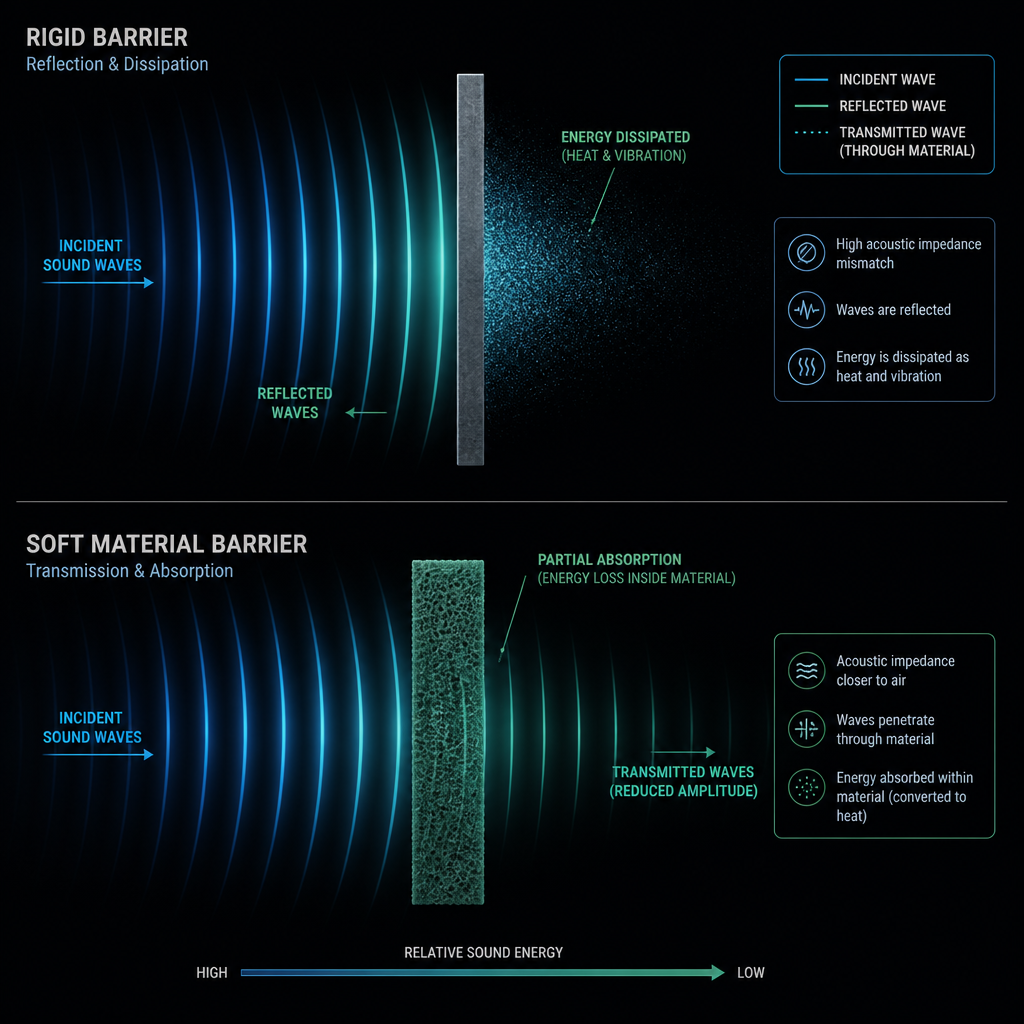
The technical term for the resistance a medium offers to sound propagation is acoustic impedance. When sound travels from a low-impedance medium (air) to a high-impedance medium (aluminium), the impedance mismatch causes the majority of the wave’s energy to reflect back at the boundary rather than pass through. This is not a design opinion; it is a consequence of the wave equation applied at material boundaries.
A soft foam earplug has an acoustic impedance that is closer to air than aluminium is. That means less reflection and more transmission through the body of the plug at the air-to-plug boundary. An aluminium body creates a far larger impedance mismatch, reflecting significantly more energy before that energy can propagate deeper.
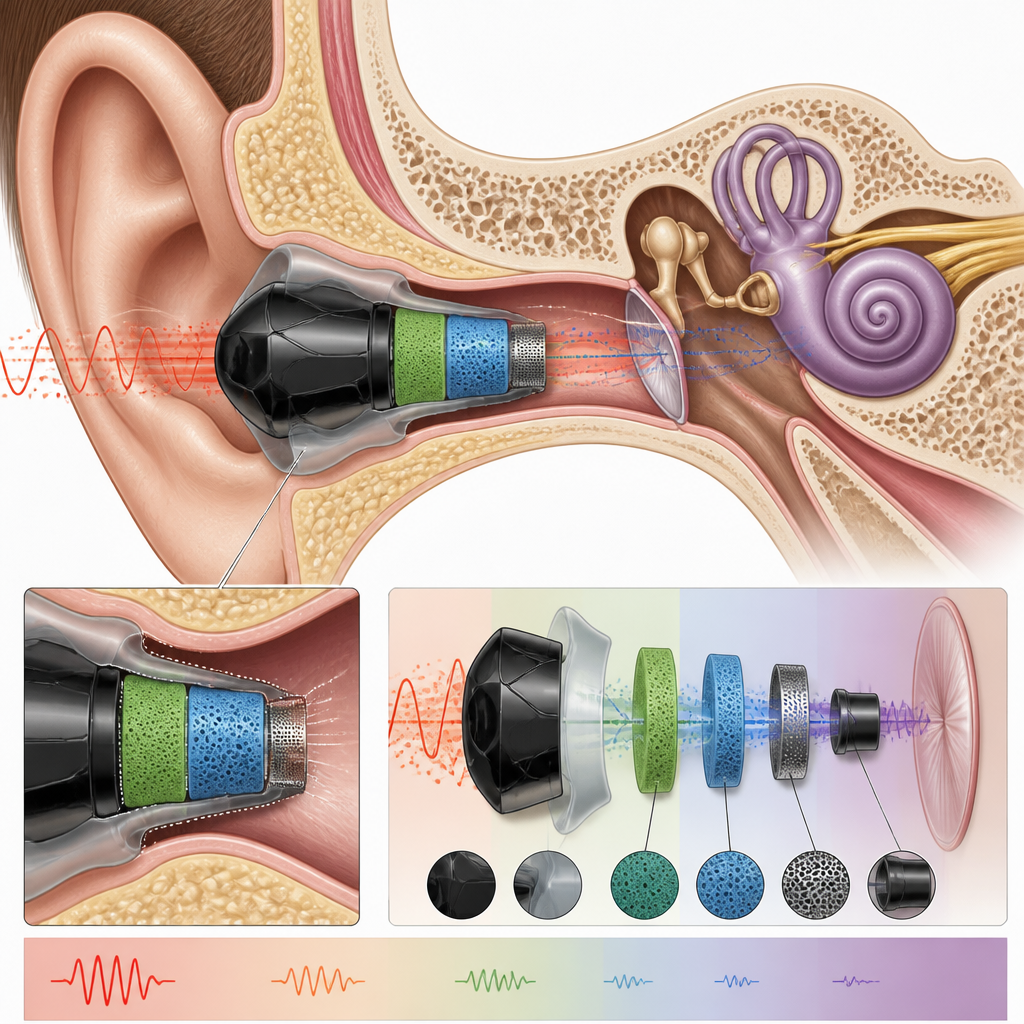
The practical result is that the aluminium shell acts as a first barrier while the memory foam tip handles the acoustic sealing function inside the ear canal. These are two distinct mechanisms operating in sequence. Neither does the other’s job; both contribute to the total attenuation the system delivers.
The concave face geometry of an aluminium earplug body is not only ergonomic. A concave surface facing the noise source creates a small bounded air volume between the outer face of the plug and the immediate environment. Sound energy entering this space reflects back and forth between the concave walls before encountering the foam tip behind it. Each reflection represents energy that does not make it cleanly to the foam seal, adding an extra dissipation step that a flat or convex foam body simply does not provide.
The most underappreciated variable in earplug performance is not the foam hardness or the NRR label. It is how well the plug’s geometry supports a consistent, repeatable seal every single time the wearer inserts it.
Published noise reduction ratings are measured under controlled laboratory conditions with trained subjects inserting earplugs with careful technique. Real-world use is messier. Research on earplug acoustics consistently shows that a leaking seal is the single largest cause of attenuation failure in practice. An ill-fitting earplug can lose a substantial portion of its rated transmission loss relative to a properly sealed configuration, simply because air gaps around the plug create a direct bypass path for sound waves.
This is the reason that earplug design matters as much as earplug material. A soft foam body that changes shape slightly with each compression-and-release cycle will eventually stop sealing as consistently as it did when new. The seal degrades not because the foam stops being foam, but because its mechanical recovery weakens with use.
An aluminium body solves the seal problem by separating two functions that traditional foam plugs force a single material to perform simultaneously. The rigid shell handles structural positioning inside the ear canal: it does not compress, does not deform, and does not fatigue. The memory foam tip, attached to that rigid anchor, handles conforming to the unique contours of the canal wall. Because the foam tip has only one job, it can do that job better. And because it attaches to a stable metal body rather than being compressed from both ends, it expands against the canal wall in a more controlled and consistent manner.
Pro tip: To get the most consistent seal from a metal-bodied earplug, gently pull the outer ear upward and back before insertion. This straightens the ear canal and allows the foam tip to expand against a flat, unobstructed surface rather than a curved one, improving both comfort and acoustic seal quality.
Regulatory bodies including OSHA recommend derating published NRR values by 50 percent for real-world exposure estimates, because the gap between lab conditions and actual use is that significant. NIOSH similarly recommends substantial derating for foam earplugs used in occupational settings. A design that actively helps the wearer achieve correct fit every time recovers a meaningful portion of that derated performance. Over the course of a full night’s sleep or an eight-hour shift in a noisy environment, that consistency difference compounds into substantially better hearing protection.
Breaking down the aluminium earplug body’s acoustic contributions into discrete mechanisms makes the design logic clear. There are three distinct mechanisms at work, each verified by materials physics.
The outer aluminium shell presents a high-impedance surface to incoming sound waves. At the air-to-metal boundary, a significant proportion of wave energy is reflected back toward the noise source rather than transmitted through the plug body. This is a passive, physics-driven attenuation stage that requires no special fit technique from the wearer.
Sound transmission through a solid material decreases as the material’s mass and stiffness increase. Aluminium’s density and stiffness mean that the small fraction of energy that does cross the air-to-metal boundary encounters significant resistance as it attempts to travel through the shell thickness. Analytical models of rigid earplug designs confirm that structurally rigid materials achieve transmission loss values far beyond what soft-body designs can reach at equivalent thicknesses.
The aluminium body acts as a precision insertion tool. Because it does not compress during fitting, it positions the foam tip at a repeatable depth and angle within the ear canal. This controlled positioning means the tip expands against the canal wall consistently, without the angle variance that affects soft-foam-only plugs where the entire body deforms under finger pressure. The outcome is a tighter acoustic seal with less variation between uses.
Pro tip: Replace the memory foam tips on a metal-bodied earplug every 6 to 8 weeks under regular daily use. The aluminium body never degrades, but the foam tip gradually loses its elastic recovery. A fresh tip on a rigid body delivers the same seal quality as the very first day of use, something a traditional foam earplug body cannot replicate.
| Design Type | Acoustic Mechanism | Key Performance Limitation |
|---|---|---|
| Traditional disposable foam | Foam absorbs sound via air resistance within cell structure, converting wave energy to heat. Entire body compresses to form seal. | Body deformation during insertion varies seal depth and angle. Cell structure degrades with repeated compression. Single material must handle both insertion mechanics and acoustic sealing simultaneously. |
| Rigid aluminium body with memory foam tips | Metal shell reflects high-impedance boundary energy. Foam tip creates conforming canal seal. Concave shell geometry adds resonance-based dissipation stage at the plug face. | Tip replacement required every 6 to 8 weeks under daily use. Correct tip size selection matters for initial fit, though multiple tip sizes (XS, S, M) address most canal geometries. |
| Soft silicone or elastomer bodies | Flexible body conforms to canal shape over time. Some acoustic absorption within the material. Lower acoustic impedance than metal means less reflective boundary effect. | Acoustic impedance closer to air than aluminium, limiting the reflective contribution of the body itself. Seal consistency depends heavily on canal shape compatibility and custom fit. |
The noise reduction rating (NRR) is a single-number laboratory measure that the U.S. Environmental Protection Agency requires on hearing protector packaging sold in the United States. A rating of 32dB represents the top end of what hearing protection devices typically deliver under controlled test conditions. The range for existing hearing protectors runs from approximately 0 to 30dB for most categories, with only a small number of well-engineered products exceeding that range.
What 32dB means in practical terms: if the ambient noise level at your ear is 92dB (a moderately loud construction site, an aircraft cabin, or a loud urban environment), an earplug rated at 32dB reduces the level entering your ear to approximately 60dB, which is roughly the equivalent of a normal conversation. For sleep, that difference means the difference between lying awake listening to traffic or a snoring partner and actually getting restorative rest.
OSHA calculates worker noise exposure by derating the NRR by 50 percent across all hearing protector types. NIOSH also recommends significant derating for foam earplugs in occupational settings, because the gap between carefully controlled laboratory insertion and actual field use is substantial. A 32dB-rated plug derated by 50 percent delivers an estimated real-world reduction of roughly 16dB. That is still meaningful protection, but it underlines why achieving and maintaining a good seal on every single use is the most important variable in actual protection performance.
An aluminium-bodied design with consistent geometry directly addresses this gap. Because the metal body positions the tip at the same depth and angle every time, real-world attenuation is closer to laboratory attenuation than it is with variable-geometry foam-only designs. The design is doing part of the insertion work for you.
NRR is a single number, but noise is not a single frequency. Foam works better at higher frequencies and is often less effective at low-frequency rumbles, which is why traffic noise, aircraft engine hum, and bass-heavy music are the sounds people complain foam plugs fail to block adequately. The mass and stiffness of an aluminium shell provide better low-frequency attenuation than foam alone, because mass law in acoustics states that heavier, stiffer structures resist low-frequency vibration more effectively. This is the reason metal-bodied earplugs often feel more effective against the frequencies that bother light sleepers most.
ATTENU8’s aluminium earplugs are engineered with all three of these mechanisms working together: the rigid shell’s high acoustic impedance, the concave body geometry, and the conforming memory foam tip seal. The result is a how earplugs work story that is quite different from the disposable foam roll-and-insert that most people have tried and found inadequate. For anyone serious about consistent, repeatable noise reduction for sleep, travel, or hearing protection in loud environments, the physics of the design are not incidental. They are the product.
The aluminium body contributes acoustic attenuation that soft foam alone cannot deliver. The rigid shell creates a high acoustic impedance boundary that reflects sound energy, and it acts as a stable insertion tool that improves seal consistency. A properly seated metal-bodied earplug with a good foam tip seal will generally outperform a disposable foam earplug inserted with typical technique, particularly at lower frequencies where foam is acoustically weakest.
The concave face creates a small bounded air volume between the earplug surface and the sound source. Sound energy entering that space reflects between the curved walls, dissipating before reaching the foam tip. It also gives the earplug a larger effective acoustic surface area than a flat or convex face, which increases the proportion of incident energy that encounters the plug rather than diffracting around it.
Acoustic impedance is a measure of how much resistance a material offers to sound wave propagation. When sound moves from a low-impedance medium like air to a high-impedance medium like aluminium, most of the wave energy reflects at the boundary rather than passing through. The larger the impedance mismatch, the more energy is reflected. Aluminium has a much higher acoustic impedance than polyurethane foam, which is why the metal shell provides a qualitatively different type of attenuation than the foam tip alone.
NRR ratings are measured under laboratory conditions with trained subjects following precise insertion protocols. Real-world use produces variable results because most people do not insert earplugs as consistently as lab conditions require. OSHA recommends a 50 percent derate for all hearing protectors; NIOSH makes similar recommendations for foam earplugs. A metal-bodied design that supports consistent insertion reduces the performance gap between lab and real-world use, meaning the effective derate is smaller in practice.
Under regular daily use, memory foam tips should be replaced every 6 to 8 weeks. The aluminium body retains its geometry indefinitely, so only the tip changes. This matters acoustically because the seal quality of a fresh foam tip is consistently higher than that of a compressed and degraded one. With disposable foam earplugs, the entire plug body degrades together, and the acoustic performance decline is not visible until the plug noticeably fails to expand. With a metal-bodied design, replacing the tip restores full acoustic performance immediately.
Comfort during sleep depends on earplug profile and tip softness, not body material in isolation. A low-profile aluminium body that sits flush with or slightly inside the outer ear, paired with a soft memory foam tip, can be significantly more comfortable for side-sleeping than a protruding foam roll that presses against the pillow. The rigid body does not compress under pillow pressure in a way that creates canal pressure, which is one of the common complaints about large disposable foam designs used for sleep.
Have you noticed a difference between metal-bodied and foam-only earplugs in your own experience with sleep or hearing protection? Share what you found in the comments.
If you have spent any time researching premium reusable ear plugs, you have almost certainly landed on both ATTENU8 and Flare Audio as the two most credible metal-bodied options. The ATTENU8 vs Flare Audio question is not trivial. Both products ditch disposable foam. Both use metal bodies. Both cost considerably more than a box of standard pharmacy ear plugs. But once you get past those surface similarities, the differences become sharp and, depending on your use case, decisive. This comparison cuts through the marketing and tells you exactly which product earns its place in your ears.
| Key Insight | Explanation |
|---|---|
| ATTENU8 is designed first for sleep and comfort | Its concave aluminium body sits flush with the ear, reducing pillow pressure for side sleepers. Flare Audio’s ISOLATE uses a cylindrical body that protrudes further. |
| ATTENU8 delivers approximately 32dB noise reduction (SNR 32) | Flare Audio ISOLATE is CE certified at SNR 30dB for the aluminium version. Both use metal bodies, but ATTENU8’s verified rating is higher. |
| Flare Audio’s roots are in music and concert use | ISOLATE was originally pitched at audiophiles, concert-goers, and motorcyclists. ATTENU8 was engineered specifically for sleep, travel, and noise-sensitive daily wear. |
| Tip replacement cycles differ | ATTENU8 tips need replacing approximately every 6-8 weeks. Both products are reusable and only require foam tip replacement, not full product replacement. |
| SNR and NRR are not the same standard | SNR (European) values run approximately 3-5dB higher than NRR (US) for equivalent products. Comparing raw numbers across different standards misleads you. |
| Metal bodies outperform foam on low-frequency noise | Both products reduce bass-heavy noise sources, such as traffic rumble and machinery hum, more effectively than equivalent-rated foam-only ear plugs. |
| ATTENU8 comes with three tip sizes plus a side-sleeper foam cap | XS, S, and M tips allow a proper seal for different ear canal sizes, plus an optional bottom foam cap specifically addresses pillow-compression discomfort. |
This is where most comparisons go wrong: they treat ATTENU8 and Flare Audio as direct substitutes. They are not. The two products emerged from different design briefs and they show that in every material choice.
Flare Audio launched its ISOLATE range with a music and sound-fidelity audience in mind. The original pitch targeted concert-goers, musicians, motorcyclists, and audiophiles who wanted noise reduction without the muffled, frequency-distorted experience that standard foam ear plugs produce. That audience cares about tonal character during active listening. They wear ear plugs in short, intense bursts, not across eight hours of sleep.
ATTENU8 was engineered for the opposite scenario. The design priority is all-night comfort combined with high attenuation. Light sleepers, frequent travellers, and noise-sensitive individuals who need to stay asleep for hours are the target. The product also serves professionals in construction, manufacturing, and similar loud environments who need reliable protection across a full shift. Those two audiences have very different definitions of what “works.”
Numbers dominate earplug marketing, and they are frequently misread. Here is what the verified figures actually say.
ATTENU8 achieves approximately 32dB noise reduction, certified to CE standard BS EN 352-2. That places it at the high end of what most sleep-focused ear plugs claim, and it is comparable to what professional hearing protection products deliver in industrial settings. The rating is achieved through the interaction between the dense aluminium body and the memory foam tip seal. Low frequencies carry the most energy, and traditional foam ear plugs absorb that energy poorly. The change in density between the metal core and the memory foam addresses that gap more effectively than foam alone.
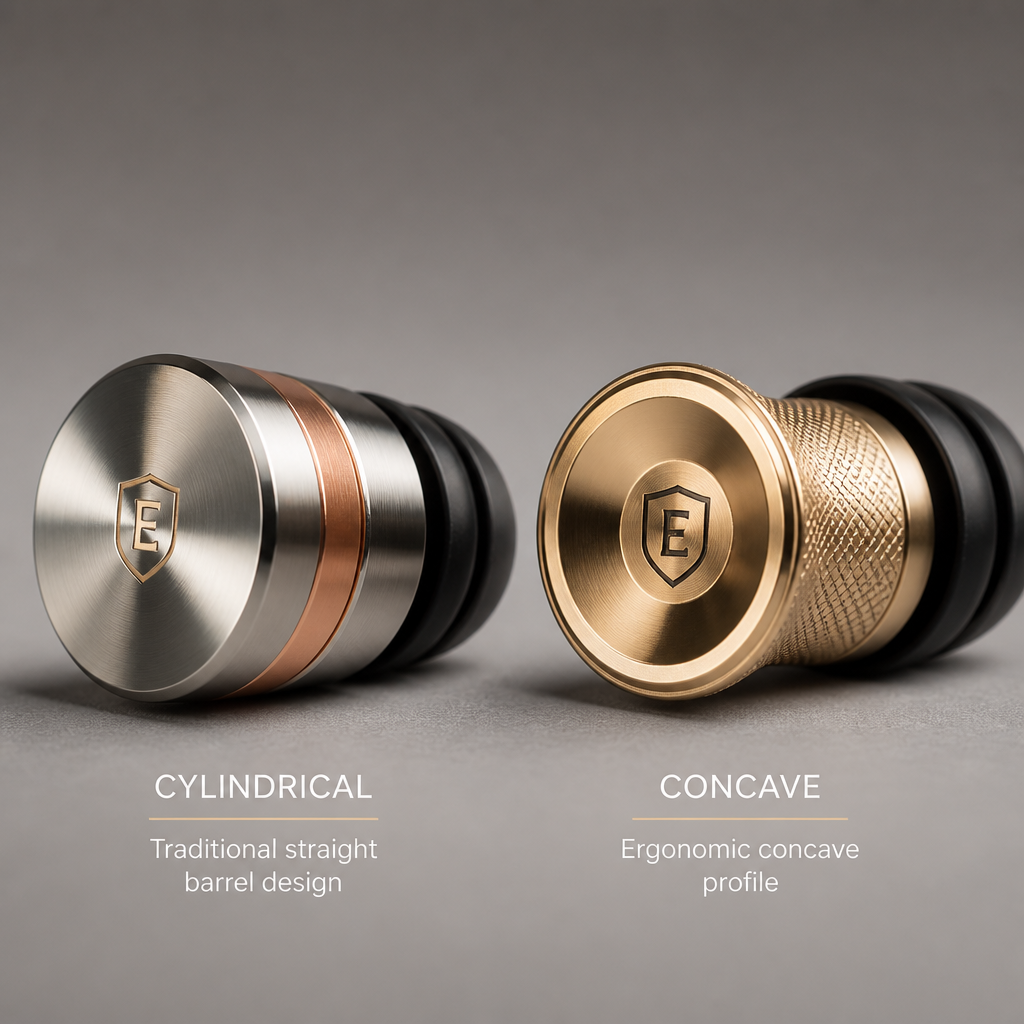
Flare Audio’s ISOLATE aluminium version is CE certified at SNR 30dB. Flare Audio also produces a titanium variant. The ISOLATE relies on a solid metal body with no acoustic filter, meaning the tip seal is doing almost all of the attenuation work. When the seal is good, the performance is strong. When the seal is imperfect because the cylindrical body does not seat correctly in a given ear shape, real-world attenuation drops meaningfully below the certified figure.
Pro tip: When comparing earplug noise reduction claims, always check whether the figure is an NRR (US standard) or SNR (European standard). SNR values run approximately 3-5dB higher than NRR values for the same product. Direct numerical comparisons between brands using different rating systems are misleading. Both ATTENU8 and Flare Audio use SNR, so their figures are directly comparable on that measure.
A 32dB rated product with a well-engineered memory foam seal will outperform a theoretically higher-rated product with a poor or inconsistent tip fit. Certified attenuation assumes a correct, consistent insertion. Real-world performance follows the fit, not the label.
Both products use metal bodies, and both benefit from that choice. Metal resists compression, maintains dimensional accuracy over thousands of insertion cycles, and does not degrade from contact with skin oils or cleaning agents. The anodised aluminium body on ATTENU8 is additionally resistant to scratches. On durability, both products are a genuine step forward from anything made of plastic or compressible foam.
ATTENU8 uses a concave aluminium body. The outer face curves inward, which means it nestles into the concha of the ear rather than projecting outward. That single design decision changes the product’s entire comfort profile for sleeping and prolonged wear. A concave surface distributes pillow pressure across a wider area when you roll onto your side. A cylindrical body, like the one Flare Audio uses on the ISOLATE, creates a point-load against the pillow and the outer ear. For short wear at a concert or during a commute, that is manageable. Across eight hours of sleep, it is the reason most people abandon the plug before morning.
ATTENU8 also made a specific choice to produce a smaller and lighter profile compared to other metal ear plugs on the market. The dimensions with foam tip attached are 21mm height by 10mm width, and the total weight is approximately 2 grams. That combination of low profile and low weight directly addresses the side-sleeper problem that no amount of noise reduction rating can compensate for.
ATTENU8 includes an optional memory foam cap that attaches to the bottom of the metal body. This cap is specifically designed for side sleepers, providing an additional soft buffer between the earplug body and the pillow surface. Flare Audio does not offer an equivalent. For side sleepers, this is a meaningful differentiator rather than a minor accessory.
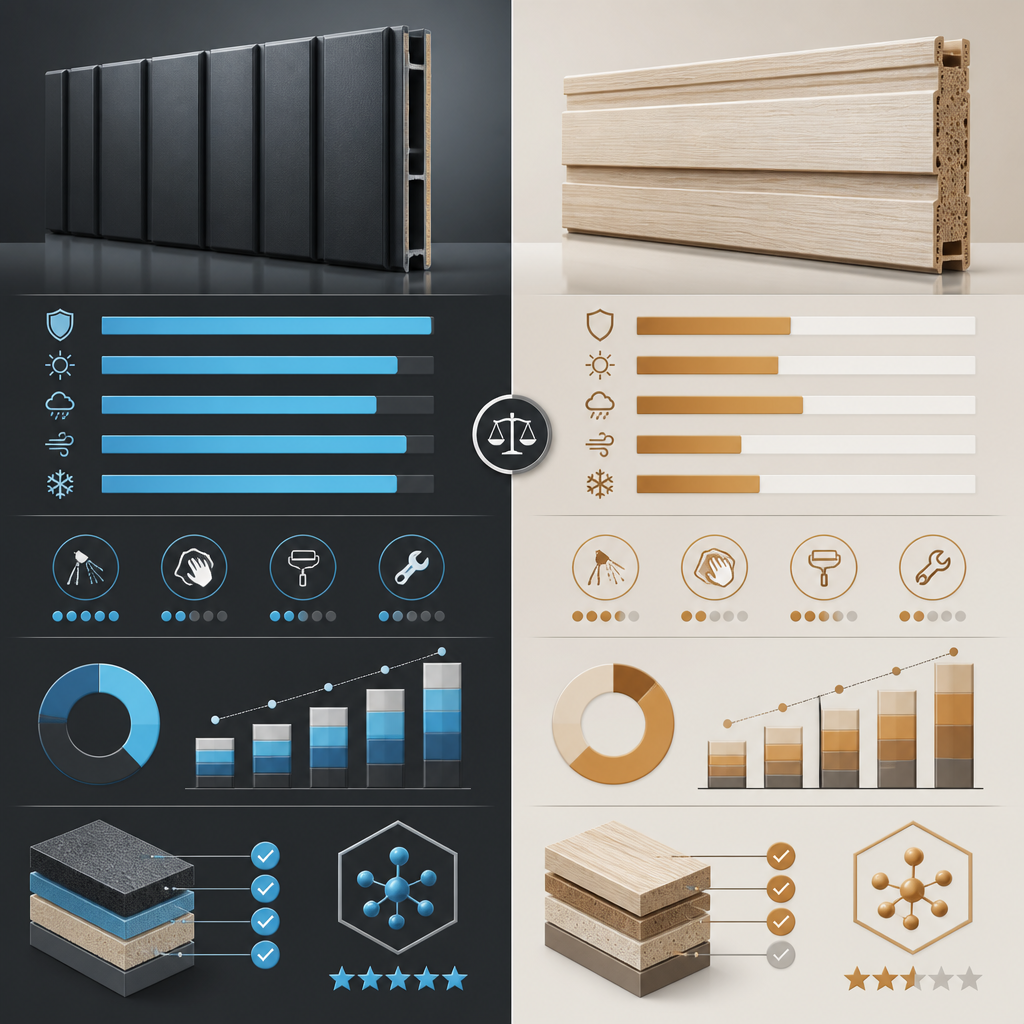
Noise reduction rating tells you the maximum potential attenuation under ideal conditions. Comfort determines whether you keep the ear plugs in long enough for that attenuation to matter. For sleep use, comfort is the primary product requirement, not a secondary one.
ATTENU8 ships with three distinct foam tip sizes: XS, S, and M. Ear canal diameter varies meaningfully between individuals, and an ear plug that fits well in one person’s ear canal will leak sound in another’s. A tip that is too small fails to seal. A tip that is too large requires deeper insertion, which increases pressure and discomfort after a few hours. The correct fit creates a gentle seal at the outer portion of the ear canal without requiring forceful insertion. ATTENU8’s three-size system allows most users to find a fit that seals properly without over-insertion.
Flare Audio’s ISOLATE also includes multiple replacement foam tip options and the memory foam tips are described as thermo-reactive, softening with body heat to conform to the canal. Both approaches address the fit problem. The practical difference is that ATTENU8’s concave body means the outer profile stays closer to the ear regardless of tip size, which matters when any pressure is applied from outside.
ATTENU8 uses bio-compatible memory foam for its tips. This is relevant for nightly contact with skin across years of use. The foam is designed to minimise irritation during extended wear, and the wipe-clean coating makes hygiene maintenance straightforward. The metal body can be cleaned with soapy water. For a product used every night, material tolerances and cleaning ease are practical factors that matter more than they do for occasional-use products.
Pro tip: If you are new to metal-bodied ear plugs, start with the medium tip size unless you already know your ear canal runs small. Insert by squeezing the foam tip, sliding the plug gently into position, and allowing body heat to expand the foam to a seal. Do not force the metal body deep into the canal. The seal forms at the entrance to the canal, not deep inside it.
| Feature | ATTENU8 | Flare Audio ISOLATE (Aluminium) |
|---|---|---|
| Body material | Anodised aluminium (concave profile) | Aerospace-grade aluminium (cylindrical profile) |
| Noise reduction rating | SNR 32dB (CE certified BS EN 352-2) | SNR 30dB (CE certified EN 352-2:2020) |
| Tip sizes included | XS, S, M plus side-sleeper bottom foam cap | Multiple sizes of memory foam tips (four pairs included) |
| Primary design intent | Sleep, travel, noise-sensitive daily wear | Concerts, motorsports, loud workplaces |
| Side-sleeper suitability | Specifically designed for side sleeping, low-profile body | Cylindrical body creates pressure when lying on side |
| Tip replacement interval | Approximately every 6-8 weeks | Replacement tips available; interval not specified by manufacturer |
| Acoustic filter | No filter; solid metal and foam seal attenuation | No filter; solid metal and foam tip seal attenuation |
| Weight per plug | Approximately 2 grams | Aluminium version is lightweight; titanium version is marginally heavier |
Both products are reusable and both require only foam tip replacement rather than full product replacement. That shared characteristic already makes them dramatically more cost-effective over time than disposable foam ear plugs, where daily users replace them every one to two days at ongoing cost.
ATTENU8 foam tips are designed to be replaced approximately every 6-8 weeks under regular use. The metal body is indefinitely reusable. The anodised aluminium surface resists scratches and is unaffected by daily cleaning with soap and water. For a nightly user, that means roughly six to eight tip replacements per year, with the core product remaining in service for years. The running cost is the foam tip replacement sets, not the ear plug itself.
The ATTENU8 metal body is straightforward to clean with soapy water. The foam tips can be maintained with a damp cloth between replacement cycles. This matters for a product used in close skin contact every night. Ear canals produce wax, skin oils, and moisture. A product that cannot be cleaned properly will accumulate residue that degrades both hygiene and tip performance over time. The ATTENU8 design makes cleaning a two-minute task rather than a problem.
Flare Audio’s ISOLATE similarly uses replaceable memory foam tips and a metal body that can be cleaned. The maintenance approach is comparable in principle. Both products reward regular cleaning and tip replacement. Neither requires anything beyond basic care.
The honest answer to the ATTENU8 vs Flare Audio question is that the right product depends entirely on your primary use. Neither product is universally superior. But the use cases where each wins are clear.
ATTENU8 is the stronger recommendation for sleep. The concave body, low profile, light weight, optional side-sleeper foam cap, and SNR 32 rating combine to address the specific failure mode of every other earplug in this context, which is that users remove them during the night because of discomfort. Snoring is a mid-to-high frequency noise source that spikes unpredictably. 32dB of attenuation with a low-profile body that survives pillow compression is the specification that matters here, and ATTENU8 delivers it.
Flare Audio’s ISOLATE was built for exactly this scenario. High-energy short-duration wear, where the cylindrical body’s fit issues are not compounded by hours of side-lying pressure. The solid metal construction and SNR 30dB rating provide meaningful hearing protection in these environments. This is a legitimate use case where the ISOLATE performs well on its own terms.
For construction, manufacturing, and similar professional environments requiring sustained hearing protection across a full shift, ATTENU8’s higher attenuation rating and durable aluminium body are the better specification. A metal-bodied plug stored in a carry case arrives undamaged at the job site. A foam disposable stored in a work bag or pocket is compromised before it is even inserted. The SNR 32 rating is viable for environments where noise levels require high attenuation, and the all-day comfort profile means workers actually keep them in.
Aeroplane cabin noise runs in the 75-85dB range, with low-frequency engine drone as the dominant source. Both metal-bodied products handle low-frequency noise better than equivalent-rated foam-only ear plugs. ATTENU8’s compact carry case and low-profile body make it practical across a long-haul flight, including periods where you want to sleep against a seat or window.
ATTENU8 is certified at SNR 32dB and Flare Audio ISOLATE aluminium is certified at SNR 30dB, both under CE standards. Both figures use the same European SNR standard, making them directly comparable. ATTENU8’s certified attenuation is higher. In practice, real-world performance for both products depends heavily on achieving a correct foam tip seal, and ATTENU8’s concave body and three-size tip system make a consistent seal easier to achieve across a wider range of ear shapes.
Yes. The concave aluminium body is specifically designed for this. It sits flush with the ear rather than projecting outward, which distributes pillow pressure across a wider surface area instead of creating a point load. ATTENU8 also includes an optional memory foam cap for the bottom of the plug that provides additional cushioning for side sleepers. Multiple users confirm comfort during side sleeping, noting the metal body does not create the discomfort they expected.
Approximately every 6-8 weeks with regular use. The metal body is indefinitely reusable and only the foam tips require periodic replacement. This makes the ongoing cost of ownership significantly lower than disposable ear plugs, where daily users replace the entire product every one to two days.
The ISOLATE can reduce noise during sleep, but its cylindrical body becomes a limiting factor for most side sleepers. The body protrudes further from the ear than ATTENU8’s concave design, creating pressure discomfort when lying on a pillow. For back sleepers, this is less of a concern. For the majority of people who sleep on their side at least part of the night, the body shape causes enough discomfort to prompt removal before morning, which defeats the purpose.
Yes. Both ATTENU8 and Flare Audio ISOLATE use replaceable memory foam tips that create the acoustic seal in the ear canal. ATTENU8 includes XS, S, and M sizes plus a side-sleeper foam cap. Flare Audio ISOLATE includes four pairs of memory foam tips. Both products’ attenuation performance depends on achieving a proper tip seal, which is why having the right size option for your ear canal matters as much as the metal body specification.
ATTENU8 is the better choice for this specific scenario. Snoring produces mid-to-high frequency noise that can spike to high volumes unpredictably. ATTENU8’s SNR 32dB rating, low-profile concave body, and side-sleeper foam cap directly address the two reasons people abandon ear plugs during the night: insufficient noise blocking and physical discomfort from pillow pressure. The three foam tip sizes also make it likely that most users find a fit that seals properly without over-insertion.
For regular users, yes. The calculation changes quickly once you account for how often disposables need replacing. Daily users of disposable foam ear plugs replace them every one to two days at ongoing per-unit cost. A single pair of ATTENU8 with a few foam tip replacement cycles costs less across twelve months than most disposable habits, and the attenuation quality is higher. The aluminium body lasts for years. The running cost is just the foam tips every six to eight weeks.
Have you tried metal-bodied ear plugs for sleep or work? We would genuinely like to hear how they performed for you and what made the difference.
If you have ever woken up at 3 a.m. to find your earplugs on the pillow instead of in your ears, you are not alone. Earplugs falling out at night is one of the most common complaints among light sleepers, side sleepers, and anyone relying on hearing protection for rest. The frustrating part is that it rarely has one cause. Wrong size, poor insertion, sleep position, and worn-out tips all work against you simultaneously. This guide breaks down every reason it happens and gives you the practical fixes that actually work, so you can stop troubleshooting at 3 a.m. and start sleeping.
| Key Insight | Explanation |
|---|---|
| Wrong size is the most common culprit | Ear canals vary significantly in diameter and length, even between your left and right ear. A plug that is too small has no grip. A plug that is too large creates outward pressure that slowly expels it. |
| Poor insertion defeats any earplug | Foam tips must be compressed before insertion and held in place for 20 to 30 seconds while the foam expands. Releasing too early means the plug never seats properly. |
| Side sleeping multiplies the problem | Pillow pressure against the ear acts as a lever, gradually working a protruding earplug loose. Low-profile designs reduce this effect significantly. |
| Worn-out foam tips lose their grip | Memory foam tips that have been used too long lose elasticity. They stop expanding to fill the canal and simply slide out. Replacing tips every 6 to 8 weeks restores performance. |
| The metal body versus foam body difference matters | A rigid outer body keeps the earplug correctly positioned against the ear, whereas an all-foam plug can shift as a whole unit when you move. |
| Left and right ears often need different tip sizes | Most people assume symmetry, but asymmetric ear canals are common. Test each ear independently with different tip sizes before settling on one pair. |
| Insertion depth is not optional | A partially inserted earplug sits at the entrance of the canal where walls cannot hold it. The foam needs to be inside the canal, not perched at the opening. |
The reason most people cycle through earplug after earplug without solving the problem is that they treat it as a product issue when it is usually a fit issue. The earplug itself is rarely at fault. The combination of wrong size, wrong technique, and wrong earplug type for the sleep position is almost always what fails.
Ear canals come in a wide range of diameters, lengths, and curvatures. A standard one-size disposable plug is built around an average that does not accurately represent most individuals. If the plug is too small for your canal, it has nothing to grip against and slides out within the first hour. If it is too large, the foam generates outward pressure that the canal walls eventually push back against, slowly ejecting the plug over several hours. You wake up with it half out or gone entirely.
Jaw movement is a less obvious contributor. Grinding, clenching, or even normal jaw relaxation during sleep shifts the tissues around the ear canal. An earplug that was marginally positioned when you fell asleep can work loose by morning just from this movement alone.
Pro tip: If your earplug falls out consistently on the same side, that specific ear canal may be slightly smaller or differently shaped than the other. Try one tip size smaller on that side before assuming the whole pair needs replacing.
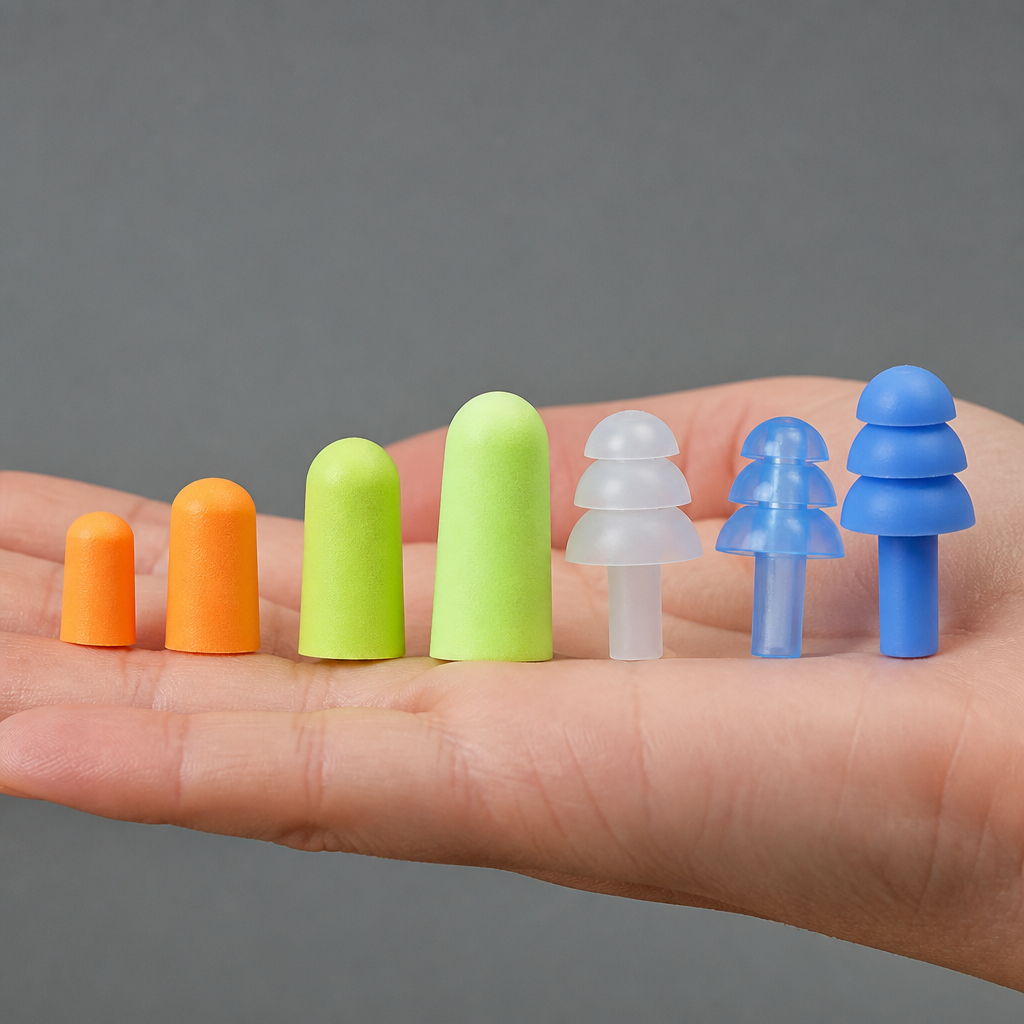
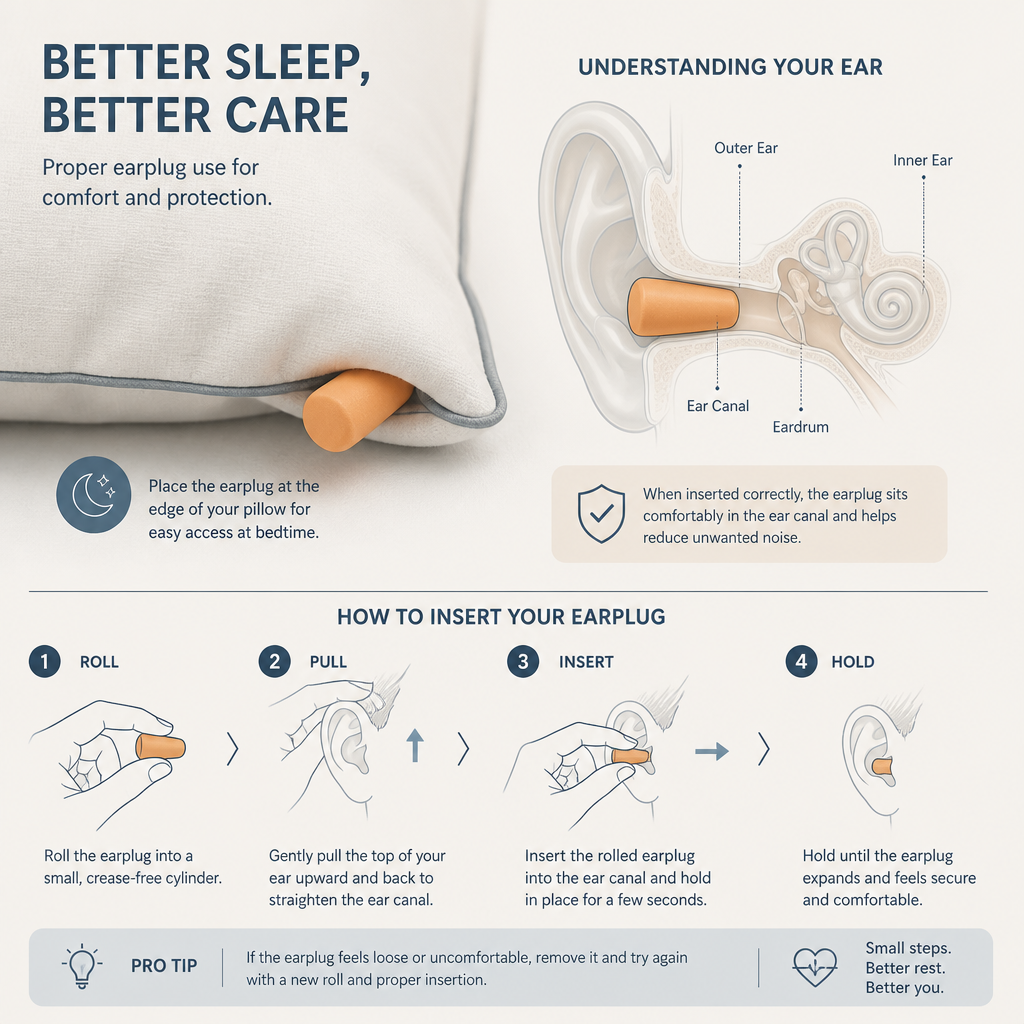
The single most effective intervention for earplugs that will not stay in is matching tip size to canal diameter. This sounds obvious but most people skip it because disposable foam plugs come in one size, and reusable options are often sold as one-size-fits-all. That is a product limitation, not a biological truth.
Insert the earplug with the tip you think is closest to your size. After insertion, gently tug the earplug backward. A correctly sized tip should offer moderate resistance, not slide out immediately but also not require significant force to remove. If it slides free with almost no resistance, go one size up. If removal feels uncomfortable or creates a strong vacuum sensation, go one size down.
Test each ear independently. Asymmetric ear canals are more common than most people realise. Your right ear may take a medium tip comfortably while your left ear needs a small. Using a product that includes multiple tip sizes, such as XS, S, and M options, is the only practical way to address this without spending money on custom moulds.
A properly sized earplug should feel snug without causing a pressure buildup sensation. There should be a noticeable but not uncomfortable reduction in ambient sound immediately after insertion. If the sound reduction feels weak and you can hear clearly without the plug being fully in, the tip is too small. If you feel pain or significant pressure within a few minutes, the tip is too large.
The fit of a hearing protector is critical. A poor fit, regardless of the product’s rated attenuation, means the wearer is not receiving the protection they expect. Sizing is not a secondary concern, it is the primary one.
ATTENU8 includes three pairs of memory foam tips in XS, S, and M with every unit specifically because canal variation between individuals, and between ears on the same person, is the rule rather than the exception. Explore the full ATTENU8 earplug range to see how the sizing system works in practice.
Pro tip: When testing tip sizes, do the test lying down on your side, not sitting upright. A fit that feels secure while you are upright can behave very differently once pillow pressure enters the equation.
Even the correctly sized earplug falls out if insertion is done poorly. This is the most fixable cause of earplugs falling out at night, and it is almost entirely a technique problem, not an equipment problem.
For memory foam tips, compress the tip between your fingers until it is as narrow as possible before inserting it. Then, reach your opposite hand over the top of your head and gently pull your outer ear upward and slightly backward. This straightens the ear canal and opens it for easier insertion. Insert the compressed tip with a slight rotating motion, pushing it in far enough that only a small portion remains visible. Then hold it in place for 20 to 30 seconds while the foam expands.
The holding step is where most people fail. Releasing the earplug before the foam has expanded means the plug was never anchored. It sits near the entrance to the canal rather than inside it, where the canal walls can grip it. A partially expanded plug has almost no resistance to movement.
A properly inserted earplug should sit with only a small portion visible at the entrance to the ear canal. If you can see most of the plug protruding from your ear, it is not inserted deeply enough. The foam body needs to be inside the canal, not balanced at the opening. When inserted correctly, you should notice an immediate and significant reduction in ambient sound, noticeably more than when the plug was sitting only partially in.
With a metal-bodied earplug like ATTENU8, the concave aluminium shell sits flush against the outer ear, giving you a clear tactile reference for correct positioning. The body does not shift as a whole unit the way an all-foam plug does, which makes maintaining insertion depth through the night considerably more reliable.

Side sleepers face a problem that back sleepers do not. When your ear presses into a pillow, any earplug that protrudes past the outer ear becomes a lever. The pillow pushes against the outer part of the earplug while the canal wall holds the inner part, and over several hours of sustained pressure the earplug slowly works its way out.
A bulky or high-profile earplug design amplifies this problem. The further the earplug extends past the ear, the greater the mechanical advantage the pillow has in pushing it loose. This is why low-profile earplug designs are not just a comfort preference for side sleepers, they are a functional requirement. An earplug that sits flush with the outer ear, or that uses a concave body designed to sit within the ear contour, dramatically reduces the leverage available to pillow pressure.
The ATTENU8 concave aluminium body is specifically shaped to sit within the natural contour of the outer ear rather than protruding from it. Bottom foam tips are included in the kit specifically for side sleepers, allowing the plug to sit closer to flush when lateral sleeping is the priority. For more detail on how sleep position interacts with earplug performance, see the ATTENU8 guide on memory foam versus silicone earplugs for side sleepers.
A softer pillow compresses around the ear rather than pushing against the earplug, which reduces the ejection force significantly. Some side sleepers find that a pillow with a contoured cutout or a pillow designed with a recessed area for the ear solves the problem entirely without changing earplugs. However, this is a workaround, not a fix. The correct earplug, correctly inserted and correctly sized, should not require a special pillow to stay in place.
Not all earplugs behave the same way at night. The type of earplug you choose has direct consequences for how reliably it stays in through movement, pressure, and hours of continuous wear.
| Earplug Type | Stay-in Performance for Sleep | Best Suited For |
|---|---|---|
| Disposable foam (all-foam body) | Poor to moderate. The entire plug can shift as a unit. Foam degrades quickly, losing grip. Requires fresh plug each night for reliable performance. | Occasional use, back sleepers who move minimally. |
| Reusable metal body with memory foam tips | Good to excellent. Rigid outer body anchors position. Memory foam tips conform to canal shape. Tips replaceable independently every 6 to 8 weeks. | Nightly use, side sleepers, anyone needing consistent 30+ dB attenuation. |
| Silicone or acoustic-filter design | Moderate. Fixed silicone shape cannot conform to canal variation. Better for daytime or social use where some ambient sound pass-through is desirable. | Daytime noise management, travel, work environments where situational awareness matters. |
The key difference between a metal-bodied reusable earplug and an all-foam disposable comes down to structural stability. When an all-foam plug shifts, the entire plug moves. When a metal-bodied earplug with a foam tip is correctly inserted, the rigid body holds position while the foam tip maintains the acoustic seal. That separation of structural and sealing functions is what makes the design significantly more reliable for overnight use.
For a deeper look at how noise attenuation figures translate to real-world sleep performance, the ATTENU8 article on why 32 dB is the sweet spot for sleep covers the science behind NRR ratings and what they actually deliver overnight.
Foam tips have a finite lifespan. Memory foam that has been compressed and released hundreds of times loses its elasticity. A tip that no longer rebounds quickly after compression cannot create an adequate seal inside the canal, and a tip without a reliable seal has nothing to hold it in place. This is one of the least-discussed reasons for earplugs that progressively get worse at staying in over time.
The practical indicator is simple: if you compress the tip and it does not spring back to its original shape within a few seconds, it needs replacing. Discolouration, stiffness, or any visible deformation of the foam surface are also clear signals. For nightly use, foam tips typically need replacing every 6 to 8 weeks. This is considerably more economical than replacing the entire earplug, which is the only option with disposable products.
One of the practical advantages of a reusable metal-bodied earplug is that the aluminium body itself does not wear out. Only the foam tips degrade, and they can be replaced independently. This makes the long-term cost lower than continuously buying disposable packs, while also reducing waste. For context on the full sleep environment picture, the ATTENU8 room-by-room guide on sleep environment and noise reduction covers how earplug performance fits into a broader approach to sleep-friendly spaces.
Pro tip: Keep a small note in your earplug case with the date you last replaced the tips. Six to eight weeks goes faster than you expect when you are using them every night, and degraded tips are the silent cause of progressively worsening overnight fit.
This almost always points to a size mismatch on that specific ear. Ear canals are frequently asymmetric, meaning your left and right canals differ in diameter or shape. Try one tip size smaller on the side that keeps losing the plug. If that does not resolve it, that canal may have a curvature that requires a slightly different insertion angle. Adjust the pull direction when opening the canal before insertion.
Movement alone rarely ejects a correctly fitted earplug. What movement does is amplify any existing fit problem. A plug that is marginally too small, barely inserted, or using a worn-out tip will fall out during movement. A correctly sized, properly inserted plug with fresh foam tips should remain in place through normal sleep movement. If you are a very active sleeper and nothing stays in, the focus should be on maximising insertion depth and switching to memory foam tips that conform more completely to the canal wall.
For most people, nightly earplug use is safe provided hygiene is maintained. Clean your earplugs regularly and replace foam tips on schedule. The main risks from nightly use are earwax buildup and minor ear canal irritation, both of which are typically avoided by keeping the earplugs clean and not forcing plugs that feel uncomfortable. If you experience any pain, ringing, or change in hearing, stop use and consult a doctor.
The most common cause is foam fatigue over the course of the night. When you first insert a foam plug, it compresses and expands against the canal walls. Over several hours, as the foam slowly relaxes further, that outward pressure decreases and the grip weakens. With worn-out foam this happens faster. Jaw relaxation during deep sleep also changes the geometry of the ear canal slightly, which can be enough to release a marginally fitted plug. Fresh tips that rebound consistently solve most cases of this gradual slipping.
Not necessarily. Most earplug fitting failures are solved by correct size selection and correct insertion technique, not by custom moulding. Custom earplugs are genuinely useful for people with unusually shaped canals, but they represent a significant expense and a process that takes time. Before pursuing that route, work through the complete checklist: test each ear independently with multiple tip sizes, master the compress-pull-insert-hold technique, check whether your current tips need replacing, and assess whether your sleep position is working against the earplug design. Most people find a standard solution within those four steps.
A low-profile reusable earplug with a rigid outer body and replaceable memory foam tips is the most reliable option for side sleepers. The rigid body prevents the earplug from shifting as a whole unit under pillow pressure, while the memory foam tip conforms to the individual canal shape for a secure seal. The profile of the earplug should sit close to or within the outer ear contour rather than protruding from it, which minimises the lever effect of the pillow over several hours of side sleeping.
Share your own experience with earplugs falling out at night in the comments below, including what worked and what did not, because the more specific the detail, the more useful it is to others dealing with the same problem.
We would love your feedback and any insights you would share with others. What perspective would you add?
Construction is one of the loudest industries on the planet, and the damage it does to workers’ hearing is permanent. Earplugs for construction workers are not an optional accessory; they are a frontline defence against irreversible noise-induced hearing loss. Yet despite the well-documented risks, construction workers report wearing hearing protection devices less than 20% of the time on site. The result: an industry where 14% of all construction workers already have measurable hearing difficulty. If you are choosing hearing protection for a construction environment, the decision matters more than most workers realise, and getting it wrong is a mistake you cannot undo.
Construction sites produce some of the most sustained and varied noise exposures of any workplace. The noise is not a single tone you can mentally tune out. It shifts throughout the day: concrete saws, jackhammers, pneumatic tools, heavy machinery reversing, and the ambient roar of plant equipment running in the background for hours at a time.
The National Institute for Occupational Safety and Health (NIOSH) sets the recommended occupational exposure limit at 85 dBA. Common construction equipment routinely exceeds that threshold. Forklifts produce around 90 dBA and hammer drills can reach 120 dBA. At those levels, sustained exposure without protection does not cause gradual, manageable decline. It causes cumulative, irreversible cochlear damage that typically goes unnoticed until a worker has already lost a significant portion of their hearing range.
The insidious part of noise-induced hearing loss is that it rarely hurts. Workers dismiss temporary ringing after a shift as normal. Over years, those “temporary” episodes become permanent. By the time a worker notices they are struggling to follow conversations, the damage is already done.
Every hearing protection device sold in the United States carries a Noise Reduction Rating (NRR), a single number measured in decibels that reflects how much noise the device blocks under ideal laboratory conditions. A higher NRR means greater theoretical noise reduction. In practice, the real-world attenuation is almost always lower than the lab figure.
OSHA recommends derating the NRR by 50% for foam earplugs to account for the gap between lab performance and real-world use. So a foam earplug with a 33 dB NRR will deliver roughly 11 to 16 dB of actual attenuation on a job site when worn by someone who has not been trained to insert them correctly. That is a significant gap, and it means that the number on the box alone should never be the sole basis for choosing a product.
The reason for the gap is technique. Disposable foam earplugs require a precise insertion method: roll the plug tightly, insert it before it begins to expand, and hold it firmly in place for 20 to 30 seconds until the foam fully conforms. Skip any step and the seal is compromised, sometimes dramatically. Field observations consistently show that a large proportion of workers skip the holding step entirely, cutting real attenuation by 8 dB or more.
Pro tip: If you can still hear your own voice clearly and loudly while wearing foam earplugs and talking, the seal has probably failed. A properly sealed earplug produces a noticeable occlusion effect, where your own voice sounds hollow and amplified inside your head.
OSHA’s construction noise standards are primarily governed by 29 CFR 1926.52 and 29 CFR 1926.101. The permissible exposure limit (PEL) for construction workers is 90 dBA over an 8-hour time-weighted average. When exposures reach or exceed this level and engineering or administrative controls cannot bring noise down to safe levels, employers are required to provide hearing protection.
Importantly, OSHA also requires that employers make hearing protectors available at no cost to employees exposed to an 8-hour time-weighted average of 85 dBA or greater. If a worker already shows signs of noise-induced hearing loss, the threshold tightens further, and protection must reduce exposure to at least 85 dB. OSHA does not mandate a specific brand or style of hearing protection. Instead, the requirement is that the device provides a sufficient NRR for the environment and that workers are trained to use it correctly.
Under 29 CFR 1926.101, ear protective devices that are inserted into the ear canal must be individually fitted or determined to fit the worker by a competent person. This is not just a procedural box to tick. A poorly fitted earplug delivers a fraction of its rated protection, making individual fit assessment a genuine safety requirement, not a bureaucratic formality.
The NRR printed on a box of disposable foam earplugs is a laboratory number. It reflects what trained subjects achieved under ideal conditions with expert insertion in a calibrated test environment. Real job sites are not calibrated test environments.
| Key Insight | Explanation |
|---|---|
| Aim for NRR 25 or higher on active construction sites | Most construction equipment operates between 85 and 110 dBA. An NRR of 25 to 33 dB gives meaningful protection across this range when fitted correctly. |
| Fit matters more than the number on the box | An NRR 33 foam plug worn incorrectly can deliver less real-world protection than an NRR 25 plug that fits perfectly every time, every shift. |
| Dusty and oily conditions degrade disposable foam fast | Foam absorbs oils from skin and dust from the environment, breaking down its cell structure and reducing its ability to form an acoustic seal. |
| OSHA mandates individually fitted ear protection in construction | 29 CFR 1926.101 requires that inserted ear protectors are fitted or verified by a competent person, not just handed out in bulk. |
| Reusable earplugs with replaceable tips cut long-term costs significantly | For construction crews using disposables daily, switching to a quality reusable programme with tip replacements every 6 to 8 weeks can reduce annual hearing protection spend by 65 to 80 percent. |
| Hearing loss on construction sites is cumulative and permanent | There is no treatment for noise-induced cochlear damage. Prevention through consistent, correctly worn hearing protection is the only effective strategy. |
| Comfort determines compliance | Workers who find earplugs painful, hot, or irritating remove them. The best hearing protection on a construction site is the one that stays in all shift. |
Not every earplug design suits construction environments equally. Understanding the differences between the main categories helps you choose something that will actually be worn, not pocketed after the first hour of a shift.
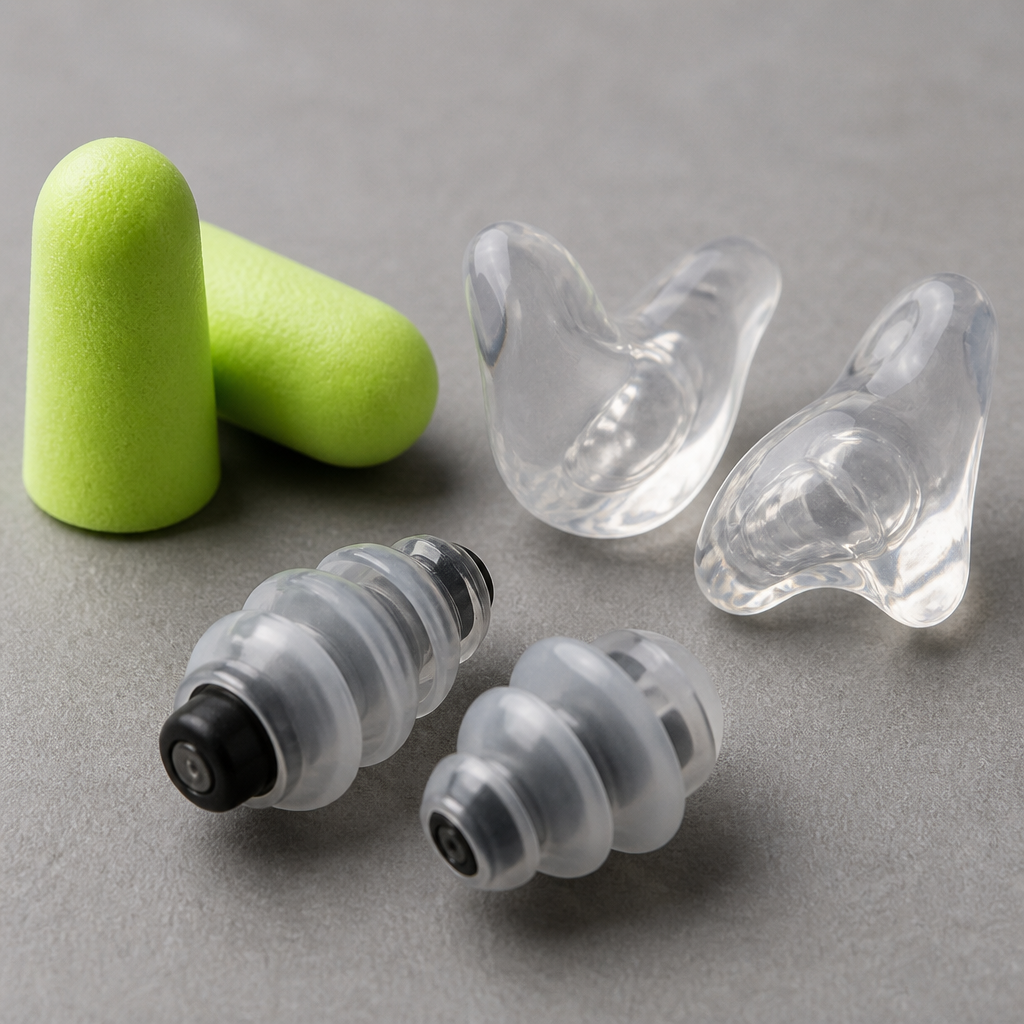

Disposable foam plugs are the most widely distributed form of occupational hearing protection. They are inexpensive per unit, widely available, and, in a laboratory environment with a trained user, capable of achieving very high NRR ratings. For construction sites, their weaknesses are significant. Foam absorbs the natural oils from fingertips during insertion, and on a dusty site it collects particulates that embed in the cell structure. Repeated use across a shift, or using a single pair for multiple days, accelerates this degradation. A foam plug that started the day at an effective NRR of 20 dB may be delivering 10 dB or less by afternoon.
There is also the technique problem. Correct insertion of a foam plug is a skill that must be taught and consistently maintained. On a busy site, workers inserting protection quickly between tasks rarely achieve the tight roll, deep placement, and prolonged hold that the lab test assumes.
Reusable earplugs built around a rigid body, particularly those with a metal housing, address most of the degradation problems that make disposables unreliable in industrial environments. The structured body maintains shape regardless of handling. The foam tips, which carry the NRR performance, can be replaced on a set schedule rather than relying on a worker to visually assess whether a small foam plug still functions correctly.
A premium metal-bodied earplug with memory foam tips delivers approximately 32 dB of noise reduction when properly fitted, covering most construction environments up to around 100 dBA. Three tip sizes ensure a seal that suits different ear canal geometries rather than assuming a universal fit. This is directly relevant to the OSHA 29 CFR 1926.101 individual fit requirement: a sized tip system is a practical mechanism for demonstrating that fit has been considered per worker, not just per job site.
Over-ear earmuffs offer the advantage of being easy to put on and remove quickly, which suits intermittent noise environments. Their weakness on a construction site is compatibility with other PPE. Hard hats, safety glasses, and face shields all compromise the seal of an over-ear muff. When the muff cushion cannot create a continuous contact with the skin around the ear, NRR drops sharply. For environments exceeding 100 dBA or for workers using equipment like jackhammers or concrete saws at close range, combining quality earplugs with earmuffs worn over the top is the appropriate solution. The two devices work together, with combined attenuation calculated according to OSHA guidance rather than by simply adding the two NRR values.
The purchasing decision for construction earplugs involves more variables than the NRR number. Here is what actually matters in a high-noise, high-usage environment.
A construction site is not a controlled environment. Earplugs get dropped on concrete, stuffed into pockets with gloves and fasteners, and handled with sweaty or dirty hands. A metal-bodied earplug outlasts foam and plastic equivalents significantly because the housing does not compress, crack, or absorb contamination the way softer materials do. The structured body also means the acoustic properties of the housing itself remain consistent throughout the product’s life. Only the foam tips, which are the consumable part, need periodic replacement.
Ear canal dimensions vary considerably between individuals. A one-size approach that uses a medium foam plug as the default leaves workers with smaller or larger canals with a compromised seal. A system offering at least three tip sizes, such as XS, S, and M, allows each worker to use the size that creates a genuine acoustic seal for their anatomy. This is not a comfort nicety. It is the difference between achieving the rated NRR and falling well short of it throughout the working day.
Eight-hour shifts are standard. Longer shifts are common. An earplug that causes pressure pain, skin irritation, or canal soreness after two hours is an earplug that will be removed. Comfort is the primary driver of compliance, and compliance is what determines whether hearing protection actually protects hearing. Memory foam conforms to the shape of the canal without exerting constant outward pressure the way standard expanded foam does, making it a more comfortable choice for extended wear.
Pro tip: Before committing to a hearing protection system for a crew, have workers trial the product for a full shift. Comfort reports after 8 hours are far more useful than comfort reports after 5 minutes. Any earplug can feel fine initially. The ones that stay in all day are the ones that matter.
Construction sites are dirty. Hearing protection that cannot be cleaned or that degrades with exposure to dust and sweat is not a good fit for the environment. A metal body can be wiped clean. Memory foam tips that are replaced on a schedule of every 6 to 8 weeks stay hygienic without requiring workers to make daily judgements about whether their protection is still serviceable. Disposable foam, by contrast, is technically single-use but is routinely used across multiple days or even weeks, accumulating contamination that compromises both the hygiene and the acoustic performance of the plug.
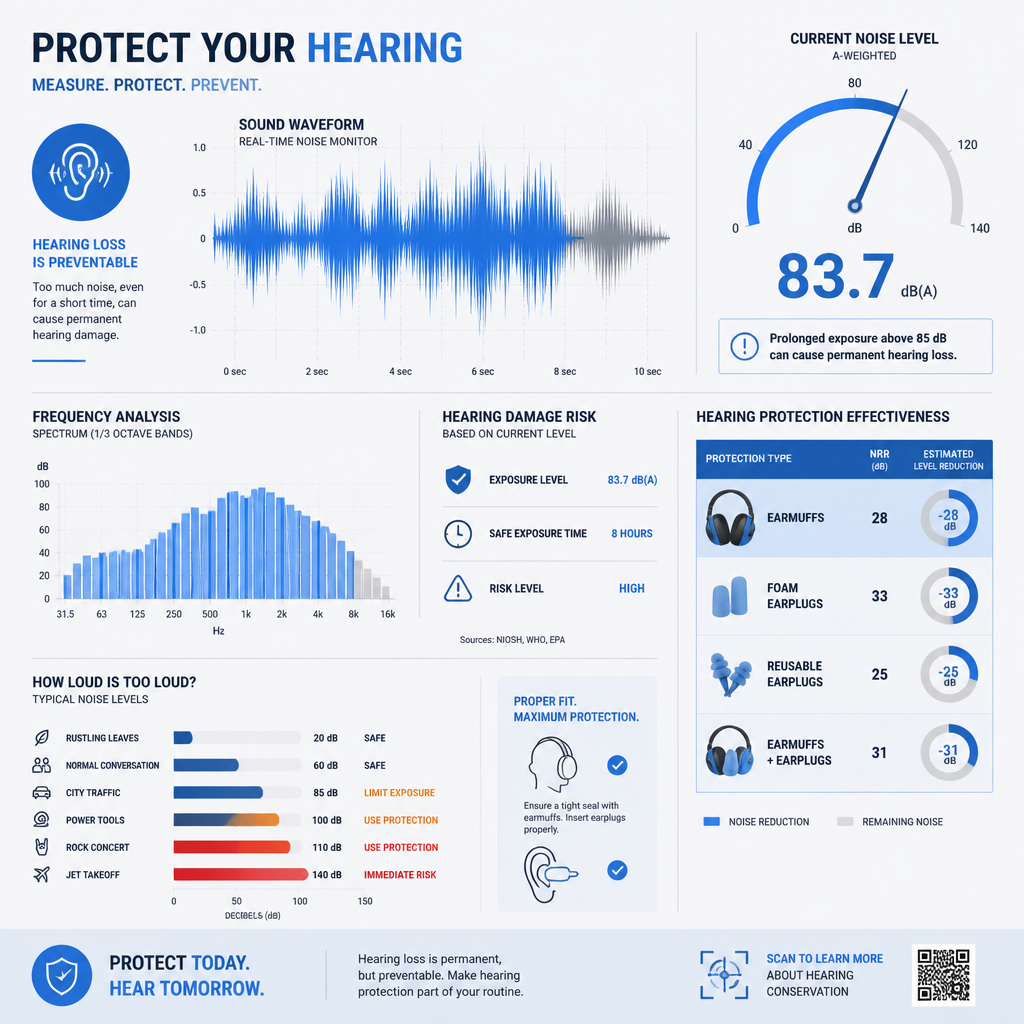
The comparison between reusable and disposable earplugs in a construction context is not purely a cost question. It involves practical performance, compliance, and long-term programme management.
| Factor | Disposable Foam Earplugs | Premium Reusable Earplugs (Metal Body, Memory Foam Tips) |
|---|---|---|
| Upfront cost per worker | Low per unit; cumulative cost is high with daily replacement | Higher upfront; tip replacements every 6 to 8 weeks are the only ongoing cost |
| NRR consistency across a shift | Degrades as foam absorbs oil, sweat, and dust throughout the day | Consistent when tips are within their replacement cycle and correctly sized |
| Fit assurance | Dependent entirely on insertion technique, which varies per worker and per insertion | Sized tips create a repeatable seal without requiring the same technique precision as rolled foam |
| Durability on a construction site | Single-use design; performance falls immediately when reused beyond intended life | Metal housing withstands drops, pocket storage, and worksite conditions without structural degradation |
| Hygiene management | Accumulates contamination if reused; hygiene depends on worker replacing as directed | Metal body is wipeable; foam tips replaced on a schedule regardless of appearance |
| Environmental impact | High waste volume for large crews using daily disposables across a full year | Significantly reduced waste with only tip replacements going to disposal |
For a construction crew switching from disposables to a reusable programme with scheduled tip replacements, the long-term cost reduction can reach 65 to 80 percent annually. The performance benefit compounds that financial case: protection that workers actually want to wear because it is comfortable, that does not degrade mid-shift because of site conditions, and that provides a repeatable seal regardless of whether someone is inserting their third or three-hundredth pair.
The gap between rated NRR and real-world attenuation is almost entirely caused by seal failure. Closing that gap comes down to consistent technique, the right tip size, and knowing when tips have reached the end of their effective life.
With a memory foam tip earplug, insertion is more straightforward than with a rolled disposable foam plug because the structured body gives you something to hold and guide. The tip should be lightly compressed between two fingers, then inserted with a gentle rotational motion while pulling the outer ear up and back with the opposite hand. This straightens the ear canal and allows the tip to seat fully. The earplug is correctly positioned when the body sits flush with the outer ear, not protruding, and when you hear a noticeable reduction in ambient noise immediately on insertion.
If the earplug consistently works loose during the shift, the tip is too small for the canal. If insertion is painful or the earplug creates significant pressure even after the foam has had time to warm and conform, the tip is likely too large. A proper fit sits securely without requiring force to stay in place. For first-time users, trialling the smallest tip first and working up is usually the most reliable approach, because an earplug that does not seat causes fewer problems to identify than one that is forced into place.
Memory foam tips give clear visual signals before acoustic performance fails completely. Tips that no longer recover their shape within a few seconds of compression, tips that have become stiff or sticky, or tips with visible surface contamination embedded in the foam have passed their useful life. Replacing tips on a regular schedule of every 6 to 8 weeks removes the subjectivity from this decision entirely, which is the right approach for a worksite programme where individual workers cannot be expected to make daily condition assessments on a small consumable.
For those looking at structured earplug programmes for a construction team, the ATTENU8 range is built specifically around this model: a durable metal body designed to outlast the job site, with memory foam tips in XS, S, and M that are replaced on a schedule rather than when they look worn.
For most construction environments, an NRR of 25 to 33 dB is the practical target range. Sites with equipment operating around 85 to 95 dBA need protection that brings exposure below the OSHA PEL of 90 dBA. For higher-noise tasks, such as operating concrete saws or jackhammers, combining earplugs with over-ear muffs provides supplementary protection. An NRR of 32 dB, properly fitted, covers the majority of construction work environments.
Disposable foam plugs are designed for single-use and should be replaced daily at minimum. In practice, they degrade faster on dusty or oily sites and should be inspected at the start of each shift. For reusable earplugs with memory foam tips, the body is durable and does not need replacement, but the foam tips should be swapped every 6 to 8 weeks to maintain their acoustic performance and hygiene.
Earplugs have a practical advantage on most construction sites because they are compatible with hard hats, safety glasses, and face shields without compromising the acoustic seal. Earmuffs lose significant NRR when their cushion seal is broken by PPE components. For extremely high-noise tasks above 100 dBA, the correct answer is both: earplugs worn beneath earmuffs provides combined protection that neither device achieves alone.
OSHA does not mandate a specific brand or product type. The requirements under 29 CFR 1926.52 and 1926.101 are that hearing protection provides a sufficient NRR for the exposure level, that it is provided at no cost to workers exposed at or above 85 dBA, and that inserted ear protectors are individually fitted or verified by a competent person. Workers must also be trained to use the protection correctly.
The most common reasons are discomfort during long shifts, the perception that noise exposure is not severe enough to cause harm, and the inconvenience of inserting and removing protection frequently throughout the day. Comfort-driven compliance is a documented pattern in occupational health research: workers will wear protection consistently only when it does not actively interfere with their ability to do their job. This makes comfort a safety specification, not a luxury.
Yes, provided the NRR is sufficient and the fit is comfortable for extended wear in both contexts. A 32 dB NRR earplug with sized memory foam tips works equally well for blocking a snoring partner as it does for reducing exposure on a job site. The key is that the product maintains consistent attenuation, and that the tips are kept in good condition. For construction use, replace tips more frequently if you are wearing them in high-dust environments.
A correctly inserted earplug significantly changes how you perceive your own voice. Speaking while wearing well-seated earplugs produces a noticeably hollow, amplified sound internally. If ambient conversation and machinery sound only slightly muffled rather than substantially reduced, the seal has failed and the earplug needs to be reinserted or the tip size reconsidered. Ringing in your ears after leaving the site is a clear sign that attenuation during the shift was insufficient.
Have you changed your approach to hearing protection on site, and what made the difference? Share your experience below.
If you use earplugs every night for sleep or wear them daily on a noisy worksite, the cost of disposable foam adds up faster than most people expect. The reusable earplugs vs disposable debate is not really about upfront price. It is about what you actually spend over 12 months, what protection you actually receive, and how much plastic you throw away in the process. Run the numbers honestly and the comparison is not close.
| Key Insight | Explanation |
|---|---|
| Disposable foam costs far more annually than it appears | A nightly foam earplug user spends roughly $60 to $180 per year on disposables alone, depending on brand and quantity purchased. |
| The break-even point for reusables is faster than expected | For a daily user, a quality reusable pair typically pays for itself within 8 to 12 weeks of switching from disposable foam. |
| Real-world NRR attenuation from foam plugs is significantly lower than the label | NIOSH research consistently shows untrained users achieve roughly 50% of the labeled NRR under real-world conditions, meaning a 33 dB plug may deliver only around 16 dB in practice. |
| Foam tip replacements are the only recurring cost of a premium reusable | ATTENU8 memory foam tips need replacing every 6 to 8 weeks. The annual replacement cost is well under $20, far below disposable spend. |
| Disposable foam is made from non-biodegradable plastics | Most foam earplugs are made from PVC or polyurethane, neither of which biodegrades. Manufacturing an estimated 40 billion foam earplugs annually requires around 1.3 million barrels of oil. |
| Sized memory foam tips deliver more consistent seals than rolled foam | Choosing XS, S, or M tips removes the technique variable that causes most disposable foam failures. The seal is consistent regardless of lighting conditions or fatigue level. |
| Metal-bodied reusables are designed for years of use, not weeks | The aluminium body of a premium reusable earplug does not degrade with daily use. Only the foam tips are consumable, which keeps the long-term cost of ownership extremely low. |
Disposable foam earplugs look cheap because the per-pair price is low. A bulk box of 50 pairs typically runs between $5 and $25 depending on the brand, putting each pair somewhere in the range of $0.10 to $0.50. That number feels negligible, which is exactly why most people never do the yearly math.
If you use foam earplugs every night for sleep, you go through roughly 365 pairs in a year. Even at the lower end of $0.10 per pair, that is $36.50. At $0.50 per pair, it reaches $182.50. The average daily user typically lands somewhere in the $60 to $100 range annually, and that is before factoring in the habit most light sleepers share: doubling up pairs when one does not seal well, which is common with disposable foam.
For workers in loud environments, the math gets worse. A construction worker or manufacturing professional who uses two pairs per shift, because single-use foam degrades quickly in dusty or oily conditions, can spend well over $100 per year as an individual. For a 50-person crew, a disposable foam program can cost between $3,750 and $6,250 in direct materials annually.
The sticker price of a single pair of disposable earplugs is the least useful number for making a purchasing decision. The number that matters is what you spend in a year.
Pro tip: Before you buy your next box of disposable foam earplugs, multiply the per-pair cost by 365 (or by the number of working days in your year). That single calculation changes how most people see the value of switching to a reusable alternative.
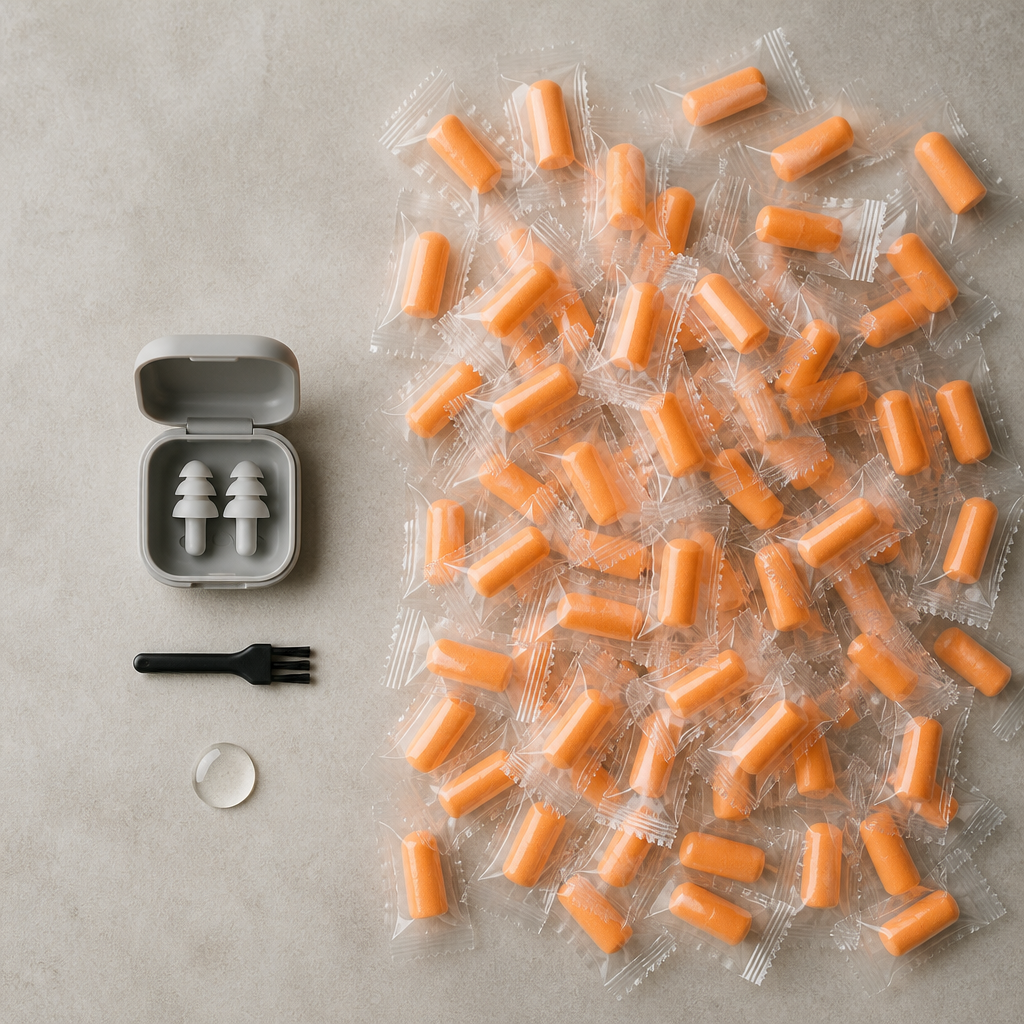
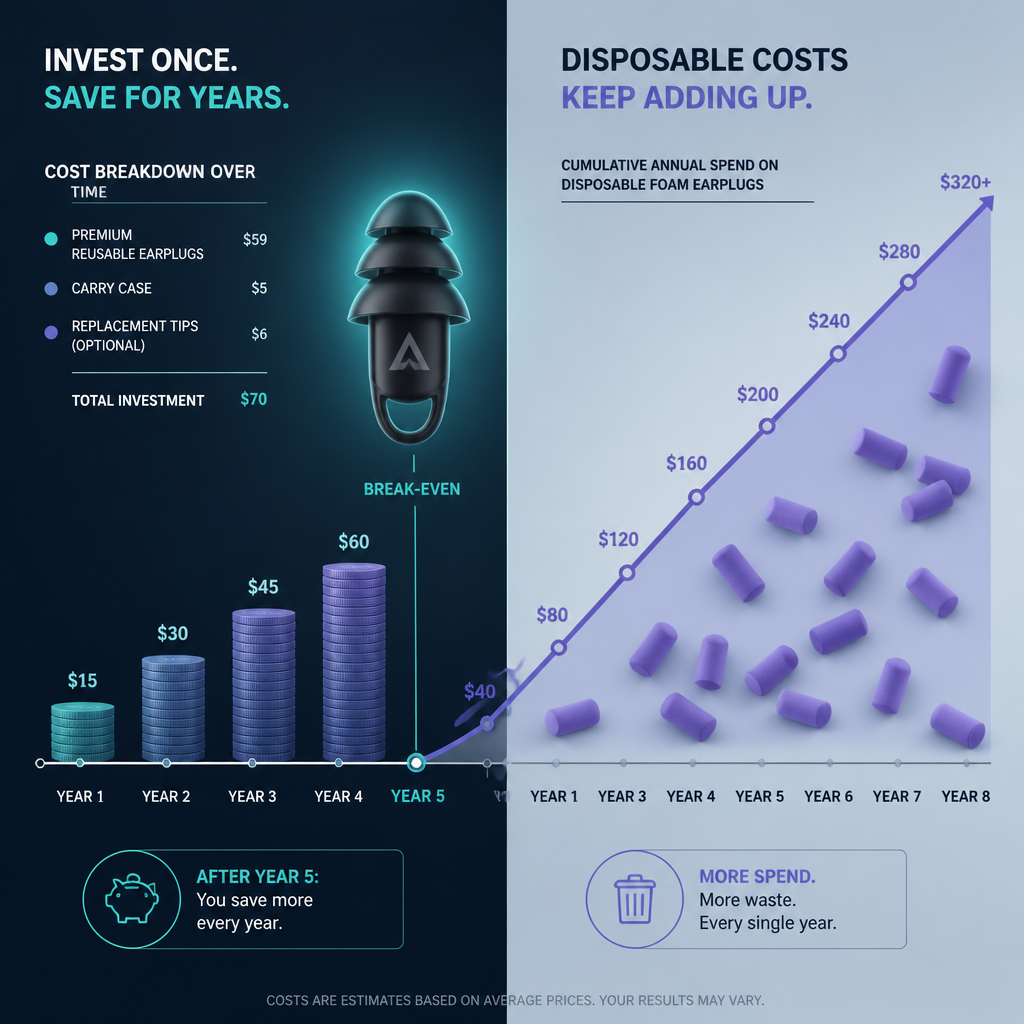
The upfront cost of a quality reusable earplug is higher than a single pair of disposable foam, which is the comparison most people instinctively make. It is also the wrong comparison. The correct comparison is the reusable’s total first-year cost versus 12 months of disposable spend.
A quality pair of metal-bodied reusable earplugs, such as ATTENU8, costs between $25 and $45 for the body, which does not degrade with daily use. The only consumable is the memory foam tip. With daily overnight use, foam tips need replacing every 6 to 8 weeks. A replacement tip set typically costs $10 to $15 for a multi-pair pack.
Over a full year of nightly use, the total spend on a premium reusable system runs approximately $40 to $60 when you include the initial body purchase and all tip replacements. That is a fraction of what the same user spends on disposables, and it provides more consistent performance throughout.
For a daily user spending roughly $4 to $5 per box of 10 pairs on disposables, the break-even point against a quality reusable is typically between 8 and 12 weeks. After that, the reusable is simply cheaper with every passing week. For a construction crew, switching from disposable to a reusable program with replacement tips can cut annual hearing protection costs by 65 to 80 percent.
Pro tip: Track your earplug spend for just one month by saving receipts or checking your purchase history. Most daily users are surprised to find they are spending more on disposable foam in a single month than a full year of reusable tip replacements would cost.
The NRR (Noise Reduction Rating) printed on a box of disposable foam earplugs is a laboratory number. It reflects what trained subjects achieved under ideal conditions with expert insertion in a calibrated test environment. It does not reflect what a light sleeper inserting foam plugs in the dark, half-asleep, actually receives.
NIOSH research consistently shows that average foam earplug users achieve roughly 50% of the labeled NRR under real-world conditions. An earplug labeled NRR 33 dB typically delivers around 16 dB of actual attenuation for an untrained user. In one study of U.S. Marine Corps recruits, pre-training attenuation values with a 33 dB NRR foam plug ranged from 0 to 50 dB, illustrating the enormous variability that insertion technique introduces.
Disposable foam requires a specific technique: roll tightly, insert before expansion begins, hold in place for 20 to 30 seconds. Skip any step and the seal is compromised. Field observations suggest that a significant proportion of workers skip the holding step entirely, reducing actual attenuation by 8 to 12 dB.
Sized memory foam tips eliminate the technique variable. When you select the correct size from XS, S, and M options and pair them with a stable metal body, the insertion is consistent each time. The seal does not depend on how well you rolled the plug or whether you held it long enough. This matters most to light sleepers inserting in low light and to professionals who insert quickly under worksite pressure.
ATTENU8’s metal-bodied design delivers approximately 32 dB of noise reduction with properly fitted tips. Because the body maintains its shape and the tip is always pre-sized rather than relying on user compression, the attenuation you achieve in practice tracks far closer to the rated figure than standard disposable foam does.

The financial comparison between reusable and disposable earplugs is compelling on its own. The environmental comparison adds another dimension that is increasingly relevant to buyers choosing eco-friendly earplugs.
Most disposable foam earplugs are made from polyvinyl chloride (PVC) or polyurethane, both fossil-fuel-derived plastics that do not biodegrade. Manufacturing an estimated 40 billion foam earplugs annually requires approximately 1.3 million barrels of oil. When these plugs reach landfill, PVC products can leach toxic chemicals into soil and groundwater. When incinerated, PVC releases hydrogen chloride gas and greenhouse gases.
A nightly user who replaces foam earplugs daily discards approximately 146 pairs per year, sending plastic-packaged foam waste directly to landfill. A construction worker using two pairs per shift generates even more. Multiply that across a large workforce and the waste volume becomes significant.
A single premium reusable earplug body, made from anodised aluminium, lasts for years under daily use. The only waste generated is the memory foam tip, replaced every 6 to 8 weeks. That is roughly 6 to 8 tip changes per year instead of 146 to 365 full earplug disposals. The volume reduction in landfill contribution is substantial.
For buyers who prioritise both cost and environmental responsibility, the calculation is the same: a durable metal-bodied design with replaceable tips is simply a better system on both counts. Choosing eco-friendly earplugs does not require accepting inferior performance. It means choosing a design where durability and sustainability reinforce each other.
| Factor | Disposable Foam Earplugs | Standard Pre-Formed Reusable | ATTENU8 Premium Metal-Bodied Reusable |
|---|---|---|---|
| Upfront Cost | Very low per pair ($0.10 to $0.50) | Low to moderate ($2 to $15) | Moderate ($25 to $45 for the body) |
| Annual Cost (daily use) | $60 to $180+ | Variable, body needs periodic full replacement | Under $20 in tip replacements after initial purchase |
| Noise Reduction (real-world) | Often 50% below rated NRR due to technique dependence | More consistent but fit varies by ear canal size | Approximately 32 dB with sized XS/S/M memory foam tips |
| Fit Consistency | Highly variable, technique-dependent | Better than foam, limited by single-size design | Three tip sizes create consistent seal across ear canal shapes |
| Environmental Impact | High: 146 to 365 pairs discarded per year per user | Lower, but full-body replacement still generates waste | Lowest: only foam tips replaced every 6 to 8 weeks |
| Durability | Single use only | Weeks to months before degradation | Aluminium body is indefinitely durable; only tips are consumable |
| Best For | Occasional, emergency, or one-off use | Moderate-frequency users who need a step up from foam | Daily sleepers, frequent travellers, worksite professionals |
Cost and noise reduction numbers matter, but for daily wearers, comfort determines whether a product actually gets used. A light sleeper who finds earplugs uncomfortable after two hours will remove them at 3 a.m. and wake up to every sound in the house. The best earplug is the one that stays in comfortably throughout the night.
Disposable foam earplugs are designed to expand after insertion. That expansion creates the seal, but it also creates sustained outward pressure against the ear canal wall. Over time, especially during a full night’s sleep, that continuous pressure causes irritation and soreness. Many users describe waking up with aching ear canals after several hours of foam plug use.
Memory foam tips on a stable metal body behave differently. The foam conforms to the canal shape and settles rather than continuously pushing outward. Combined with the concave aluminium body sitting partially in the concha bowl rather than deep in the canal, the pressure profile is gentler. Side sleepers in particular notice the difference: a low-profile metal body does not create the pillow-pressure pain that a protruding foam plug often does.
A disposable foam earplug picks up skin oils, earwax, and bacteria from the very first insertion. Because it is discarded after one or two uses, that contamination is not a long-term concern in theory. In practice, many users reuse disposable foam well beyond its intended single-use lifespan, either because they forget or because discarding every pair feels wasteful.
A metal-bodied reusable with replaceable foam tips keeps the aluminium body cleanable and replaces only the foam component on a set schedule. Replacing tips every 6 to 8 weeks with fresh memory foam means the contact surface is never older than two months, regardless of how long you keep the body. This is a more hygienic system than either single-use foam that gets reused or older reusable designs where the entire body accumulates contamination without a clear replacement schedule.
Pro tip: When you are a side sleeper, choose an earplug with the smallest possible external profile. A metal-bodied design with a flush or recessed fit in the ear sits flat against the head, while a protruding foam plug creates a pressure point against the pillow that wakes most side sleepers within a few hours.
On paper, high-rated disposable foam plugs can match or exceed the rated NRR of many reusables. In practice, disposable foam consistently underperforms its rating because correct insertion requires a specific technique that most users do not execute consistently. Reusable earplugs with sized memory foam tips deliver more predictable real-world attenuation because the fit does not depend on how well the user rolled and timed the insertion. For daily sleepers and worksite users, that consistency matters more than the rated number on the box.
A well-made metal-bodied reusable earplug body, such as those made from anodised aluminium, lasts for years under daily use because the structural component does not degrade with normal wear. The memory foam tips are the consumable part. With daily overnight use, tips typically need replacing every 6 to 8 weeks, or around 300 to 350 insertion cycles. Following that schedule keeps both comfort and noise reduction performance consistent throughout the body’s lifespan.
A nightly disposable foam earplug user goes through roughly 365 pairs per year. At typical retail prices of $0.10 to $0.50 per pair, the annual spend ranges from about $36 to $182. Most daily users fall somewhere in the $60 to $100 range annually, and those who habitually replace plugs mid-night because of poor initial fit spend more. Compare that to a premium reusable system at under $20 per year in tip replacements after the initial body purchase, and the financial case for switching is straightforward.
Significantly so. Most disposable foam earplugs are made from PVC or polyurethane, both non-biodegradable plastics that go directly to landfill after use. A nightly user discards around 146 pairs per year. A reusable user with a metal-bodied earplug replaces only the memory foam tip every 6 to 8 weeks, generating a fraction of that waste. The aluminium body is durable enough to last for years, making the total material footprint of a premium reusable system far lower over time than an equivalent period of disposable use.
Yes, and this is one of the strongest arguments for premium reusable designs. A metal-bodied earplug with replaceable memory foam tips delivers approximately 32 dB of noise reduction, which covers light sleepers dealing with snoring or traffic noise as well as worksite professionals in environments up to moderate industrial noise levels. The consistent seal from sized tips makes a single pair genuinely versatile across both use cases, unlike disposable foam, which degrades quickly in dusty or oily worksite conditions and requires technique precision that is hard to maintain during a busy shift.
Memory foam tips show several clear signs of degradation before they fail completely. The foam takes longer to expand after compression, feels less resilient in the hand, or shows visible discoloration from accumulated oils and wax. You might also notice that the seal feels less secure or that sounds you previously blocked are coming through more clearly. Replace tips at the first signs of performance change rather than waiting for complete failure. For daily overnight users, the 6 to 8 week replacement schedule generally aligns with when these signs first appear.
For genuinely occasional users, such as someone who only needs earplugs a few times a year for travel or a specific event, a small pack of disposable foam is a practical choice. The calculus shifts quickly for anyone using earplugs more than a few times per week. Once you cross into regular daily or nightly use, the reusable system pays for itself within weeks and continues to save money for as long as you own the body. The upfront investment is only “high” relative to a single pair of foam plugs, not relative to the annual total cost of daily disposable use.
If you have made the switch from disposable to reusable earplugs, or are still weighing it up, share what drove your decision in the comments, your experience could help someone else make the right call.
If you lie awake listening to traffic, a snoring partner, or neighbourhood noise, you are not just unlucky. You are dealing with a documented physiological problem. Research into noise and sleep quality makes one thing very clear: your brain never fully switches off its response to sound, even during deep sleep. The noise that does not fully wake you is still doing damage, triggering stress hormones, shifting you into lighter sleep stages, and quietly eroding the recovery your body depends on. This article breaks down exactly what the science says and what you can practically do about it.
| Key Insight | Explanation |
|---|---|
| Your brain stays alert to noise all night | Even during deep sleep, auditory processing continues. Sounds trigger physiological reactions without necessarily causing full wakefulness. |
| Noise pushes you into lighter sleep stages | Environmental noise increases stage 1 (lightest) sleep and reduces slow-wave and REM sleep, the two most restorative stages. |
| Sounds as low as 30 dB can disturb rest | Even relatively quiet noise can affect sleep. A whispered conversation sits around 30 dB. Your bedroom does not need to be loud to be disruptive. |
| Noise activates your stress hormones at night | Nighttime noise triggers adrenaline and cortisol production, elevates heart rate, and raises blood pressure, even without waking you. |
| Sound machines are not a reliable fix | Recent research published in the journal Sleep found that pink noise reduced REM sleep by nearly 19 minutes and worsened outcomes when combined with traffic noise. |
| Earplugs outperform sound masking for deep sleep protection | The same study found that wearing earplugs was far more effective than pink noise at protecting deep, restorative sleep from traffic noise disruption. |
| Noise sensitivity is partly neurological | Research suggests brain rhythm patterns influence how vulnerable an individual is to noise-related awakenings, meaning light sleepers are not imagining it. |
Sleep is not a single state. It is a cycle of distinct stages, each with a different function and a different level of vulnerability to noise. Stage 1 is the lightest, barely distinguishable from wakefulness. Stage 2 is where most of us spend roughly half the night. Slow-wave sleep (stage 3) is the deepest, most physically restorative stage. REM sleep is where memory consolidation, emotional processing, and cognitive recovery happen.
Environmental noise, particularly from traffic and aircraft, has been shown to increase time spent in stage 1 sleep while reducing slow-wave and REM sleep. That trade-off matters enormously. You might technically sleep for eight hours, but if noise keeps pulling you out of slow-wave and REM and pushing you into stage 1, you will wake up feeling like you barely rested. Stage 2 is also where noise is most likely to cause a full awakening, since auditory awakening thresholds are generally lower there than in slow-wave sleep.
One important nuance: most noise-triggered arousals are not remembered. Your brain briefly surfaces, registers the sound, and partially settles again, all without you being consciously aware. This is why many people insist they slept through the noise when their sleep quality data tells a completely different story.
Pro tip: If you consistently feel unrefreshed despite getting enough hours in bed, noise-triggered micro-arousals are a credible cause. You do not need to remember waking up for the disruption to be real.
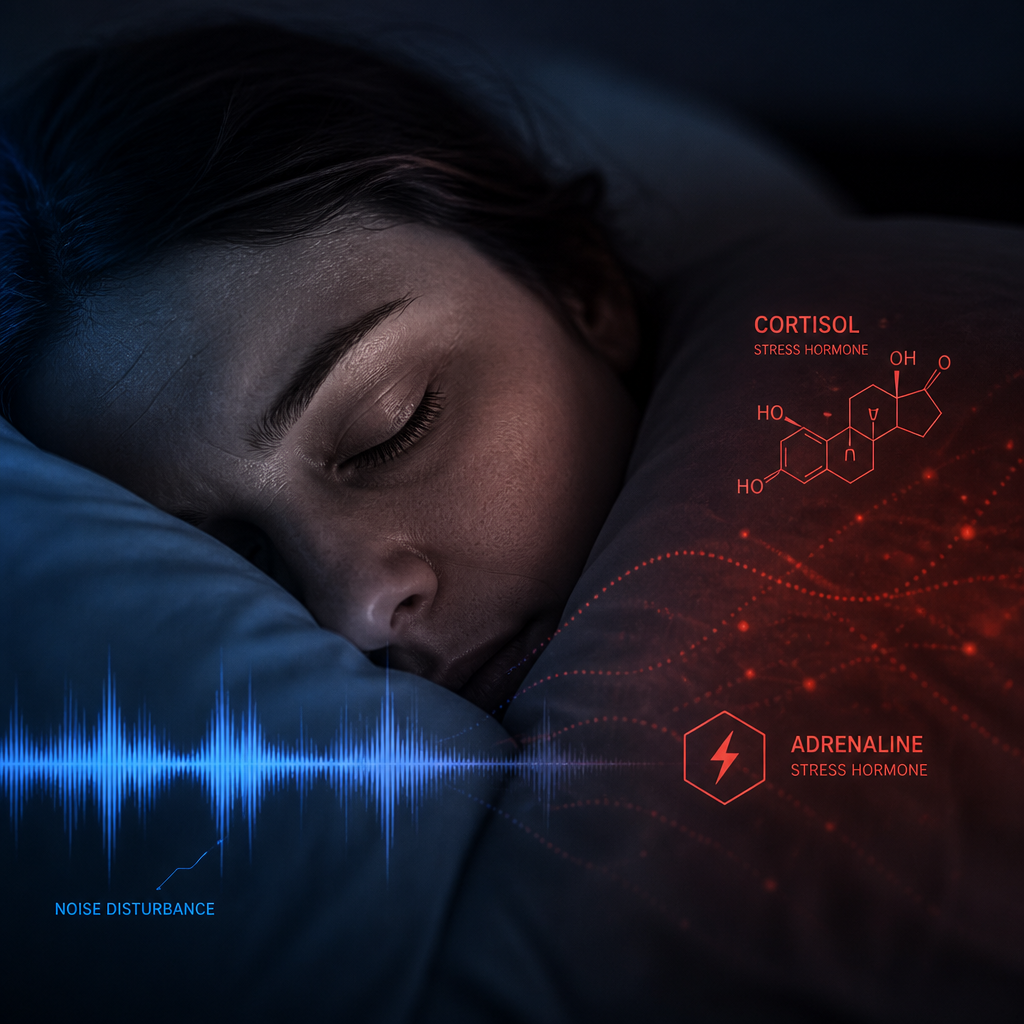
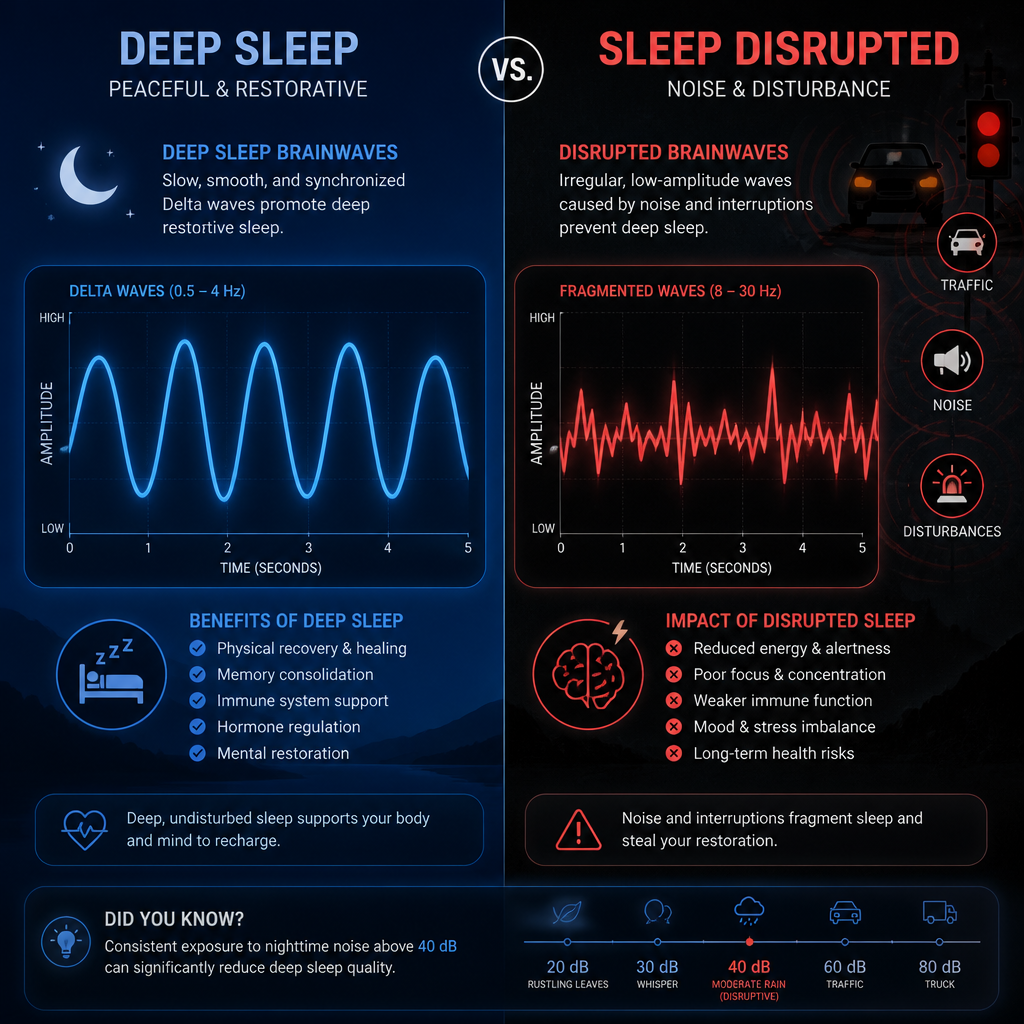
The effects of noise during sleep are not limited to wakefulness. Even sounds that do not cause a full awakening trigger measurable physiological responses. Research has found that a noise of around 48 dB, quieter than the hum of a refrigerator, was 3.4 times more likely to cause a change in pulse wave amplitude, a measure related to blood flow. Sounds above 40 dB produced detectable increases in heart rate.
Nighttime noise also stimulates the production of stress hormones including adrenaline and cortisol, and can elevate blood pressure. Researchers have suggested that these responses may be a primitive survival mechanism, the body preparing to respond to a potential threat. That is useful if a predator actually approaches. It is damaging if it happens every time a truck changes gear outside your window.
Chronic exposure compounds the problem. When noise-triggered cardiovascular responses occur repeatedly night after night, research indicates they may increase the risk of hypertension, heart disease, and other adverse health outcomes. This is not a fringe finding. Research has estimated that traffic-related noise alone causes the loss of over one million years of healthy life among Western Europeans annually.
Even when you sleep through the noise, your nervous system does not. Adrenaline, cortisol, elevated heart rate, disrupted blood flow: the body keeps score, even when the conscious mind does not.
Health guidance generally recommends keeping nighttime bedroom noise below 30 decibels to support uninterrupted sleep. For context, busy road traffic runs at roughly 70 to 85 dB, a subway at around 90 dB, and even a conversation in an adjacent room can exceed 30 dB when sound travels through walls. Reaching that 30 dB threshold in a typical urban or suburban bedroom is harder than it sounds.
If you have ever shared a room with someone who sleeps through a thunderstorm while you lie awake at the sound of a dripping tap, you already know that noise sensitivity is not uniform. Research confirms this is not just a personality trait. Brain rhythm patterns, specifically the activity of sleep spindles during stage 2 sleep, appear to play a role in how effectively a person’s brain filters out external sounds during sleep. People with more active sleep spindles show greater resilience to noise disruption.
Age is another significant factor. Studies show that children and older adults are the most vulnerable to sound-related sleep disruption. Emotional salience also matters: a sound with personal significance, such as your baby’s cry, your name, or an alarm, cuts through sleep far more effectively than a neutral sound at the same volume. The brain is not passively receiving noise. It is actively evaluating it.
For genuine light sleepers, this neurological sensitivity is not something that can be trained away easily. It calls for a practical, physical reduction in the noise reaching the ears, rather than an expectation that willpower or adaptation will solve the problem.
Pro tip: If you identify as a light sleeper and you have tried relaxation techniques without much success, focus on the environment first. Reducing the decibel level reaching your ears is a more reliable intervention than trying to change how your brain processes sound during sleep.
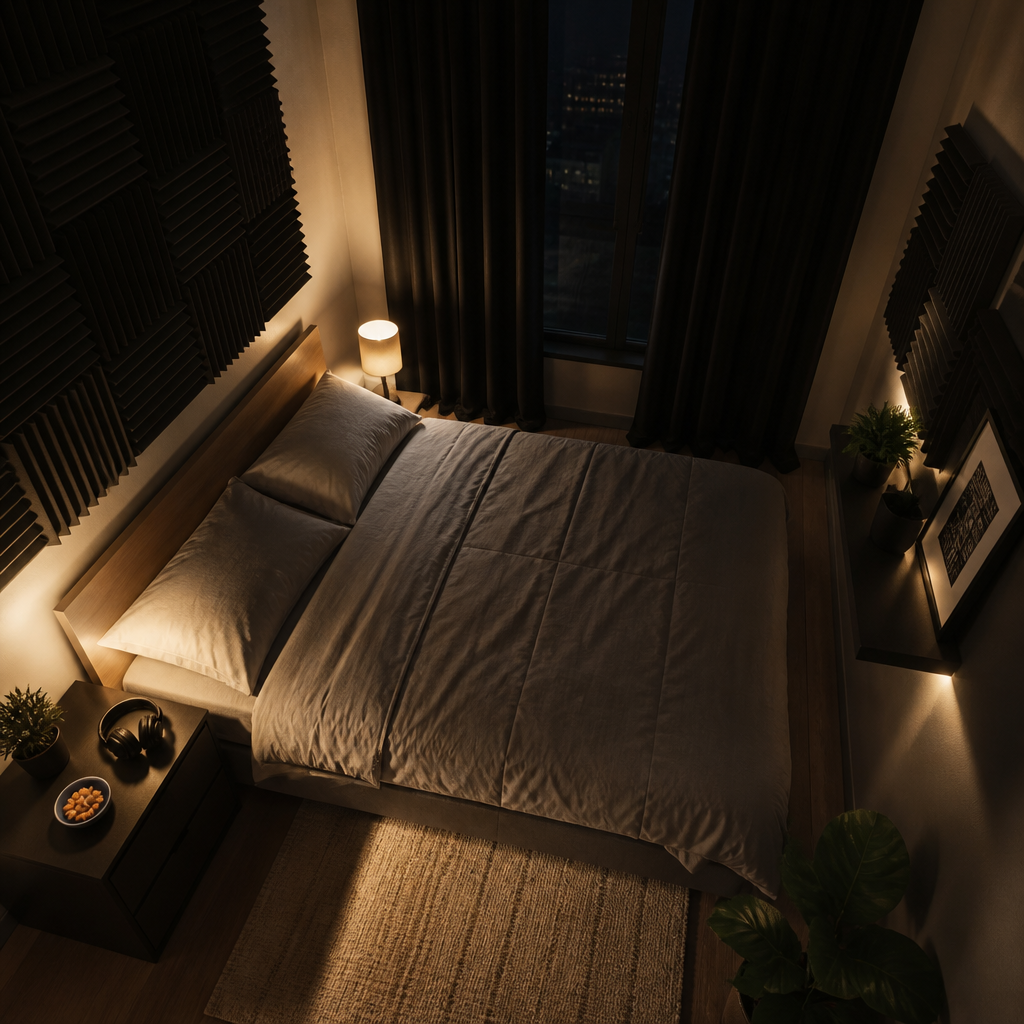
Understanding the scale of the problem helps calibrate the solution. Not all noise is equal, and what disrupts sleep is a combination of volume, frequency, unpredictability, and duration. A single loud event is disruptive; repeated unpredictable events across the night are far worse, because the brain cannot habituate to irregular patterns the way it can to constant background sound.
The most common sleep-disrupting noise sources include road traffic, aircraft, snoring partners, neighbours, and environmental sounds like air conditioning or plumbing. In urban settings, it is rare to have a bedroom that stays below 40 dB through the night without active intervention. Even a quiet suburban environment can see regular spikes from passing vehicles, animals, or wind.
Snoring deserves a specific mention because it is uniquely difficult to habituate to. Research on emotional noise shows that personally relevant sounds are harder to filter out, and few sounds are more personally relevant at 2 AM than a partner’s snoring directly beside you. Snoring typically registers between 50 and 70 dB, well above the threshold for disrupting sleep architecture.
There are broadly three categories of approach to managing sleep disruption noise: physical noise blocking, acoustic masking, and environmental modification. Each has a different evidence base and a different practical ceiling.
| Approach | How It Works | Evidence and Limitations |
|---|---|---|
| Ear protection (earplugs) | Physically reduces sound reaching the ear canal. High-quality options with memory foam tips can reduce noise by 25 to 32 dB across a wide frequency range. | Research from the University of Pennsylvania found earplugs outperformed pink noise machines at protecting both REM and deep slow-wave sleep from traffic noise disruption. Most direct evidence of benefit. |
| Sound masking (white, pink, or brown noise) | Adds continuous background sound to reduce the perceived contrast when disruptive noises occur. | A study published in the journal Sleep found pink noise at 50 dB reduced REM sleep by nearly 19 minutes on its own, and worsened sleep further when combined with traffic noise. Popular but overstated in effectiveness. |
| Environmental modification (windows, insulation, room positioning) | Structural changes to reduce external noise entering the room: double glazing, heavy curtains, door seals, changing which room you sleep in. | Double-pane windows can reduce noise by 10 to 20 dB. Effective but expensive and impractical for renters. Best used in combination with ear protection rather than as a standalone solution. |
The practical takeaway is that earplugs, particularly well-fitted ones that maintain a seal throughout the night, represent the most evidence-backed immediate intervention for noise-related sleep disruption. Sound masking is better suited to situations where earplugs are not practical, and even then the evidence for benefit is weaker than most sound machine marketing implies.
For light sleepers and anyone dealing with persistent sleep disruption noise, the goal is not to eliminate every sound from the universe. It is to reduce the spikes, the sudden changes in volume that pull you out of deeper sleep stages. That is where the right ear protection makes a significant difference.
Comfort across an entire night’s sleep is the non-negotiable factor that most people underestimate. A plug that works well for 30 minutes may become painful by hour three, particularly for side sleepers. Foam tips that conform to the ear canal are more comfortable for extended wear than rigid options. Having multiple tip sizes available matters too, because ear canal dimensions vary significantly between individuals, and a poor fit means both discomfort and reduced noise attenuation.
Durability is the second factor. Disposable foam earplugs need to be replaced constantly, accumulate in landfill, and often lose their expansion capacity after a single use. A well-constructed reusable option with replaceable foam tips addresses both the environmental cost and the long-term economics. The ATTENU8 aluminium-bodied earplug is built around exactly this principle: a precision-machined metal body with three sizes of soft memory foam tips (XS, S, and M), delivering around 32 dB of noise reduction with foam tips that only need replacing every six to eight weeks rather than after every use.
In practice, ear protection works best as the primary intervention, with environmental modifications as a supporting layer. Closing windows, using heavier curtains to absorb sound reflections, and positioning the bed away from the noisiest wall all reduce the baseline noise level before earplugs need to do their work. Start with the physical environment, then add ear protection, and you compound the benefit of both without needing to reach for a sound machine that the evidence suggests may be doing more harm than good.
For people in genuinely loud occupational environments, such as construction or manufacturing, the principle that protects hearing at work applies at home too: sustained noise exposure at levels that trigger physiological stress responses has cumulative consequences. The same discipline that goes into workplace hearing protection should extend to the sleep environment.
Pro tip: If you travel frequently for work and struggle with hotel noise, carrying your own earplugs is one of the highest-return sleep interventions available. Hotel rooms vary wildly in noise levels, and blackout curtains handle light but do nothing for sound from corridors, traffic, or thin walls.
Research suggests sounds as low as 30 decibels can affect rest, and noises above 40 dB produce measurable cardiovascular responses even without waking a sleeper. For context, a quiet conversation registers around 40 to 50 dB. You do not need to be startled awake for noise to be damaging your sleep quality.
Partially, but not fully. The brain can become less likely to fully wake in response to familiar, predictable sounds over time. However, the underlying physiological responses, including cortisol production and heart rate changes, persist even with adaptation. Chronic exposure to noise does not become harmless simply because it becomes familiar.
The evidence is more cautious than the marketing. A recent study published in the journal Sleep found that pink noise, one of the most popular formats, reduced REM sleep by nearly 19 minutes per night, and made sleep quality worse when combined with traffic noise. Sound masking can reduce the perceived contrast of disruptive noises, but it does so by adding more sound to the ear. Physical noise blocking through well-fitted earplugs is better supported by the research for protecting deep and REM sleep.
Stage 2 sleep is where most full awakenings triggered by noise occur, largely because auditory awakening thresholds are lower there than in slow-wave sleep. However, slow-wave sleep and REM sleep are both reduced by environmental noise exposure even when the noise does not cause a full waking event. All stages are affected; stage 2 is just where you are most likely to notice it consciously.
Yes. Chronic exposure to nighttime noise has been linked in research to elevated risk of hypertension, heart disease, and other cardiovascular conditions. The mechanism is the repeated activation of stress responses during sleep, including cortisol and adrenaline release and heart rate elevation, which accumulate as a physiological burden over time. This is why managing your sleep noise environment is a health priority, not just a comfort preference.
Memory foam tips that expand to form a seal within the ear canal are generally the most comfortable for extended wear and the most effective at reducing noise across a broad frequency range. The key variables are tip size, which must match your ear canal for both comfort and attenuation, and the body design, which should not create pressure points for side sleepers. Reusable earplugs with replaceable foam tips are more practical and economical for nightly use than single-use disposables.
Yes. Studies consistently show that children and older adults are the most vulnerable to noise-related sleep disruption. Children spend a higher proportion of sleep in REM, which is particularly sensitive to audio interference. Older adults tend to experience lighter sleep overall, which raises their vulnerability to being woken by noise events. Both groups benefit disproportionately from a quieter sleep environment.
Have you found a particular approach that helped you manage noise and get better sleep? Share your experience below, as it might help someone else dealing with the same problem.
If you have ever lain awake at 2 a.m. listening to a partner snore, a neighbour’s bass, or street traffic rattling through your window, you already know that not every earplug solves the problem equally. The ATTENU8 vs Loop earplugs debate comes down to one core question: do you want the maximum noise reduction a reusable earplug can realistically deliver, or do you want a lighter, more social-friendly attenuation that takes the edge off sound without blocking it entirely? Both products are reusable, both target noise-sensitive individuals, and both cost more than a bag of disposable foam plugs. That is where the similarities end.
| Key Insight | Explanation |
|---|---|
| ATTENU8 delivers approximately 32dB noise reduction (SNR 32) | This places it in the same attenuation tier as traditional industrial foam plugs, while being fully reusable and more comfortable to insert. |
| Loop’s flagship sleep product (Quiet 2) is rated at 24dB SNR / 14dB NRR | This is meaningful attenuation for ambient social noise, but falls short for heavy snoring, construction, or high-decibel environments. |
| The material difference matters more than most people expect | ATTENU8’s aluminium body paired with memory foam creates a density change that dramatically improves low-frequency noise absorption, the type most likely to disrupt sleep. |
| Loop earplugs are silicone-bodied | Silicone is flexible and comfortable, but it does not create the same acoustic mass as metal. This is a trade-off between comfort and raw attenuation. |
| ATTENU8 foam tips are replaced every 6 to 8 weeks, not the whole product | The aluminium body is a one-time purchase. Only the memory foam tip is consumable, which reduces long-term cost significantly compared to disposable alternatives. |
| Loop’s product range targets multiple use cases simultaneously | Loop offers concert, focus, and sleep variants (and a multi-mode switch version). This breadth is useful for casual users, but adds complexity for someone who specifically needs maximum sleep protection. |
| Real-world attenuation is always lower than the rated figure | Standard regulatory halving corrections mean a 32dB-rated product delivers roughly 16dB real-world protection. Even so, 16dB of consistent nightly protection is meaningfully more than 12dB from a 24dB-rated product. |
Before diving into the detailed comparison, it is worth stating clearly: these two products are not actually competing for the same buyer in most cases. ATTENU8 is built around a single uncompromising goal, the highest practical noise reduction in a durable, reusable format. The Loop range is built around versatility and lifestyle aesthetics. If you are reading this because noise is genuinely affecting your sleep or you work in a loud professional environment, that distinction will determine everything.
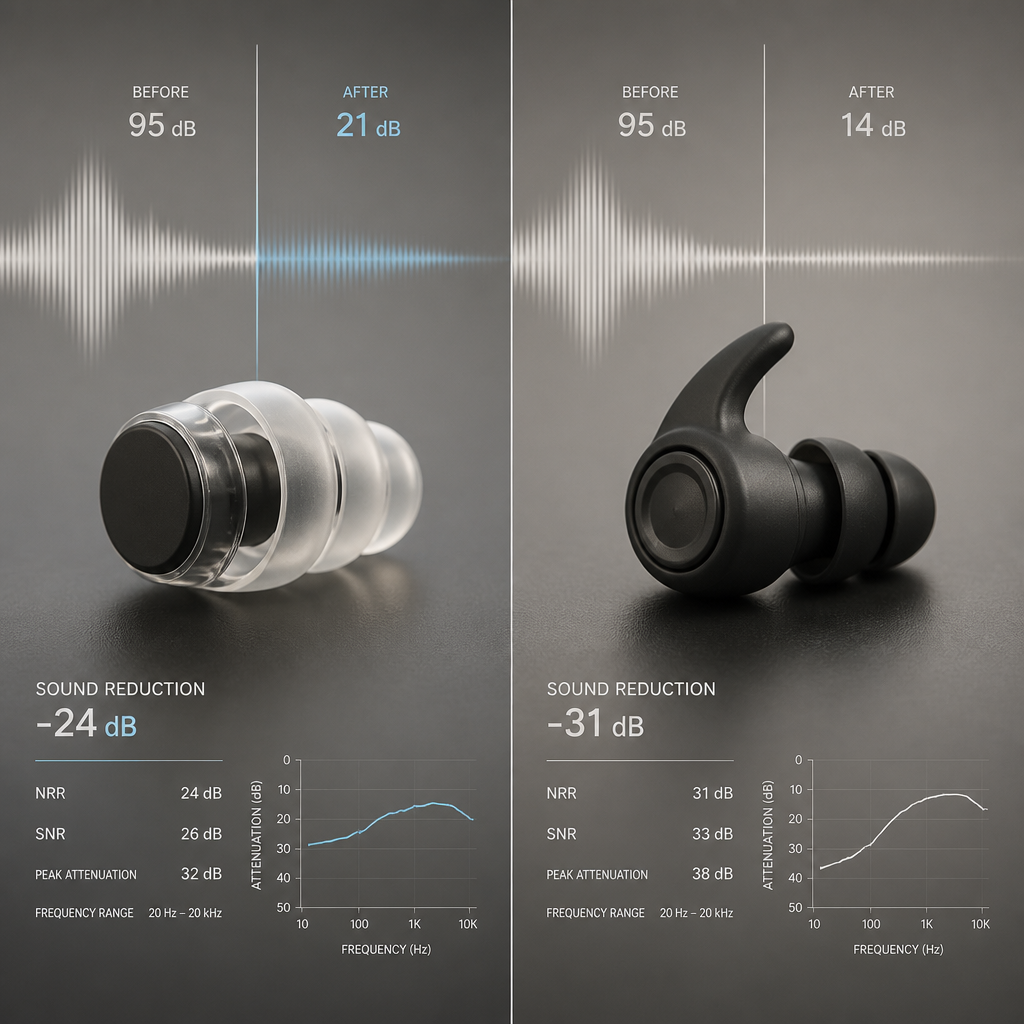
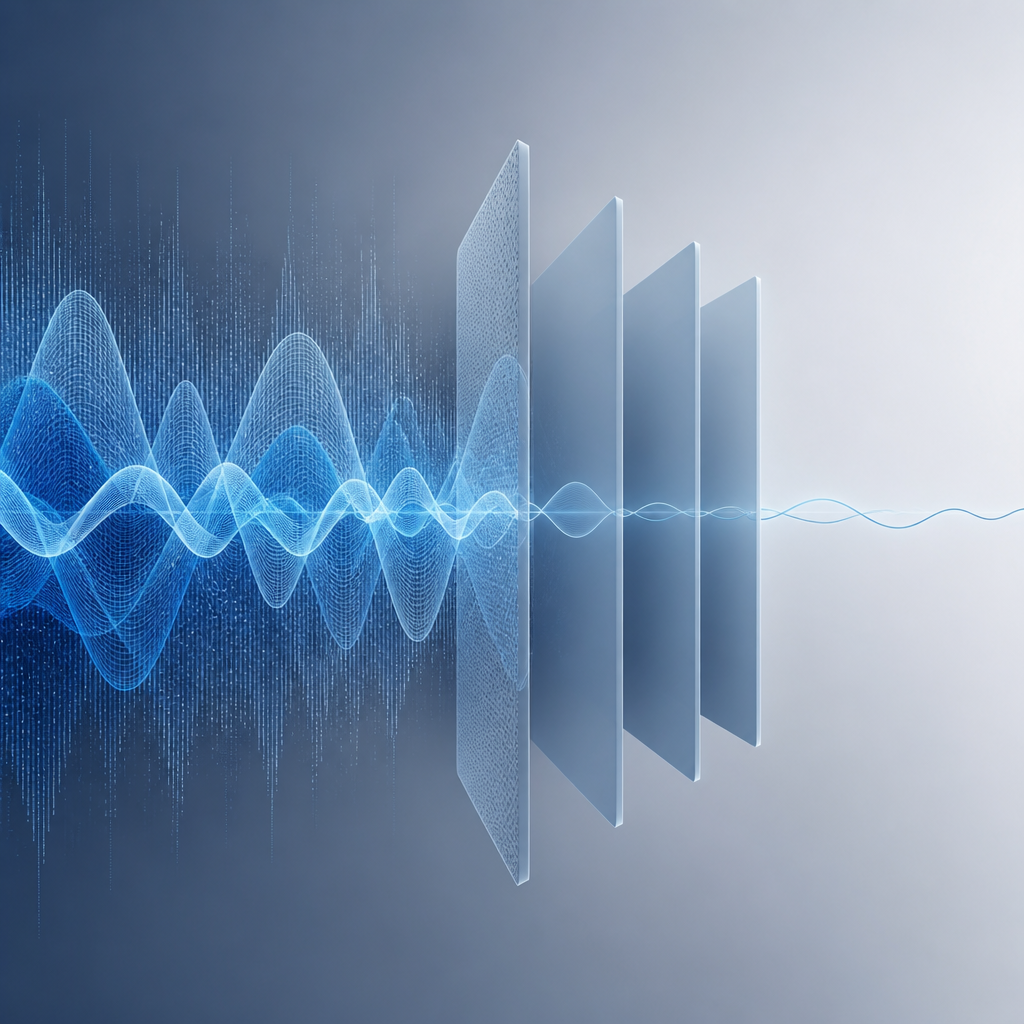
Understanding the physical construction of each product explains most of the performance differences before you even look at a spec sheet.
ATTENU8 uses a concave aluminium body paired with soft memory foam tips available in three sizes: XS, S, and M. The metal body is anodised and weighs approximately 2 grams per earplug, making it lighter than most people expect from a metal product. The concave shape improves grip during insertion and positions the foam tip precisely at the canal entrance, which is important for achieving a reliable acoustic seal night after night.
The physics behind the design are deliberate. Low-frequency sound, the type generated by snoring, traffic rumble, and HVAC systems, carries the most energy and is the hardest for standard foam to absorb. By creating a density change between the dense aluminium body and the compressible memory foam, ATTENU8 significantly improves attenuation in exactly this frequency range. This is not a marketing claim. It is the same acoustic principle used in industrial hearing protection design, applied to a consumer sleep product.
The product carries CE certification to BS EN352-2:2002, the European standard for hearing protection plugs. The SNR 32 rating places it in the same protection category as heavy-duty disposable foam earplugs, without requiring you to throw the earplug body away after each use.
Loop produces several distinct products targeting different use cases. The Quiet 2 is the model most directly aimed at sleep and focus users. It is made from flexible silicone rather than metal, which makes it softer and more pliable, but also means it lacks the acoustic mass that metal provides.
The Quiet 2 is rated at 24dB SNR (approximately 14dB NRR). The Experience 2, aimed at concerts and travel, is rated at 17dB SNR. The premium Switch 2 model, which includes a physical mode selector for toggling between three levels of attenuation, is rated at different levels depending on the mode selected. None of the Loop products reach the 32dB SNR level that ATTENU8 delivers.
Pro tip: When comparing earplug ratings, always look at SNR for European-market products and NRR for US-market products. They are calculated differently and cannot be directly compared as equal numbers. ATTENU8’s SNR 32 is not the same as a product with NRR 32. The key is to compare SNR to SNR or NRR to NRR for an honest picture.
The rated SNR or NRR figure on any earplug is a laboratory measurement. Real-world attenuation is consistently lower because ears differ, insertion technique varies, and no two ear canals are identical. Regulatory agencies in most markets recommend applying a halving correction to rated figures to estimate real-world protection. For ATTENU8 at SNR 32, a conservative real-world estimate is around 16dB of consistent nightly attenuation. For Loop Quiet 2 at SNR 24, the equivalent figure is around 12dB.
That 4dB difference might not sound significant, but acoustic attenuation is measured on a logarithmic scale. A 3dB difference represents roughly double the sound energy. The gap between 12dB and 16dB of real-world protection is not trivial for someone in a genuinely noisy environment.
The metal body of an earplug provides the structure and positioning that makes correct seal geometry repeatable night after night. The foam tip provides the actual acoustic seal. When both work together, consistent protection becomes achievable rather than hit-or-miss.
Standard SNR ratings are averaged across frequencies. What the number does not tell you is how a product performs specifically at low frequencies, which is where sleep-disrupting noise typically lives. Snoring peaks between 50Hz and 500Hz. Road traffic rumble sits in a similar range. Traditional foam plugs, and silicone earplugs by extension, attenuate high frequencies more effectively than low ones.
The density contrast in ATTENU8’s aluminium-plus-memory-foam construction creates better low-frequency attenuation than a uniform foam or silicone material. This is why users who have found standard foam earplugs insufficient for partner snoring often report a noticeable improvement with ATTENU8, even if both products carry similar top-line ratings.
Pro tip: If a partner’s snoring is the specific problem you are trying to solve, prioritise attenuation products with a metal or dense composite body. The rated SNR figure alone will not tell you whether a product handles low-frequency sound well. Look at the construction material first.

This is the area where the comparison becomes more nuanced. Comfort is not a single variable. It includes how an earplug feels during insertion, how it feels after several hours of wearing, whether it stays in place through movement, and whether it creates pressure pain when you lie on your side.
Side sleepers face a specific challenge that most earplug reviews gloss over. Any earplug that protrudes from the ear canal will create pressure against the pillow when you roll over. Sustained pressure on a hard object against soft tissue is uncomfortable enough to wake you up, which defeats the purpose of wearing the earplug in the first place.
ATTENU8’s concave aluminium body sits close to the ear canal entrance without significant protrusion. The 21mm height and 10mm width of the assembled earplug (body plus tip) is compact enough that most side sleepers do not report pillow pressure as a problem. The inclusion of a dedicated pair of flat bottom foam tips designed specifically for side sleepers further addresses this. This level of deliberate design for a specific sleep position is not something most competing products bother to include.
Loop Quiet 2 uses a small circular loop structure that connects to a tip. The loop itself is the part that sits against the outer ear. Some users find this comfortable because the loop is flexible silicone, but others, particularly those who move frequently during sleep, find the loop creates lateral pressure against the ear concha. The company markets the Quiet 2 as comfortable for side sleepers, and for many users it is, but the fit is highly dependent on individual ear geometry.
Both ATTENU8 and Loop Quiet 2 include multiple tip sizes. ATTENU8 provides XS, S, and M memory foam tips, plus the flat bottom tips for side sleepers. Loop Quiet 2 includes four sizes (XS, S, M, L). More tip sizes increase the probability of finding a good fit, which directly impacts how much noise reduction you actually achieve.
Memory foam, which ATTENU8 uses, expands to fill the ear canal shape after compression during insertion. This self-adapting behaviour creates a more reliable seal across a wider range of ear canal shapes than a fixed-geometry silicone tip. A silicone tip either fits or it does not. Memory foam adjusts. For users with irregular or unusually shaped ear canals, this matters significantly.
The table below compares ATTENU8 against the two most relevant product tiers from the Loop range: the sleep-focused Quiet 2 and the versatile Switch 2. All specifications are drawn from manufacturer or verified retailer listings.
| Feature | ATTENU8 | Loop Quiet 2 |
|---|---|---|
| Body material | Anodised aluminium (concave shape) | Flexible silicone |
| Tip material | Soft memory foam (replaceable) | Silicone tips (washable) |
| Noise reduction rating | SNR 32 (approx. 32dB) | SNR 24 / NRR 14 |
| Tip sizes included | XS, S, M + flat bottom tips for side sleepers | XS, S, M, L |
| Primary use case | Sleep, travel, high-noise industrial settings | Sleep, focus, general noise sensitivity |
| Certification | CE certified (BS EN352-2:2002) | CE certified |
| Tip replacement cycle | Every 6 to 8 weeks (tips only, body is permanent) | Full product replacement or tip cleaning |
| Protrusion from ear | Minimal (21mm height with tip) | Loop structure extends beyond ear canal |
| Low-frequency attenuation | Enhanced by metal-to-foam density change | Standard silicone attenuation |
| Best for side sleepers | Yes, includes dedicated flat bottom tips | Moderate, depends on ear shape |
ATTENU8 is the right choice if noise is seriously disrupting your sleep or if you work in an environment where adequate hearing protection is not optional. The SNR 32 rating with CE certification means it meets professional hearing protection standards. That matters if you are in construction, manufacturing, military settings, or any workplace where sustained noise exposure above safe thresholds is a reality. A lifestyle earplug rated at SNR 17 or SNR 24 is simply not appropriate in those environments, no matter how comfortable it is.
For sleep specifically, ATTENU8 is the stronger choice for light sleepers dealing with low-frequency noise sources: a snoring partner, traffic, HVAC systems, or neighbours with subwoofers. The combination of metal body acoustic mass and memory foam tip self-adapting seal addresses the exact conditions that standard foam or silicone earplugs handle poorly.
ATTENU8 is also the better long-term cost option for daily users. Because only the foam tips are consumable and those last 6 to 8 weeks each, the ongoing cost of ownership is low relative to disposable alternatives. The aluminium body does not degrade in the way foam does. It does not compress and lose its shape. It does not absorb moisture and soften over weeks of use. It is the same body on day one and on day 365.
Loop earplugs, on the other hand, make more sense for users who want a single product that moves between social settings, office focus work, and occasional sleep use. The multi-mode Switch 2 is particularly well suited to someone who does not need maximum attenuation but wants flexibility. If SNR 24 is sufficient for your noise environment and you prioritise a sleek appearance over raw decibel blocking, that product serves you well. The honest answer is that many people who think they need maximum attenuation actually do not, and for them, the versatility of a mid-tier silicone earplug is a genuine advantage.
But if you are reading this comparison because your current earplugs are not working well enough, the answer is almost always to move up the attenuation scale, not sideways to a product with a different aesthetic at a similar or lower protection rating.
The durability comparison between a metal-bodied and a silicone-bodied product is straightforward. Aluminium does not degrade under normal use conditions. It does not fatigue from repeated compression and release the way silicone eventually does. Silicone is a durable material in absolute terms, but it is less durable than anodised aluminium under the specific conditions of repeated nightly use.
The cost calculation favours ATTENU8 for high-frequency users. Disposable foam earplugs used nightly cost meaningfully more per year than a reusable product with only foam tip replacements every 6 to 8 weeks. The ATTENU8 model, where only the tips are replaced rather than the entire product, is inherently more cost-efficient for long-term regular users.
For occasional users, the comparison is less clear-cut. If you use earplugs a few times a month, any reusable product represents good value over disposables. In that case, the choice between ATTENU8 and a mid-range silicone earplug comes down to how much attenuation you actually need in those specific situations.
There is also an environmental dimension worth noting. Disposable foam earplugs are one of the more wasteful personal care products in common use. A product that replaces only the foam tip rather than the entire earplug every few weeks is a meaningful reduction in material waste for daily users. The aluminium body of ATTENU8 is also recyclable at end of life in a way that mixed-material or silicone products are not always handled cleanly.
For anyone serious about hearing health over the long term, the decision to invest in a higher-attenuation reusable product is one of the more straightforward ones to make. Hearing loss from noise exposure is cumulative and irreversible. Consistent protection matters more than occasional perfect protection. A product you actually wear every night, that fits reliably and delivers genuine attenuation, is worth more than a technically superior product that you skip using because it is uncomfortable or inconvenient. ATTENU8’s design specifically addresses the friction points that cause people to abandon hearing protection: difficult insertion, poor fit, discomfort during side sleeping, and the expense of constant replacement.
If you want to explore ATTENU8’s full product details, tip replacement options, or find the right size for your ear, visit attenu8.co directly.
For most people dealing with a snoring partner, ATTENU8 is the stronger choice. Snoring is a low-frequency sound, and the density contrast between ATTENU8’s aluminium body and memory foam tip creates better attenuation in that frequency range than silicone-bodied alternatives. The SNR 32 rating also provides approximately 8dB more rated protection than Loop Quiet 2’s SNR 24, which translates to a meaningful real-world difference in how effectively disruptive noise is blocked.
Yes. ATTENU8 is specifically designed with side sleepers in mind. The compact profile of the aluminium body minimises pillow pressure, and the product includes a dedicated pair of flat bottom foam tips designed to reduce protrusion further for side sleeping. This level of side-sleeper-specific design is not common across the earplug category.
The memory foam tips should be replaced approximately every 6 to 8 weeks under regular nightly use. The aluminium body itself does not need to be replaced. Only the consumable foam tip is changed, which makes ATTENU8 significantly more economical and less wasteful than disposable earplug alternatives used daily.
Loop’s product range is not generally designed or certified for industrial hearing protection requirements. Products rated at SNR 17 to SNR 24 fall below the attenuation typically required in sustained high-noise workplaces like construction sites, manufacturing floors, or military environments. ATTENU8’s SNR 32 rating and CE certification to BS EN352-2:2002 puts it in the hearing protection tier appropriate for professional noise environments.
Yes. While ATTENU8 is particularly effective for sleep, the same properties that make it useful at night (high attenuation, secure fit, reliable seal) make it useful in any high-noise environment. Frequent flyers, commuters on loud public transport, and people with general noise sensitivity during the day will benefit from the same level of consistent protection. The compact carrying case makes it practical to keep with you throughout the day.
SNR (Single Number Rating) is the European standard measurement for hearing protector attenuation. NRR (Noise Reduction Rating) is the US standard. They use different testing methodologies and cannot be compared as equal numbers. A product rated SNR 32 does not have the same real-world performance as a product rated NRR 32. When comparing earplugs across different markets, always confirm which standard applies and compare like-for-like. ATTENU8 carries an SNR 32 rating under European CE certification standards.
The Switch 2 is a versatile product designed for users who want one earplug that works across multiple settings: concerts, focus work, and sleep. It is a well-designed option for that specific use case. However, even in its highest-attenuation mode, it does not reach ATTENU8’s SNR 32 protection level. If your primary need is sleep protection or professional hearing protection, the Switch 2’s versatility does not compensate for the attenuation gap. If you genuinely need one product for multiple environments and maximum sleep attenuation is not the priority, the Switch 2 is a reasonable choice.
Have you tried ATTENU8, Loop earplugs, or any other reusable earplug for sleep or noise sensitivity? Share what worked, and what did not, in the comments below.
Most people who complain that earplugs “don’t work” are not using a bad product. They are using a good product badly. A poorly inserted earplug can deliver a fraction of its rated noise reduction, turning a 32dB shield into something closer to a windshield. Whether you are a light sleeper battling street noise, a construction worker protecting your hearing over a long career, or a frequent flyer trying to get rest on a plane, knowing how to insert earplugs correctly is the single highest-leverage thing you can do. This guide covers every step, every common mistake, and every check you need to get a true acoustic seal, every single time.
| Key Insight | Explanation |
|---|---|
| Pull your ear up and back before inserting | Straightening the ear canal is the step most people skip. Without it, the plug cannot seat deep enough to seal. |
| Roll memory foam into a thin cylinder first | A compressed plug enters the canal cleanly. An uncompressed plug bunches at the entrance and creates a shallow, leaky fit. |
| Hold the plug in place for 20 to 40 seconds | Memory foam needs time to expand and fill the canal. Releasing too early means the plug expands outward rather than inward. |
| Only about one-third of the plug should be visible | If you can see more than a third of the plug protruding, it is not inserted deeply enough to seal. |
| Tip size changes everything | A tip that is too small allows sound to leak around the sides. A tip that is too large causes discomfort and poor canal contact. |
| Dirty hands and oily skin break seals | Oils and debris on the foam surface prevent proper expansion against the canal wall. Wash hands before every insertion. |
| Metal-bodied reusable earplugs insert differently from disposables | With a rigid body like ATTENU8’s aluminium shell, you are seating the foam tip, not rolling the entire earplug. The technique is faster and more consistent once learned. |
The noise reduction number printed on an earplug’s packaging is measured in a laboratory under ideal conditions, by trained technicians fitting the plugs perfectly. In real-world use, a poor seal can cut your actual protection in half or worse. This gap between rated and real performance is not theoretical; it is the most important practical fact about hearing protection.
The fit is the product. A pair of ATTENU8 earplugs rated to approximately 32dB of noise reduction will only deliver that figure when the memory foam tips create a complete acoustic seal against the walls of your ear canal. A partial seal, even one that feels secure, lets low-frequency sound bypass the plug through the gap, which is exactly the rumble of engines, traffic, and snoring that sleepers and travellers most need to block.
A well-fitted earplug is not just more comfortable. It is a fundamentally different level of protection from the same piece of hardware.
Pro tip: Before spending money on a higher-rated earplug, check whether your current insertion technique is the actual bottleneck. A 32dB earplug inserted correctly will outperform a 36dB earplug inserted poorly, every time.
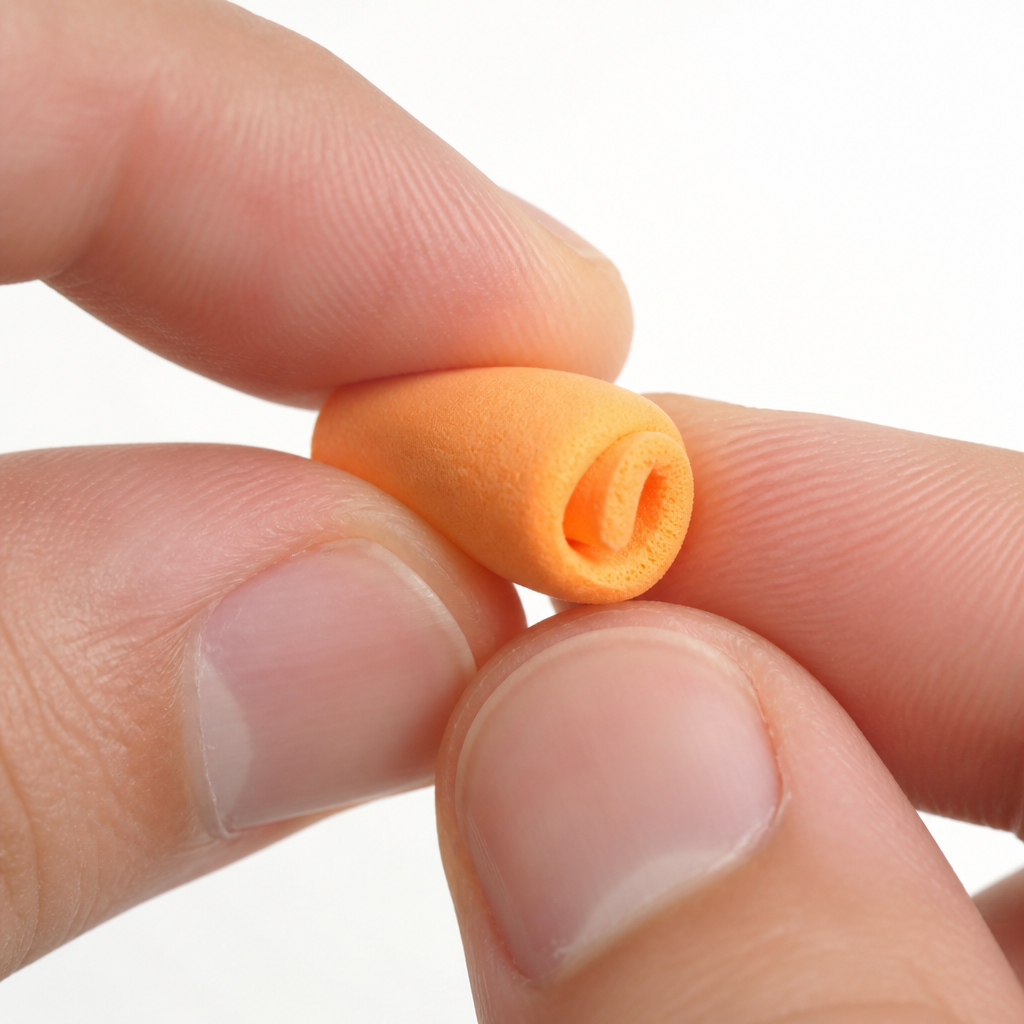
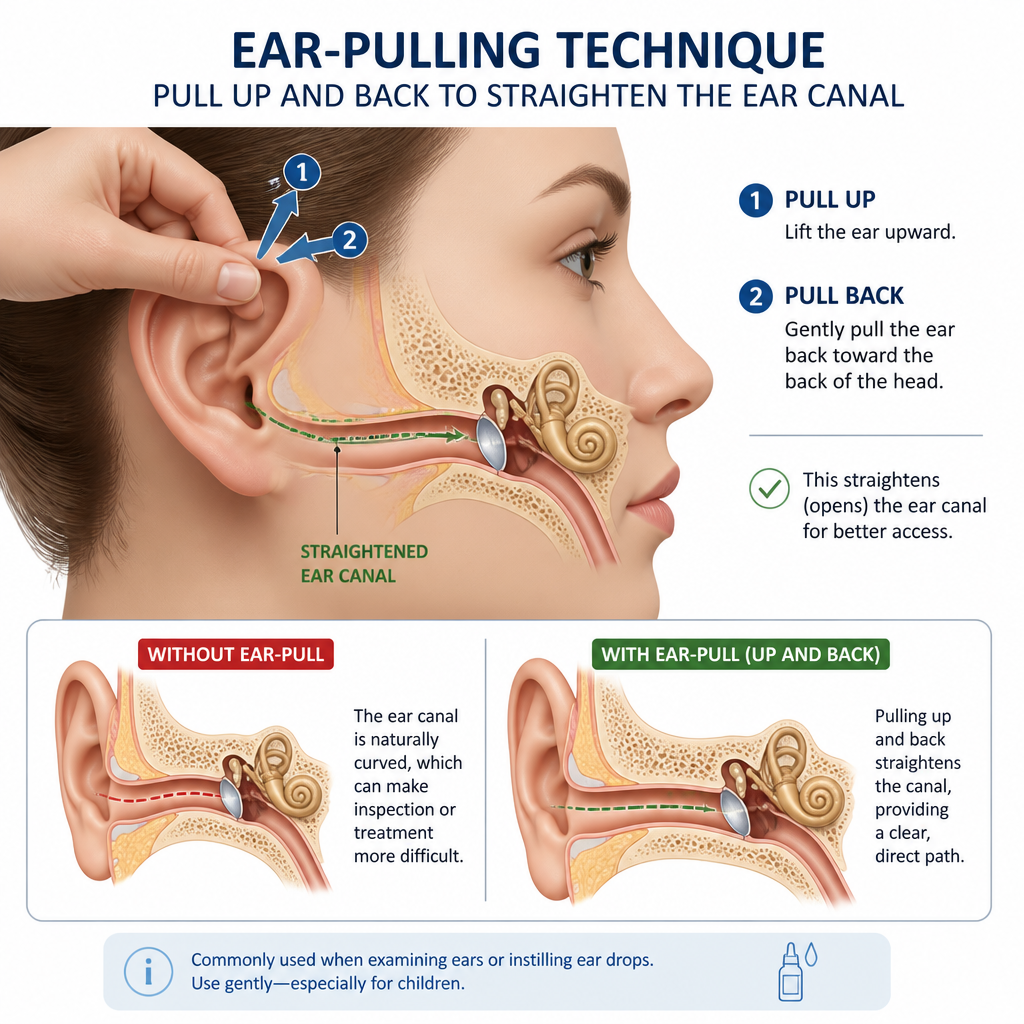
This guide covers both traditional rollable foam earplugs and metal-bodied reusable earplugs with memory foam tips, such as ATTENU8. The steps differ at the start, but the canal-opening and seating stages are identical.
Step 1: Wash your hands. Oils, skin cells, and debris on your fingers coat the foam and prevent even expansion against the canal wall. This is not optional hygiene advice; it directly affects acoustic performance.
Step 2: Roll the earplug into a thin, crease-free cylinder. Use your thumb and index finger to compress the foam lengthwise. The goal is a smooth, narrow tube with no ridges or bulges. Creases create uneven expansion and gaps in the seal.
Step 3: Pull your ear up and back to open the canal. Reach your opposite hand over the top of your head and grasp the upper portion of your ear. Pull gently upward and slightly backward. This straightens the natural curve of the ear canal, creating a direct path for the plug.
Step 4: Insert with a slight rotating motion. Guide the compressed plug into the canal with a gentle screw-like movement. Push it in until roughly two-thirds of the plug is inside the canal, with only a small portion visible at the entrance.
Step 5: Hold for 20 to 40 seconds. Keep your finger pressed gently against the plug while the foam expands. Releasing too early lets the plug push itself partway out before it has seated properly.
Step 1: Wash your hands and select your tip size. ATTENU8 ships with XS, S, and M memory foam tips. Choose the size that fills your canal without causing pressure. When in doubt between two sizes, try the smaller one first; a firm seal with a smaller tip beats a painful fit with a larger one.
Step 2: Compress the memory foam tip between your fingers. You are not rolling the entire earplug. Gently squeeze the foam tip to reduce its diameter before insertion. Because the aluminium body gives you a firm grip, this step is quicker and more controlled than rolling a disposable.
Step 3: Pull your ear up and back with your opposite hand. The canal-opening step is identical regardless of earplug type. Do not skip it. This is the step that separates a true seal from a surface-level fit.
Step 4: Guide the tip into the canal with a gentle twist. The concave body of the ATTENU8 plug gives you a natural grip point. Insert with a slight rotating motion until the tip is seated inside the canal and the aluminium body sits flush against the ear entrance.
Step 5: Hold for 20 to 30 seconds. Memory foam tips on a rigid body expand the same way as on a disposable. Keep your finger on the body of the plug, not just the tip, for a stable hold while the foam seats.
The quickest seal check is the cupping test. Once both earplugs are in, cup your palms firmly over both ears and then remove them repeatedly. If the sound changes noticeably when you cup your ears, the earplug is not sealing well, and you are relying on your hands to fill the gap. A correct seal should sound roughly the same whether your hands are in place or not.
A second check is your own voice. When earplugs are seated correctly, your voice sounds slightly muffled or hollow to you, like hearing yourself speak with your fingers in your ears. If your voice sounds normal, the plugs are not deep enough. If it sounds extremely booming or pressurised, the tips may be too large or inserted too aggressively.
Pro tip: Try counting out loud at a steady pace while slowly cupping and uncupping your ears. If the muffled quality of your voice stays consistent whether your hands are on or off, your seal is good. This is the same self-check recommended by occupational health guidelines for workers without access to formal fit-testing equipment.
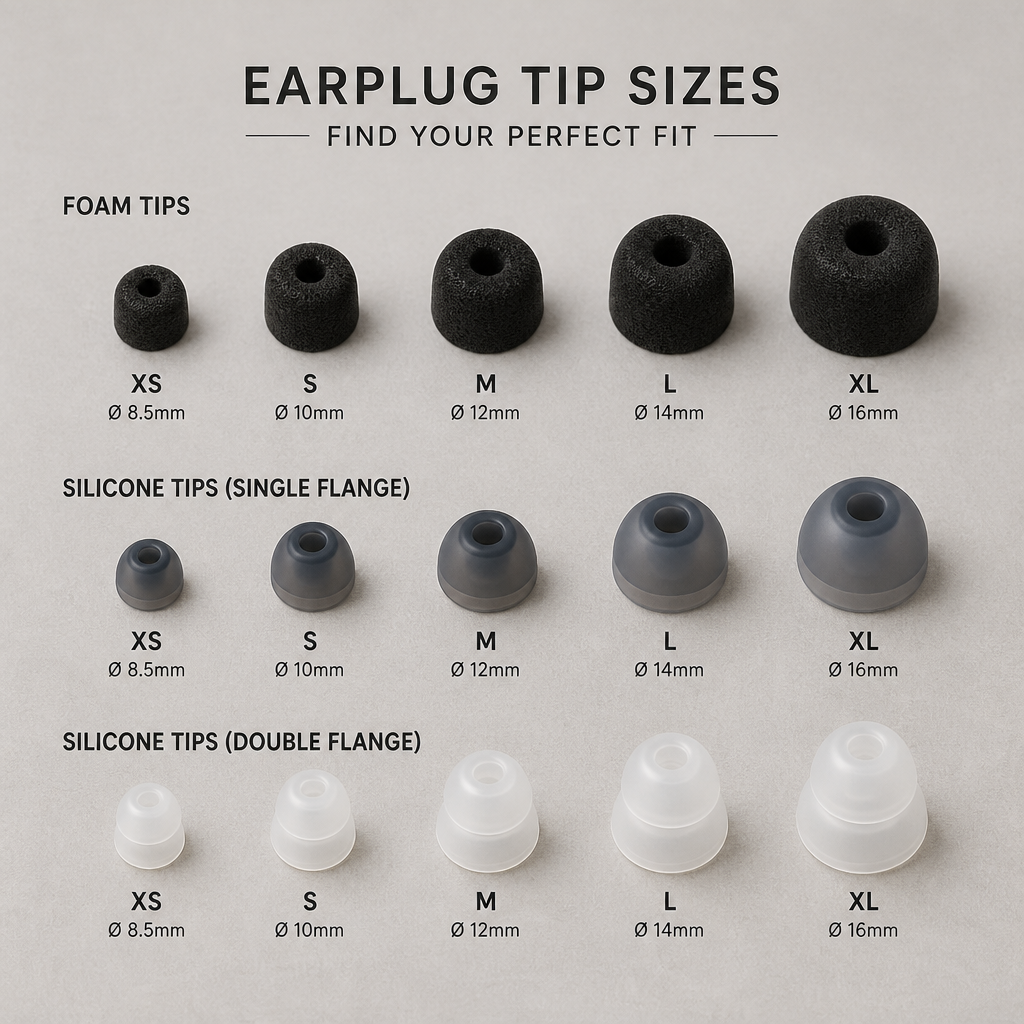
Tip size is not cosmetic. The right tip size is the one that matches your canal diameter well enough to create full circumferential contact with the canal wall once expanded. A tip that is too small will never seal, no matter how correctly you insert it. A tip that is too large causes pain, blocks natural insertion depth, and can actually reduce seal quality because it bunches at the canal entrance instead of seating inside it.
ATTENU8 includes three tip sizes (XS, S, and M) precisely because ear canal diameters vary significantly between individuals. The right approach is to start with the medium tip and assess comfort after a full hold period. If the tip is uncomfortable or feels like it is pressing against the canal walls rather than conforming to them, move down one size. If you feel no expansion pressure at all after the hold period, move up one size.
It is also worth knowing that your left and right ear canals may not be the same size. Some people need different tip sizes for each ear. This is normal, and it is one practical advantage of a system like ATTENU8’s that ships with multiple sizes rather than a single one-size-fits-all foam disposable.
Memory foam tips degrade over time. The foam loses its elasticity and stops expanding as fully as it did when new, which directly reduces seal quality even if your technique is correct. ATTENU8 tips are designed to be replaced every 6 to 8 weeks under regular use, at which point you replace the tips rather than the entire earplug. This replacement interval is not arbitrary; it is the point at which foam elasticity is typically no longer sufficient for a reliable seal.
The insertion technique and seal reliability differ meaningfully between earplug types. Understanding these differences helps you choose the right format for your situation and avoid applying the wrong technique.
| Earplug Type | Insertion Method | Seal Reliability and Longevity |
|---|---|---|
| Disposable rollable foam (single-use) | Full roll-pull-insert-hold technique required. Foam degrades after one use; seal quality drops sharply if reused. | Highest rated NRR available (up to 33dB), but consistency depends entirely on rolling quality. Single-use limits hygiene and long-term cost control. |
| Metal-bodied with memory foam tips (ATTENU8) | Compress the foam tip only. Rigid body provides better grip and more controlled insertion angle. Pull-ear step still required. | Consistent seal across uses because the body maintains shape. Tip replacement every 6 to 8 weeks maintains foam elasticity and seal integrity over months or years of use. |
| Pre-moulded silicone or flanged reusable | No rolling needed. Insert with pull-ear step and gentle twist to seat flanges. No hold time required. | Seal quality depends entirely on fit of fixed shape to your canal. Cannot adapt to minor canal shape variations. No degradation, but less adaptive than memory foam. |
The gap between a working earplug and a useless one is almost always one of a small number of repeatable errors. These are not edge-case problems. They are the norm for first-time users and surprisingly common even among experienced wearers who have developed bad habits.
This is the most common single mistake. The plug enters the canal opening but does not travel deep enough for the foam to expand against the canal walls. A shallow fit means that sound leaks in around the sides of the plug, reducing its noise-blocking ability significantly. The visual sign is more than one-third of the plug visible outside the ear after it has expanded.
The ear canal is not straight. It has a natural curve that makes deep insertion almost impossible without first straightening it by pulling the ear upward and back. Skipping this step is the reason many people find earplugs “impossible to insert properly.” The pull is not optional. It is what allows the plug to travel the full required depth.
Memory foam expands on a time delay. Releasing your finger after five seconds means the foam will push the plug outward as it expands, seating it at a shallower depth than where you placed it. The 20 to 40 second hold is the time required for the foam to conform to the canal before it exerts enough outward pressure to move the plug.
Choosing a tip size based on what seems comfortable in your fingers rather than what seals in your canal is a consistent source of poor protection. The right tip size is the smallest one that creates a full seal, not the largest one that fits without pain.
Oils and debris on the foam surface prevent the plug from making clean contact with the canal wall. Worn-out foam that no longer expands fully is an equally invisible problem, because the plug still feels like it is in place. Replace tips on a regular schedule rather than waiting until they visibly deteriorate. With ATTENU8, this means replacing memory foam tips every 6 to 8 weeks and keeping the aluminium body, which does not degrade.
The most reliable self-check is the cupping test. Cup both palms firmly over your ears and then release them. If sound changes significantly when you cup your ears, the earplugs are not sealing properly. A correctly sealed earplug should sound approximately the same whether your hands are over your ears or not. Your own voice will also sound slightly muffled when the seal is correct.
The most common reason is shallow insertion. If the foam has not expanded deep inside the canal, it has little to grip against, and movement during sleep pushes it out. Roll the foam thinner, pull your ear further up and back, insert deeper, and hold for the full 30 to 40 seconds. Using the correct tip size also matters. A tip that is too small provides minimal grip surface inside the canal.
Not necessarily. The left and right ear canals are often different sizes in the same person. Start by testing the medium tip in both ears. If one side consistently feels loose or fails the cupping test, try a smaller tip in that ear. ATTENU8’s multi-size tip system exists partly for this reason, allowing you to match each ear independently.
Memory foam tips lose their elasticity over time, which reduces how fully they expand inside the canal and weakens the acoustic seal. For regular daily use, plan to replace your tips every 6 to 8 weeks. The signs that tips need replacing include visibly compressed or discoloured foam, a feeling that the plug is looser than it used to be, or reduced noise attenuation that cannot be fixed by adjusting your technique. With ATTENU8, you replace only the foam tips rather than the entire earplug, which keeps ongoing costs low.
Technically you can insert them again, but the foam has already expanded once and loses much of its elasticity after the first use. A reused disposable earplug is unlikely to compress tightly enough for a clean insertion, which means a shallower fit and a weaker seal. For anyone using earplugs regularly, a reusable metal-bodied design with replaceable foam tips is both more hygienic and more economical over time.
Yes, and the difference is not subtle. The ear canal curves, and without pulling the ear upward and back, you are trying to push a soft foam cylinder around a corner. The pull straightens the canal, creates a direct insertion path, and allows the plug to reach the depth needed for a full seal. Most people who report that earplugs “never work for them” are skipping this step.
A correct seal creates a noticeable reduction in ambient sound, a slight sense of pressure or fullness in the ear, and a muffled quality to your own voice. It should not be painful. If you feel sharp pressure or pain, the tip may be too large or inserted too aggressively. If you feel nothing different from wearing no earplug, the plug is not deep enough or the tip size is too small for your canal.
Have you changed your insertion technique after reading this? Share what made the biggest difference for you, whether it was the ear pull, the hold time, or switching tip sizes, as your experience might help someone else.
Most people associate hearing damage with dramatic, obvious events: a gunshot, a rock concert, an industrial accident. The reality is far less dramatic, and far more common. Noise-induced hearing damage builds silently, exposure by exposure, across the ordinary soundtrack of daily life. The lawnmower on Saturday morning, the subway commute on Monday, the earbuds you wear to get through the afternoon: each one is doing work on your inner ear that your body cannot undo. Approximately 40 million American adults may have hearing loss resulting from noise exposure, and the mechanism is the same every time: once the hair cells inside your cochlea are gone, they do not grow back.
| Key Insight | Explanation |
|---|---|
| 85dB is the damage threshold | Sounds at or above 85 decibels can start damaging your hearing over time. Heavy traffic from inside a car already sits at this level. |
| Damage is cumulative and irreversible | Each loud exposure adds to a running total. Inner ear hair cells do not regenerate once destroyed. |
| Earbuds are a major underrated risk | Listening at high volume through earbuds or headphones consistently puts users above safe thresholds, especially with noise-cancelling devices cranked up. |
| Time at volume matters as much as the volume itself | At 85dB, 8 hours of exposure is the working safety limit. Every 3dB increase roughly halves the safe exposure duration. |
| Over 1.5 billion people worldwide have hearing impairment | The WHO reports this figure, with noise exposure being the primary occupational cause in adults. The number is projected to grow. |
| Reusable ear plugs with high SNR ratings offer consistent daily protection | A product rated at SNR 32 (like ATTENU8) delivers meaningful attenuation across the noise types you meet every day, not just in extreme environments. |
| Protection must be comfortable to be used consistently | Foam tips that conform to the ear canal create a seal. Rigid or ill-fitting plugs are discarded when they become uncomfortable, leaving you exposed. |
Decibels are not a linear scale. Every 3dB increase represents a doubling of sound intensity, which means the jump from 85dB to 100dB is not a modest step up but a dramatic one. Occupational safety standards in most countries set 85 decibels over eight hours as the maximum safe daily dose for workplace noise. Exceed that either in volume or in duration, and you are accumulating damage.
The physiology is straightforward and unforgiving. Your inner ear contains thousands of tiny hair cells in the cochlea. These cells convert sound vibrations into electrical signals your brain reads as sound. Loud noise physically bends and eventually destroys these cells. Unlike skin or bone, they do not regenerate. The loss is permanent, and it tends to start in the higher frequency ranges, which is why people with early noise-induced hearing damage often struggle to follow conversation in noisy rooms before they even notice anything is wrong.
Sounds at or below 70dB are generally considered safe for indefinite exposure. Normal conversation between two people sits at around 60dB. The problem is that almost everything else in a typical day edges closer to the danger zone than most people expect.
None of the following noise sources are exotic. Most people encounter several of them every single day without giving their hearing a second thought. That indifference is exactly the problem.
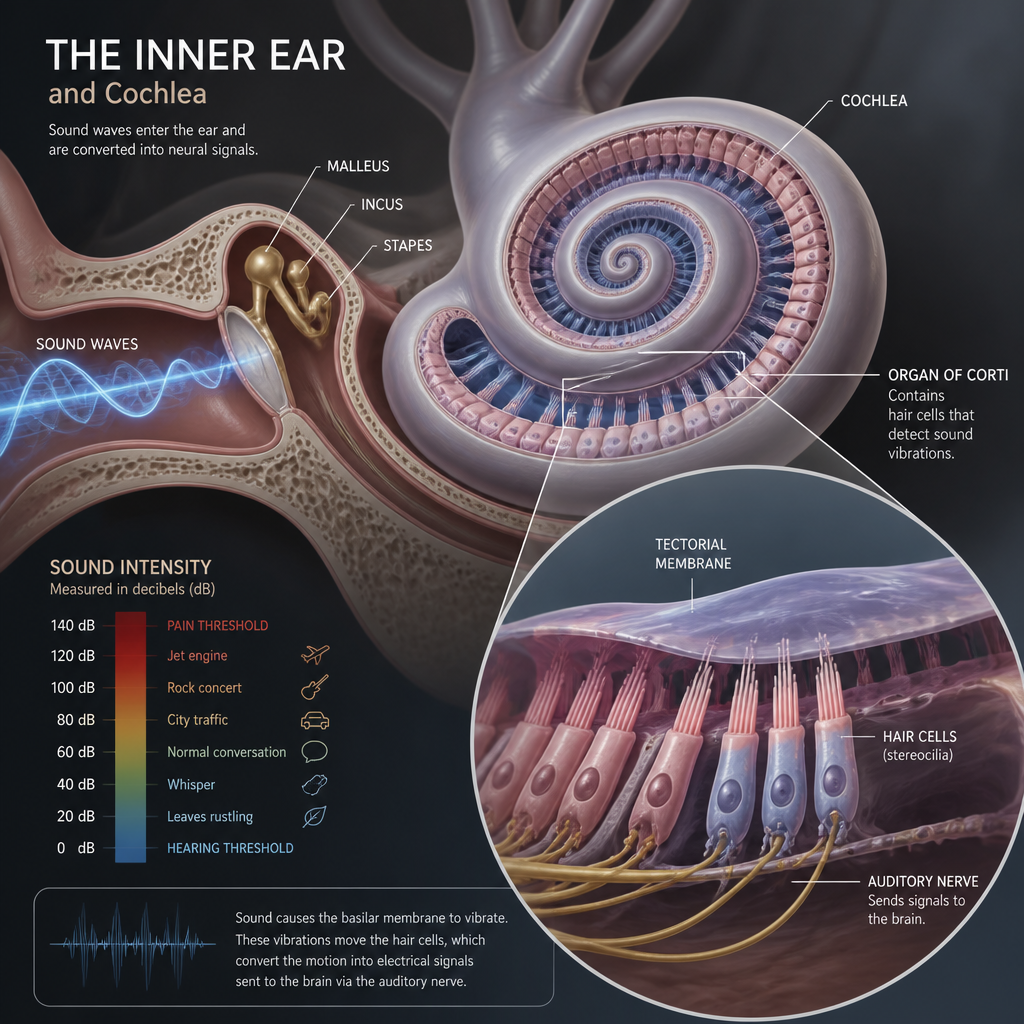

Sitting inside a car in heavy urban traffic already puts you at approximately 85dB, which is the occupational safety threshold. For daily commuters spending an hour or more in stop-and-go traffic with windows down or in a convertible, this exposure adds up across working weeks and years in a way that is genuinely consequential.
Subway noise regularly reaches 90dB or above, particularly when trains are accelerating or braking in enclosed stations. A 30-minute commute each way means an hour of near-constant 90dB exposure daily. Many commuters compound this by turning their earbuds up to overcome the background noise, pushing total exposure into a far more damaging range.
This is the most widespread source of noise-induced hearing damage in people under 35. Used at unsafe volumes, earbuds and headphones are contributing to an epidemic of hearing loss, particularly among young people. The World Health Organization has warned that over 1 billion young people aged 12 to 35 are at risk of permanent hearing damage from recreational noise exposure, with personal audio devices identified as a primary driver.
The problem is compounded by noisy environments. When you put earbuds in on a subway platform, you instinctively turn the volume up to hear your music over the train noise. You are now stacking two damaging sources on top of each other.
Yard work tools like power mowers and leaf blowers regularly register sounds over 90 decibels. A standard lawnmower session of 30 to 45 minutes without protection delivers a meaningful dose of noise-induced stress to your hearing. Most people operating this equipment are focused on the task and give no thought to their ears.
Hair dryers sit at around 90dB and are held close to the ear. A daily hair-drying routine of 10 to 15 minutes may seem trivial, but it is a daily, sustained exposure at a level above the safe threshold. The proximity to the ear matters: sound intensity drops with distance, so a dryer held close to the head delivers more energy than the same device at arm’s length.
Blenders, food processors, and garbage disposals all cluster around 85 to 90dB. Brief exposures from short appliance runs are less concerning than sustained ones, but households that run these appliances for extended periods daily, as in a commercial kitchen or a family preparing multiple meals, accumulate genuine noise exposure through this route.
DIY work is one of the most underappreciated sources of recreational hearing damage. Drills, circular saws, sanders, and nail guns operate well above 90dB, with some reaching 100 to 110dB. At 100dB, safe exposure time drops to roughly 15 minutes. Most home renovation sessions run for hours. The noise is not continuous, but the spikes are severe.
Busy restaurants and bars are noisier than most people realize. Background music, hard surfaces, and the collective noise of many conversations can push ambient levels to 85 to 95dB. A two-hour dinner in a loud venue is not a trivial exposure. This is a source that people tend to dismiss because it feels social rather than industrial, but the ears cannot distinguish context.
Live music venues are among the loudest environments most people voluntarily enter. Levels of 100dB or more are common, and at these intensities, safe exposure limits are measured in minutes rather than hours. A three-hour concert without protection is a significant acoustic event for your cochlea, and the ringing in your ears afterward is not a quirk: it is your auditory system signaling that damage has occurred.
Stadium crowds, air horns, and PA systems in enclosed arenas can reach 100dB or above. Like concerts, these are events people attend enthusiastically and repeatedly. The fact that the experience is enjoyable does not mitigate the physical effect on your inner ear hair cells.
Understanding noise-induced hearing damage requires thinking in terms of dose, not just peak volume. The relationship between loudness and safe exposure time is roughly this: at 85dB, you have about 8 hours. At 88dB, that drops to around 4 hours. At 91dB, roughly 2 hours. Every 3dB increase in sound level halves the duration you can safely tolerate.
This is why a commuter who spends 45 minutes on a loud subway, then works out with earbuds at high volume, then attends a loud restaurant lunch has potentially exceeded a safe daily noise dose before 2pm, without ever visiting a construction site or a concert.
The danger of everyday noise is not drama. It is repetition. The sounds that do the most cumulative damage are the ordinary ones you stop noticing precisely because they are ordinary.
Recreational noise is particularly problematic because it is not regulated or tracked the way occupational noise is. Workplace regulations set a cap of 85dB for eight hours, but this limit does not account for recreational noise exposure outside work, which can push total daily exposure well beyond a safe threshold.
Pro tip: If you need to raise your voice to be heard by someone standing an arm’s length away, the background noise is likely at or above 85dB. That is a reliable real-world signal to put hearing protection in.
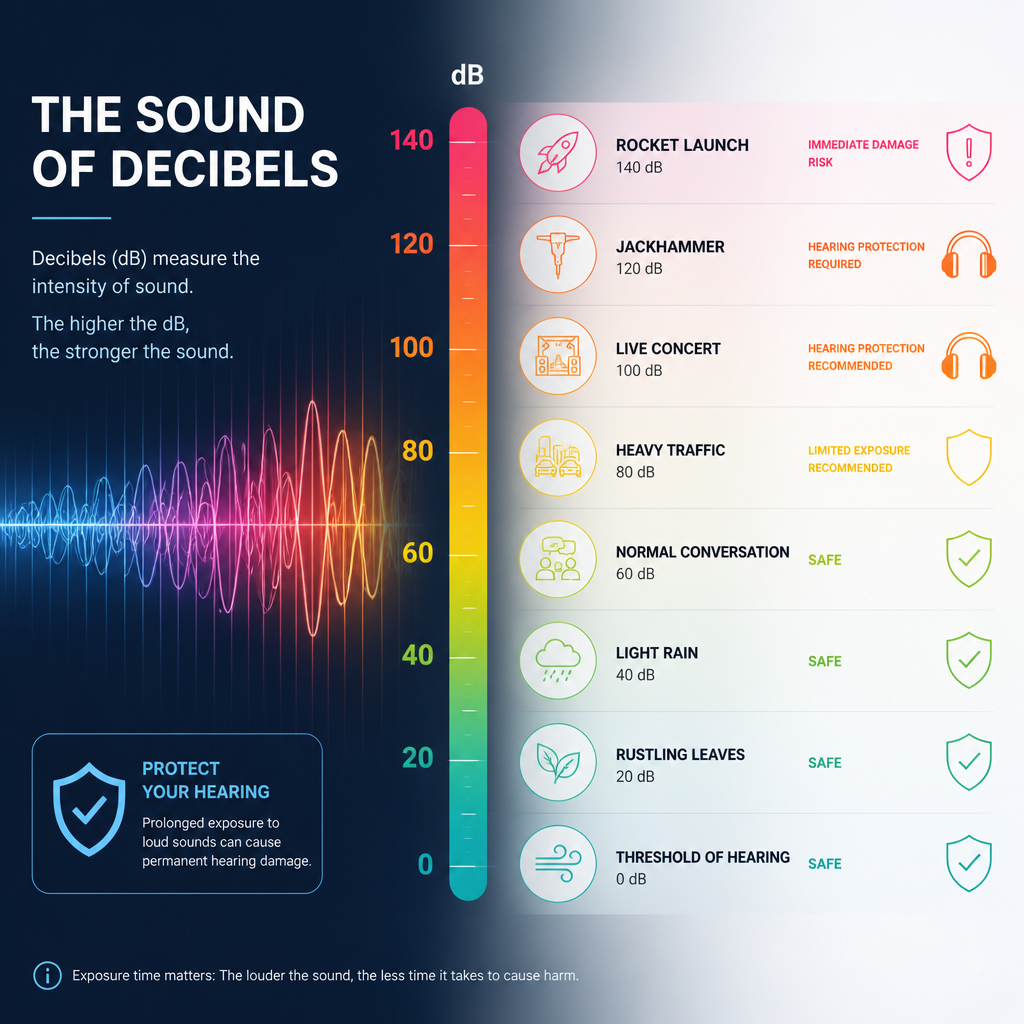
Not all hearing protection is equivalent. The format, fit, attenuation rating, and practicality for real-life use vary considerably. Here is a direct comparison of the three main categories people use for everyday noise-induced hearing damage prevention.
| Protection Type | Typical Noise Reduction | Best For / Limitations |
|---|---|---|
| Disposable foam ear plugs | Up to ~33dB NRR (when correctly inserted) | Cheap and widely available, but inconsistent fit, single-use waste, and uncomfortable for extended wear. Correct insertion is harder than it looks, reducing real-world attenuation significantly. |
| Earmuffs / over-ear protection | 20-30dB NRR depending on model | Easy to put on correctly and suitable for construction or power tool use. Bulky, hot, and impractical for commuting, sleep, or wearing in social environments. |
| Premium reusable metal-bodied ear plugs (e.g. ATTENU8, SNR 32) | Approximately 32dB noise reduction | Consistent attenuation across noise types, with memory foam tips in multiple sizes (XS, S, M) that conform to the ear canal for a proper seal. Durable body requires only foam tip replacement every 6 to 8 weeks rather than full replacement. Practical for sleep, commuting, concerts, and occupational use. |
The practical gap between disposable foam plugs and a well-designed reusable option is significant. A disposable plug that is not inserted correctly delivers a fraction of its rated protection. A plug with a concave body that is easy to grip and memory foam tips that seal to the individual ear canal removes that variable. You either have a seal or you do not, and a proper fit tells you immediately.
Pro tip: If you are wearing ear plugs for sleep or travel, the body shape matters as much as the attenuation rating. A flat or cylindrical plug presses against the ear canal when you lie on your side. A concave design reduces that contact pressure, making sustained wear far more tolerable and far more likely to actually stay in through the night.
Generic advice about hearing protection tends to be useless because it treats protection as an occasional intervention for extreme situations. The sources of noise-induced hearing damage outlined above are not extreme. They are the ordinary pattern of daily life. Protection that only gets used at concerts will not prevent the damage being done on the subway every morning.
For sleep, the priorities are comfort during sustained wear and sufficient attenuation to block snoring partners, traffic outside, or urban ambient noise. For commuting, you need something that fits discreetly in an ear without falling out on a moving train. For construction or power tools, you need the highest practical attenuation you can achieve with a well-sealed fit. One product does not always serve all three contexts equally well, but a premium reusable plug with multiple tip sizes gives you a much better chance of finding a configuration that works across them.
A common mistake is treating hearing protection as equipment for specific jobs rather than a daily item. If your ear plugs are in your work locker or your tool bag, they are not with you when you need them at a restaurant, on a train, or at a weekend event. Carrying a compact reusable case in a pocket or everyday bag removes the friction point that causes people to go without protection in situations where they clearly need it.
Memory foam tips that have degraded do not seal as effectively even if they appear intact. With ATTENU8, the replacement schedule is every 6 to 8 weeks for regular users. Ignoring this means you are wearing protection that delivers less attenuation than the rated figure, which defeats the purpose, particularly at borderline noise levels around 85 to 90dB where a few extra decibels of reduction make a genuine difference.
Sounds at or below 70dB are considered safe for extended listening. That gives you a practical target: keep your personal audio at a volume where you could still hold a conversation with someone nearby without raising your voice significantly. If you cannot hear someone speaking normally over your music, you are almost certainly above safe levels. Noise-cancelling features in some headphones let you lower volume while maintaining clarity, which is one of the more practical ways to reduce total daily noise dose from personal audio.
For anyone whose work or lifestyle involves regular loud noise exposure, the most effective approach is layering protection: keep your personal audio at safe volumes, use ear plugs during high-noise activities, and treat protection as a non-negotiable part of the day rather than an inconvenience to consider at the last minute.
Sounds at or above 85 decibels can damage your hearing over time, depending on how long you are exposed. Brief exposure to very high levels, such as a gunshot or explosion, can cause immediate damage in a single event. For everyday sounds like traffic, appliances, and personal audio devices, it is the sustained duration at or above 85dB that accumulates into measurable hearing loss.
No. The inner ear hair cells in the cochlea that are destroyed by loud noise do not regenerate. Some very brief exposures may cause temporary threshold shifts, which is the muffled feeling and ringing you experience after a loud concert, and hearing may seem to recover. But repeated temporary damage leads to permanent loss, and the cells responsible for high-frequency hearing tend to go first.
At maximum volume, many consumer earbuds and headphones can reach 100 to 110dB or higher. Even at 60 to 70 percent volume, some devices deliver levels well above 85dB directly into the ear canal. The proximity of the speaker to the eardrum amplifies the effect compared to a distant sound source at the same decibel reading.
Daily ear plug use is safe for most people when plugs are kept clean and tips are replaced regularly. Using dirty or degraded tips can increase the risk of minor ear canal irritation. The bigger practical risk is wearing plugs that do not fit correctly, which reduces their protective value and can cause pressure discomfort during extended wear. Soft memory foam tips in multiple sizes address both issues by conforming to the individual ear canal rather than forcing a rigid fit.
Yes, if you do these things frequently. Lawn mowers and hair dryers both sit at approximately 90dB, and at that level, repeated exposures without protection add to cumulative hearing damage. A single session is not the issue. The problem is doing these things daily or weekly for years without any protection, which is exactly how noise-induced hearing damage progresses without anyone noticing until the loss is significant.
Both are standardized measures of how much noise a hearing protection device reduces, but they use different testing methods and are used in different markets. NRR (Noise Reduction Rating) is the standard used in the United States, while SNR (Single Number Rating) is used in Europe. An SNR of 32, as carried by ATTENU8 ear plugs, means the device is certified to reduce noise exposure by 32 decibels under the European standard, which represents strong attenuation for everyday and occupational noise sources.
Have you found a particular noise source in your daily routine that surprised you once you started paying attention to it? Share your experience in the comments below.
You buy a pair of earplugs, the label says 33 dB, and you expect 33 dB of silence. Then you wear them on a construction site or try sleeping next to a snoring partner and wonder why they feel barely adequate. The problem is not the earplugs. The problem is that the earplug decibel rating printed on the box is a lab number, not a real-world guarantee. Understanding what NRR and SNR actually measure, how they are calculated, and how much protection you realistically get from them is the difference between choosing hearing protection that works and buying false confidence.
| Key Insight | Explanation |
|---|---|
| NRR is a US lab standard | The Noise Reduction Rating is set by the EPA and tested under ANSI S12.6 standards in controlled lab conditions. Real-world protection is always lower. |
| SNR is the European equivalent | The Single Number Rating follows EN 352 standards and is typically 3 dB higher than the NRR for the same product. The two numbers are not directly interchangeable. |
| The OSHA real-world formula is (NRR – 7) / 2 | This gives you a more realistic estimate of actual decibel reduction. An earplug rated NRR 33 delivers roughly 13 dB of real protection under typical wearing conditions. |
| NIOSH recommends halving the NRR for foam earplugs | The National Institute for Occupational Safety and Health derates formable foam earplugs by 50% to reflect inconsistent insertion quality in actual use. |
| Fit is the biggest variable | A poorly inserted earplug with NRR 33 can drop to just 10 dB of effective attenuation. Rating means nothing without a proper seal. |
| 85 dB is the critical threshold | Sustained noise exposure at or above 85 dB over an 8-hour period can cause permanent hearing damage. Your earplug choice should keep you comfortably below this level. |
| Higher NRR is not always better for sleep or travel | For light sleepers or commuters, a moderate but consistently well-fitting earplug delivering 25-30 dB reliably outperforms a high-NRR earplug inserted badly. |
An earplug decibel rating is a single number expressed in decibels (dB) that tells you, in theory, how much ambient noise a hearing protection device can block. Two systems dominate the market: NRR (Noise Reduction Rating), used in the United States, and SNR (Single Number Rating), used across Europe and increasingly elsewhere. Both ratings measure the same fundamental thing – attenuation, meaning the reduction in sound intensity that reaches your ear canal – but they use different test protocols, different frequency ranges, and different statistical methods, which is why the same pair of earplugs can carry two different numbers depending on which side of the Atlantic it is being sold on.
Before diving into the mechanics, it helps to understand what decibels actually represent. The decibel scale is logarithmic, not linear. A sound at 90 dB is not twice as loud as one at 45 dB. A 3 dB increase in sound intensity actually represents a doubling of sound energy. This matters enormously when evaluating earplug ratings, because even a few decibels of difference in real attenuation translates to a meaningful change in noise exposure at the eardrum.
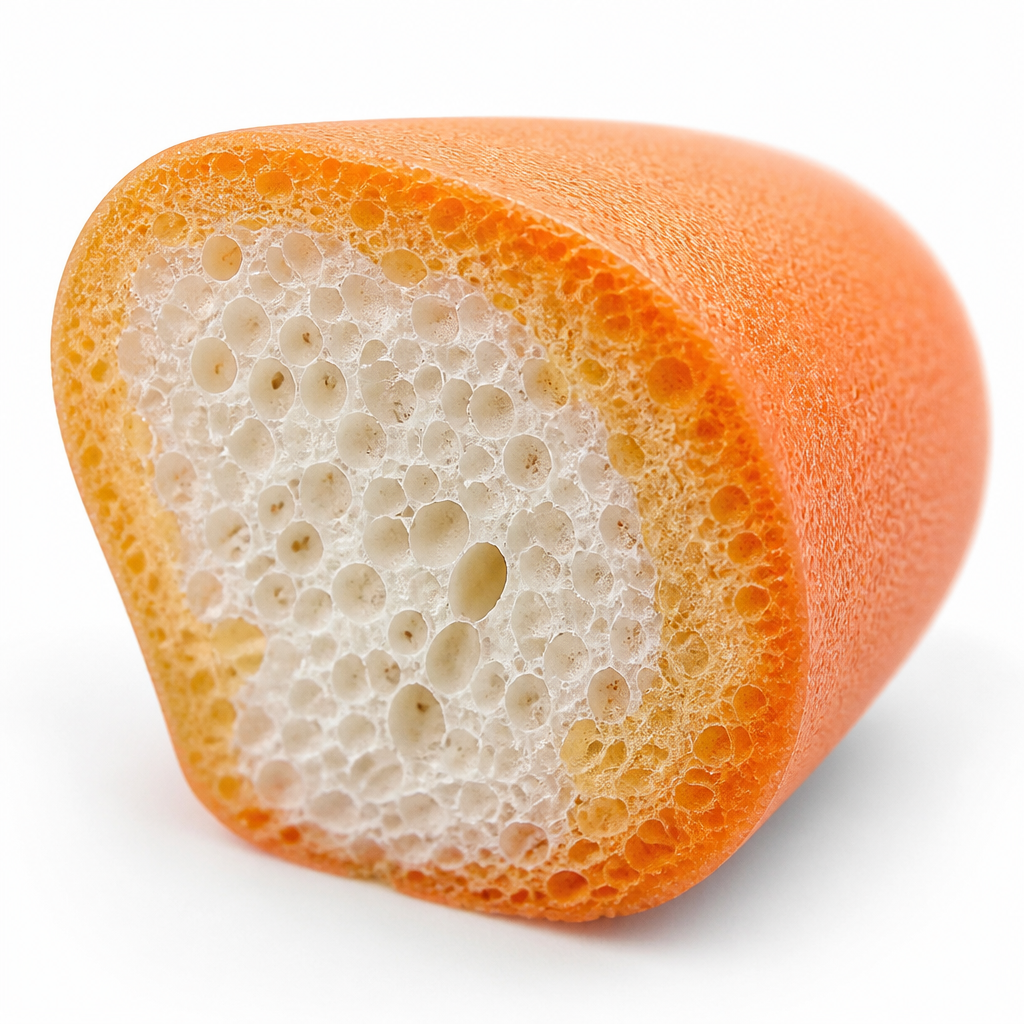
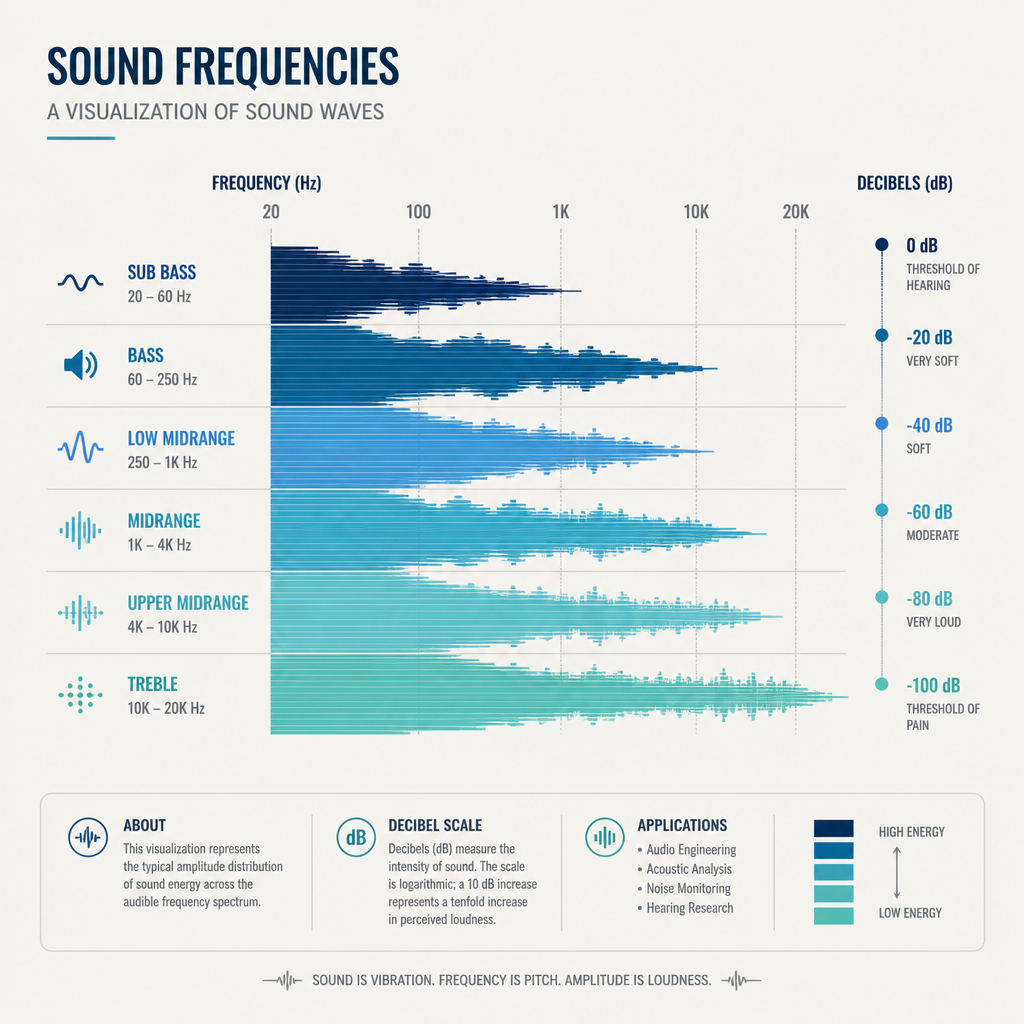
The Noise Reduction Rating is the standard measurement used in the United States to indicate how much noise a hearing protection device can reduce. It is expressed in decibels and is regulated by the US Environmental Protection Agency (EPA), which requires the NRR to be printed on the label of every hearing protector sold in the country. The testing process follows ANSI standards and involves exposing the hearing protection device to different frequencies of sound in a laboratory, then measuring the attenuation across those frequencies to produce an average.
The result is a single number: the NRR. A device with an NRR of 30 dB means it was measured, under ideal lab conditions with trained subjects inserting it perfectly, to reduce noise by 30 dB. The critical phrase is “under ideal lab conditions.” Real human ears, real insertion technique, and real environments introduce variation that the lab does not capture. This is why regulatory bodies and occupational health authorities consistently recommend applying a derating formula before treating the NRR as a practical guide.
The NRR is derived from a controlled test. Participants wear the hearing protection device, sounds at various frequencies are played, and the attenuation at each frequency is measured. An adjustment value is then applied to account for variability, and the final figure is divided by two. For earplugs, the adjustment value used is 7 dB. This means the rated NRR is already somewhat conservative compared to raw attenuation data, but it still reflects better-than-average insertion quality because laboratory subjects are trained in how to fit the device correctly.
Pro tip: When evaluating any earplug on the NRR alone, remember the number was generated by trained test subjects in a quiet lab. Your first-time insertion in a noisy environment will almost never match those conditions. Budget a real-world performance figure that is meaningfully lower than the label.
Because NRR overstates real-world protection, both OSHA and NIOSH apply derating methods. OSHA recommends derating all hearing protection by 50%. NIOSH goes further, recommending a 50% derating for formable foam earplugs and a 70% derating for all other earplugs, while applying only 25% derating to earmuffs. The most widely used practical formula for everyday estimates is the OSHA method: (NRR – 7) / 2. For an earplug with an NRR of 33, that calculation gives you (33 – 7) / 2 = 13 dB of realistic noise reduction. If ambient noise is 100 dB and you apply 13 dB of protection, your effective exposure is around 87 dB, still close to the 85 dB danger threshold.
This is not a flaw in the formula. It is an honest acknowledgment that rated performance and worn performance are not the same thing, and that hearing protection choices should be made with conservative estimates, not optimistic ones.
The Single Number Rating is the European equivalent of the NRR. It is the standard method used primarily in Europe under EN 352 standards to indicate the noise attenuation capability of a hearing protection device. The SNR provides a single-figure estimate of how many decibels a protector can reduce, averaged across a broad spectrum of sound frequencies from 63 Hz to 8,000 Hz. This wide frequency range is designed to account for both high-frequency sounds such as whistles and machinery whine, and low-frequency sounds such as engine rumble and bass noise.
For most earplugs and earmuffs, the SNR is roughly 3 dB higher than the NRR for the same product. This difference is not because European earplugs perform better. It reflects the different calculation methods and statistical approaches used by each standard. The two ratings are not directly interchangeable, and you should not compare an NRR from one product with an SNR from another and assume the higher number is superior protection.
To use the SNR, subtract it from the noise level you are exposed to. An SNR of 35 worn in an environment measuring 100 dB would give a theoretical exposure of 65 dB at the ear. As with NRR, this is a best-case figure. The EN 352 standard acknowledges that real-world attenuation depends heavily on the quality of fit, which varies from person to person and insertion to insertion.
The actual decibel reduction from wearing hearing protection may not match the rated number. Fit quality and insertion technique are the dominant variables that determine real-world performance, not the rating on the label.
If you are purchasing earplugs sold in both the US and EU markets, you will often see both ratings on the packaging. In that case, use the NRR and the OSHA formula if you are in the US, or the SNR if you are evaluating against European occupational exposure limits. Do not mix the two in the same calculation.
Understanding which standard applies to your context saves confusion when shopping for hearing protection. The table below compares the two systems across the dimensions that matter most to buyers and professionals.
| Feature | NRR (Noise Reduction Rating) | SNR (Single Number Rating) |
|---|---|---|
| Primary region of use | United States | Europe (and many international markets) |
| Regulatory body | US EPA (under ANSI S12.6) | European EN 352 standard |
| Frequency range tested | 125 Hz to 8,000 Hz | 63 Hz to 8,000 Hz (broader low-frequency coverage) |
| Typical value for same product | Lower number (e.g., NRR 29) | Higher number (e.g., SNR 32), typically ~3 dB more |
| Recommended derating | OSHA: 50% / NIOSH: 50-70% for earplugs | No universal mandatory derating formula, but real-world performance still falls below the label |
| Label requirement | Mandatory on all US hearing protectors | Mandatory for CE-marked products sold in Europe |
| Direct comparability | NRR and SNR are not directly comparable. Do not use one to evaluate a product rated only with the other. | |
This is where most earplug buying decisions go wrong. People see a high NRR rating and assume they are fully protected. In practice, the gap between the label and reality can be substantial. Laboratory NRR tests are performed by trained subjects who insert the earplugs correctly under controlled conditions. Real users, inserting earplugs quickly in noisy environments, often achieve significantly lower attenuation.
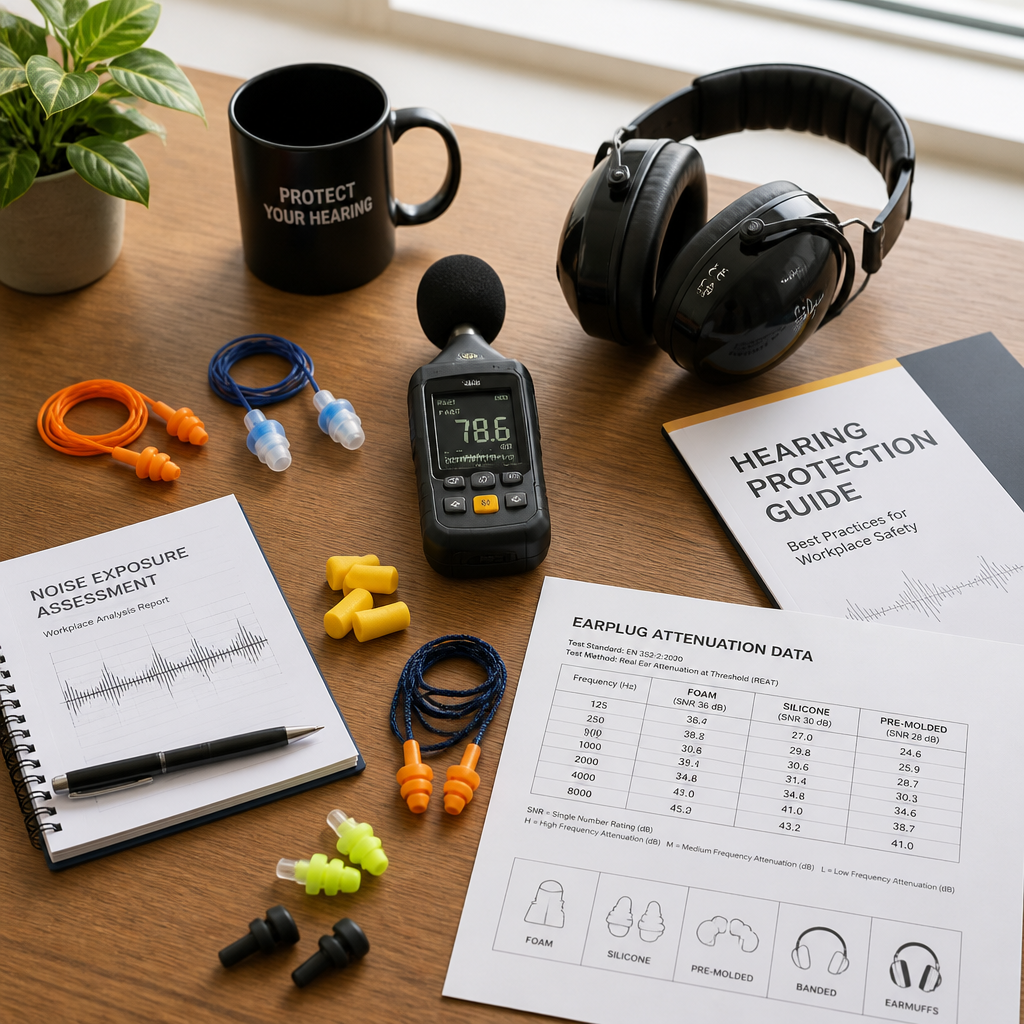
A commonly cited example from occupational health literature makes this concrete: an earplug rated NRR 33, inserted poorly, can drop to providing just 10 dB of effective noise reduction. That is not an edge case. That is what happens when people push foam earplugs into their ear canals without rolling them down first, or when an earplug body does not create a proper seal against the canal wall.
For practical planning, use the OSHA method: (NRR – 7) / 2 = estimated real dB reduction. Here is what that looks like across common NRR values:
Note that these estimates apply to conditions where fit is average. Earplugs that consistently deliver a reliable seal, because of their design, material, or adjustable tip system, will perform closer to their rated figure than earplugs that rely entirely on the user rolling and inserting a loose foam cylinder correctly every time.
If you are working in an extremely loud environment and need maximum attenuation, you can wear earplugs and earmuffs simultaneously. However, you cannot simply add the two NRR ratings together. When using two forms of hearing protection in combination, you add only 5 dB to the device with the higher NRR. This reflects the physical limits of sound blocking once you have created a basic seal around the ear canal.
Pro tip: For sleep and travel use, combining two protection devices is rarely practical or comfortable. Instead, focus on consistent fit quality from a single well-designed pair of earplugs with memory foam tips. A product that delivers a reliable seal every night is more valuable than a higher NRR that only materialises under perfect insertion conditions.
The answer depends entirely on what you are protecting against. There is no universal “right” NRR because the purpose matters. Noise reduction needs fall into two broad categories: occupational hearing protection, where you are preventing permanent hearing damage, and comfort and sleep use, where you are managing unwanted sound to preserve sleep quality or concentration.
For construction workers, manufacturing professionals, and anyone exposed to heavy machinery, the goal is keeping effective noise exposure below 85 dB. At or above this level for an 8-hour working day, the risk of permanent noise-induced hearing loss becomes significant. For an environment running at 100 dB, you need an earplug that delivers at least 15 dB of real-world reduction after applying the OSHA derating formula. That means an NRR of at least 29-33 on the label. Military personnel in particular may face impulse noise from firearms or explosions, which requires specialist hearing protection rated for both sustained and peak noise events.
For light sleepers, travellers, and people working in noisy open offices, the noise environment is typically much lower than an industrial site. Ambient traffic, a snoring partner, or aircraft cabin noise typically falls in the 60-80 dB range. In these cases, you do not need the maximum possible NRR. You need an earplug that fits comfortably enough to wear for hours, creates a reliable seal without causing ear canal irritation, and provides consistent attenuation night after night. A reusable earplug with memory foam tips such as those on the ATTENU8, which are designed in three tip sizes (XS, S, and M) to match individual ear canal geometry, solves the comfort-and-consistency problem that undermines many high-NRR disposable foam earplugs.
With approximately 32 dB of noise reduction, the ATTENU8 sits at the practical upper end of what a well-designed earplug can deliver for everyday use. Applied against the OSHA formula, that is roughly 12.5 dB of conservative real-world reduction, and likely more in practice for users who achieve a good seal with the correct foam tip size, because the concave aluminium body holds the memory foam tip securely in position throughout the night.
Of all the factors that determine how much noise protection you actually receive, fit is the most important and the most underestimated. A poorly fitting earplug creates gaps between the foam and the ear canal wall, and those gaps allow sound to bypass all the blocking material entirely. Even a small gap can reduce effective attenuation by 10 dB or more. This is why the same NRR 33 earplug can protect one person adequately and barely protect another at all.
The fit problem is particularly acute with standard disposable foam earplugs. They require a specific rolling and insertion technique. They need to be held in the canal while they expand. They work best in ear canals that fall within a narrow size range. When these conditions are not met consistently, the earplug decibel rating on the box becomes almost meaningless as a guide to actual protection.
Memory foam tip systems that come in multiple sizes address this problem directly. When you can select the tip size that matches your specific ear canal, the foam has less work to do in bridging gaps and more of its surface area is in contact with the canal wall from the moment of insertion. The result is a more reliable, more repeatable seal, which means the real-world attenuation you get is closer to the rated figure and stays there throughout the night or work shift rather than degrading as the earplug slowly works itself loose.
This is one of the key reasons that reusable metal-bodied earplugs with replaceable memory foam tips represent a meaningful step up from disposable foam cylinders for consistent users. The aluminium body maintains its position in the ear canal. The memory foam tip provides the seal. The combination reduces the insertion variability that is the primary cause of the gap between rated NRR and real-world performance.
Memory foam degrades over time, losing its ability to expand to a full seal. For regular users, this means the tips need periodic replacement, not the entire earplug. Replacing foam tips every 6 to 8 weeks maintains the consistent sealing performance that makes the rated noise reduction achievable in practice. This is both more economical and more environmentally sustainable than discarding the entire earplug every few uses.
An earplug’s decibel rating, expressed as NRR or SNR, represents the amount of noise reduction the earplug was measured to provide during standardised laboratory testing. It is not a guarantee of what you will experience in practice. Real-world reduction depends heavily on fit, insertion technique, and how well the earplug matches your ear canal size. Use the OSHA formula (NRR – 7) / 2 to estimate a more realistic figure for everyday conditions.
Not necessarily. A higher NRR rating is important when you are exposed to very loud noise, such as on construction sites, shooting ranges, or in manufacturing facilities. For sleep or travel, where the goal is comfort over extended periods, a slightly lower NRR in an earplug that fits reliably and stays in place all night will protect you more effectively than a higher-rated earplug that you remove at 3am because it is uncomfortable or has shifted out of position.
The NRR and SNR are calculated using different testing protocols. The NRR follows US ANSI standards while the SNR follows European EN 352 standards. The two use different frequency ranges and statistical methods, which is why the SNR for the same product is typically around 3 dB higher than the NRR. They measure the same physical property, but the numbers are not interchangeable. Always compare products using the same rating system.
Sustained exposure to noise at or above 85 dB over an 8-hour period poses a risk of permanent hearing damage. NIOSH and OSHA both identify 85 dB as the threshold at which a hearing conservation programme should begin. In practice, it is sensible to use hearing protection any time you are regularly exposed to persistent loud noise, even below this level, since cumulative lower-level exposure also contributes to long-term hearing decline.
The right tip size is the one that fills your ear canal without requiring excessive force to insert and without feeling like it is about to fall out. A well-fitted tip creates a gentle but complete seal around the canal wall. Most people discover they need a different size in each ear, which is normal. Starting with a medium tip and comparing it against small and extra-small options is a reliable way to find your correct size. The difference in effective noise reduction between a correctly fitted and an incorrectly sized tip is far larger than any difference between earplug models with similar NRR ratings.
Yes, and this is a common approach in very high-noise industrial environments. However, the combined NRR is not the sum of both ratings. When using dual protection, you add 5 dB to the device with the higher NRR to estimate total protection. For most everyday uses, including sleep and travel, wearing both simultaneously is impractical. Choosing a single well-fitting earplug with a strong NRR is the more workable solution.
Disposable foam earplugs should be replaced after each use, as they collect bacteria and lose their expanding ability quickly. Reusable earplugs with replaceable memory foam tips offer a more sustainable model: the earplug body itself lasts indefinitely, while the foam tips should be replaced approximately every 6 to 8 weeks of regular use to maintain sealing performance and hygiene. Replacing only the tips, rather than the entire device, also makes reusable earplugs more cost-effective over time.
Have you found a meaningful difference between the rated NRR and what you actually experience when wearing earplugs? Share your experience in the comments below.

