


 0

Exam room noise is a different problem from everyday study noise. A pencil tapping, a chair creaking two rows back, or a neighbour’s clicking calculator can break your train of thought in a room where you cannot simply get up and leave. Many students who wear ear plugs every night at home discover on exam morning that they have no plan for the test itself, and that gap costs focus when it matters most.
Choosing the right ear plugs for studying exams is less about raw noise reduction and more about fit, rules, and rehearsal. This guide covers how to check what your test provider allows, which type suits which setting, and how to practice until insertion takes seconds. Late in the semester, when library seats are scarce and study schedules run long, getting this right is worth the effort.
| Key Insight | Explanation |
|---|---|
| Check exam rules early | Earplug rules vary by test provider and sometimes by individual test center. Ask before you buy anything. |
| Practice with foam if the exam requires it | Roll-down foam is often the only type permitted on standardized tests, so rehearse with it even if you prefer another style. |
| Use reusable pairs for daily study | Reusable ear plugs suit libraries, dorm rooms, and home study, where you control the setting and can remove them freely. |
| Rehearse insertion until it takes seconds | Fiddling with plugs during a timed test costs focus, so practice inserting and reinserting them well before exam week. |
| Replace memory foam tips every 6 to 8 weeks | Worn tips lose their seal and comfort, which reduces the noise you actually block. |
| Test your fit in a real study session | Wear them for a full block of work with the same material you will study, and check for pressure, leaks, or ear discomfort. |
A steady background hum is easy to tune out after a few minutes. Exam halls and busy study rooms are rarely that simple, because the sounds that break concentration are sudden, short, and unpredictable. A cough, a chair scrape, or a page turn grabs attention faster than a constant sound does.

In practice, students who try to study through this kind of noise describe the same pattern. They re-read the same paragraph three times, lose the thread of a worked problem, and only notice the time when they glance at the clock. The real cost is not the noise itself but the repeated restart each time attention gets pulled away.
Your brain is built to flag anything new or unexpected. That means a single sharp sound can cost you more concentration than a louder but steady one. This is why a room that feels quiet to you can still be hard to think in.
A detailed comparison of study earplugs by one experienced tester makes a useful point. Most distracting everyday noises sit in the lower-mid, mid, and higher frequency ranges, and the foam options tested were effective across all three. That matters because people talking nearby and keyboard clatter fall right into those bands.
Many people buy ear plugs for sleep first and then try to use the same pair for studying. That can work, but the priorities differ. For studying, you need quick insertion, reliable reinsertion, and a fit you can forget about after twenty minutes. If you want more background on how ear plugs affect rest, our post on whether ear plugs can improve your sleep covers that side of the question.
The same logic applies to noise-sensitive students. If sudden sounds make you tense, a comfortable pair you can wear for hours matters more than the highest rating on the box. Our article on hyperacusis and noise sensitivity explains how sensitivity to everyday sounds changes what a good fit feels like.
The most expensive mistake students make is buying a pair of ear plugs that the exam room will not allow. Test providers set their own policies, and those policies do not always match what you use at home. Before you commit to a specific type, find the official rules for your exam and read them in full.
Standardized exams such as the LSAT, MCAT, GMAT, GRE, the bar exam, and the CFA all have their own earplug policies. In some cases the test center supplies the only earplugs you are allowed to use. If you are sitting a test with a test center, ask these questions in writing and keep the answers.
Start with the basics. Can you bring your own earplugs, and if so, which types are permitted? Do they need to be in a sealed package? If the center provides them, which brand and model are they? Knowing the exact model lets you buy a similar one and practice with it before exam day.
Keep one more question on the list: what happens if your earplugs are rejected at check-in? Some students only learn the answer when they are standing at the desk, which leaves them with no time to adapt. A short email to the test provider avoids that situation entirely.
Remote versions of some standardized tests have changed the picture. The rules for at-home tests can differ from those at testing centers, and in some cases no earplugs are allowed at all. Do not assume that a setup which works in the library will be acceptable at your kitchen table.
In practice, the safest plan is to treat any formal exam as a foam-only situation until your provider confirms otherwise. Use your reusable pair for regular study, and use foam for practice under exam conditions. That way, you are never surprised by a rule on the day.
There is no single best ear plug for every study situation. The right choice depends on whether you need something for a formal exam room, a library, a shared bedroom, or a long session at home. Start by matching the type to the setting, then adjust for comfort.
Roll-down foam earplugs are the orange, squishy type that many people picture first. They are often the only option allowed on standardized tests, so you need experience with them. Both foam options highlighted in one detailed study guide are easy to roll up and expand slowly, which makes insertion simple once you have the technique.
Foam is also easier to reinsert than many other foam designs if you need to remove a plug briefly. That matters during an exam when you may want to take one out to hear an announcement and then put it back without fuss.
For regular study sessions, a reusable pair is the practical choice. ATTENU8 ear plugs use a concave aluminium body with three sizes of memory foam tips (XS, S, and M), and they are rated at approximately 32dB noise reduction. Because you swap only the foam tips, the body lasts far longer than a disposable pair.
The advantage is consistency. You can wear the same pair in the library on Monday and in a study group on Thursday, and you know how it sits in your ear. Choose the tip size that feels snug without pressure, since a loose fit leaks sound no matter how good the material is.
Pro tip: Practice with the exact foam type you will be allowed to use on exam day. Switching to a different style the morning of an exam is the fastest way to lose focus.
Ear plugs that take two minutes to insert are a problem during a timed exam. The goal is a routine you can perform without looking at your hands. That routine has to be built during normal study weeks, not learned for the first time in the test center.
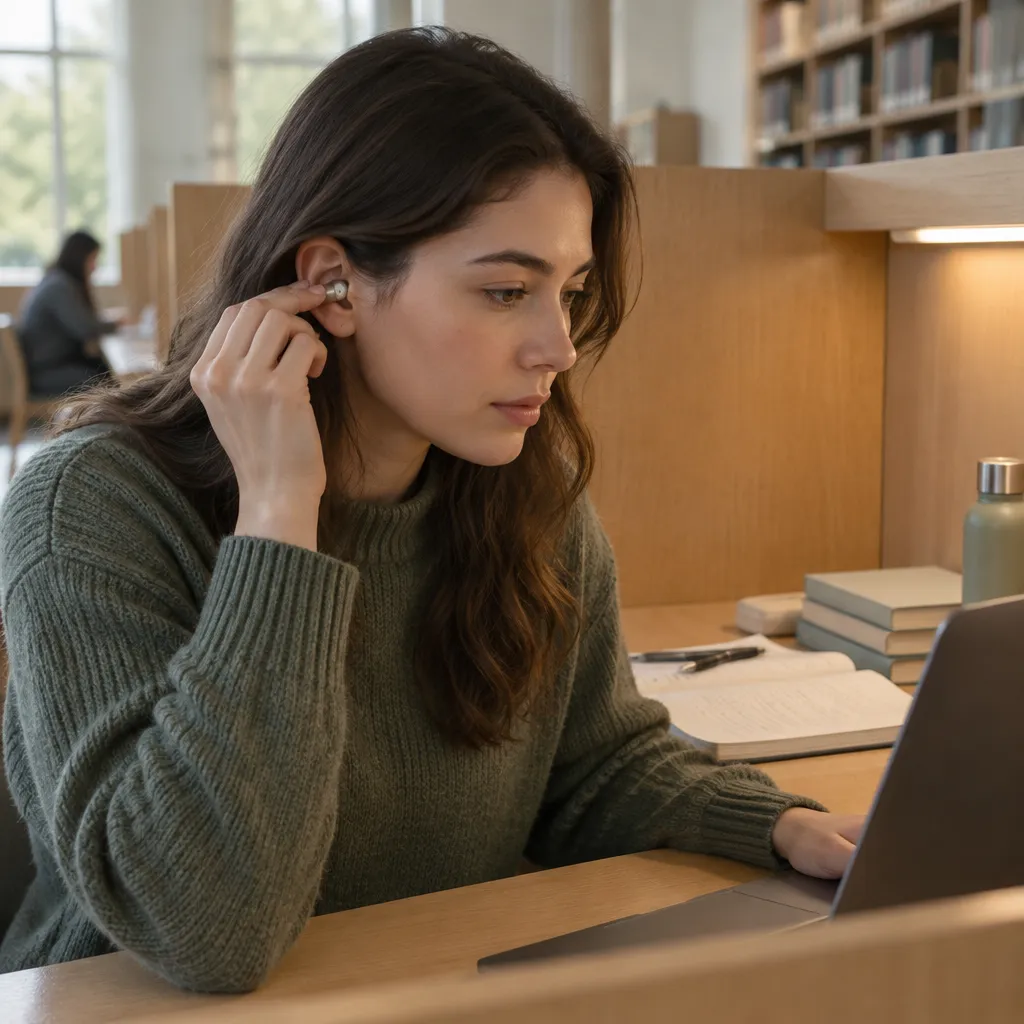
Begin by setting a timer. Insert, check, remove, and reinsert your plugs five times in a row, and note how long each round takes. When the time drops to a few seconds without hurrying, you are ready to practice in a more demanding setting.
For roll-down foam, roll the plug into a thin cylinder, pull your outer ear up and back, and hold the plug in place while it expands. For reusable pairs, insert the tip gently and turn it slightly until it seals. The ATTENU8 How to Fit page walks through the same steps with illustrations, which is useful if you are setting up a new pair.
In practice, most fit problems come from rushing. People push a plug in too fast, feel a pop or pressure, and assume the fit is wrong. Slow down, let the material settle, and recheck the seal before you start working.
Once a plug is in, check for leaks by listening to a steady sound, such as a fan or a running tap, and then covering and uncovering your ear. A good seal should make that sound noticeably quieter. Stop and reposition if you feel sharp pressure, itching, or pain.
If your fit never feels right, do not keep wearing a pair that causes problems. ATTENU8 offers a 15 Days Money Back Guarantee, and the details are set out in the Refund Policy and T&Cs linked from the site footer. Contact Us is the fastest route if you need help choosing a tip size.
Ear plugs that demand attention during a test are already costing you focus. The aim is to make insertion so routine that you forget you are wearing them.
Exam preparation is rarely a single quiet block. It is library hours, group sessions, and late nights in a shared room, each with its own noise pattern. Matching your ear plug habits to each setting keeps you focused without making you miserable.
Libraries are full of small, unpredictable sounds: chairs, bags, printers, and conversations three tables away. A reusable pair works well here because you can wear it for long stretches and remove it quickly when you need to speak to someone. Keep a spare set of tips in your bag so you are not stuck if one set wears out mid-semester.
Shared study rooms add a different challenge. You may need to hear a group member or a staff announcement. A simple habit helps: take one plug out before you talk, and put it back once the conversation ends.
Roommates keep different schedules, and a hallway can be busy until late. When you need to sleep between study blocks, a fit that holds through the night matters as much as one that works at a desk. Our guide to ear plugs for students in shared housing covers how to manage both study and sleep when space is limited.
For a more specific case, our article on dorm room ear plugs for roommate and hallway noise looks at the sounds that tend to disrupt late-night revision. Pairing those tips with a steady routine makes a noticeable difference.
Some students also rely on ear plugs for studying in their regular routine rather than only during exam periods. That habit makes the fit familiar, so exam week feels less like a new test.
Three options come up most often for students: roll-down foam, reusable pairs with memory foam tips, and wax. Each has a clear best use, and each has a trade-off you should accept with your eyes open. The table below sets them side by side for the situations students actually face.
Roll-down foam is the default for formal exams and any setting where rules are strict. Its drawback is that it needs rolling and a little practice, and it can feel warm after several hours. Reusable pairs suit repeated daily use, but they are often not permitted in formal exam rooms, so they belong in your study routine rather than on the exam desk.
| Option | Best for | Trade-off |
|---|---|---|
| Roll-down foam | Standardized tests where foam is required, and exam practice under timed conditions | Needs rolling and practice; can feel warm after several hours |
| Reusable metal-bodied pair with memory foam tips | Daily study in libraries, dorm rooms, and home offices | Often not permitted in formal exam rooms, so check rules first; tips need replacing every 6 to 8 weeks |
| Wax | Short, quiet sessions where comfort is the priority | Harder to reinsert consistently and less dependable in loud rooms |
Wax has a niche, but it is not the right choice for high-stakes study. It does not reinsert cleanly, so you will be tempted to fiddle with it. For exam preparation, foam for practice and a reusable pair for daily work covers almost every case.
A reusable pair only saves money and time if you look after it. Worn tips and dirty plugs cause poor sealing, skin irritation, and inconsistent noise reduction. A few simple habits keep your pair working from the first week of term to the final exam.
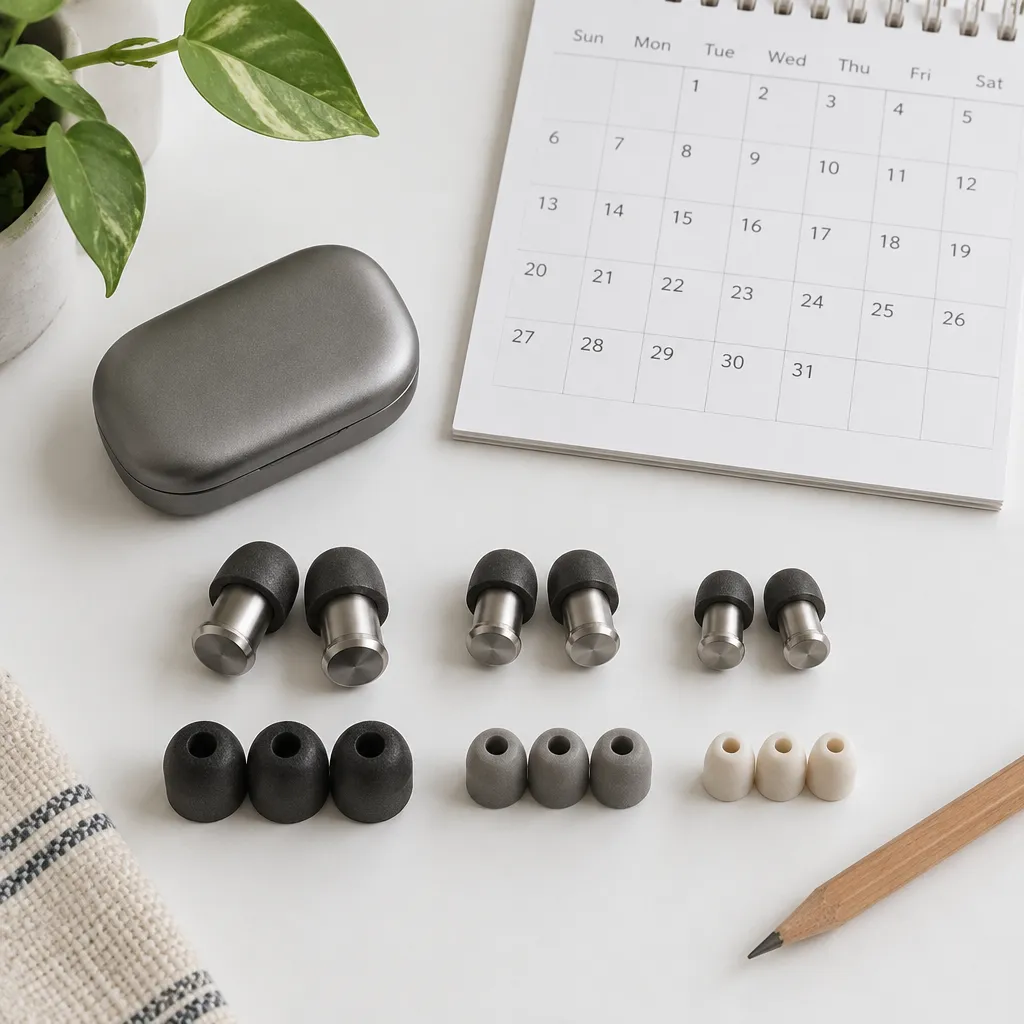
The key habit is replacing the memory foam tips on schedule. ATTENU8 ear plugs need only foam tip replacements, and the tips should be changed every 6 to 8 weeks rather than replacing the whole product. During a heavy exam period, it is easy to forget, so set a calendar reminder when you start a new tip set.
Look for signs that a tip has lost its shape, such as flattening, discolouration, or a loose feel when you insert it. A tip that no longer springs back will not seal well, even if it still looks fine. If you notice your study sessions getting noisier or the fit feeling different, check the tips before you blame the product.
Wash your hands before inserting plugs, and keep them in a clean, dry case between sessions. Avoid storing them in a damp bag or near a radiator, because heat and moisture can degrade foam over time. Wipe the metal body with a dry cloth after use.
Pro tip: Keep one spare set of foam tips in your exam bag. If a tip tears or loses its seal on the morning of a test, you can swap it in seconds rather than trying to work through discomfort.
It depends on the test provider and sometimes on the individual test center. Some centers allow your own sealed earplugs, while others only allow the ones they supply. Ask in advance, and treat foam as the safe default until you have written confirmation.
For regular home study, a reusable pair with a snug fit is usually the most practical option. ATTENU8 ear plugs, for example, are rated at approximately 32dB noise reduction and come with three tip sizes, so you can find the best fit for your ear. Practice with the same type you will use in your exam if you are preparing for a formal test.
Replace memory foam tips every 6 to 8 weeks. Tips that flatten, discolour, or no longer spring back will not seal properly, so change them sooner if you notice a difference in how well they block sound.
Poor-quality materials can cause irritation, so choose soft, well-made tips and keep them clean and dry. Stop using a pair that causes pain, itching, or discharge, and see a healthcare professional if symptoms continue.
They reduce all sound, including speech, so you will hear less of what is around you. Take one plug out when you need to listen, and keep both in when you are focusing on your work. Practice this switch during study sessions so it feels natural in an exam room.
Try a different tip size first, since fit varies from person to person. If the problem remains, ATTENU8 offers a 15 Days Money Back Guarantee, and the Refund Policy and T&Cs are linked from the site footer. You can also use the Contact Us page for help with sizing.
Tell us in the comments or through our Contact Us page which exam setting you are preparing for and which ear plug type has worked best for your study routine.
Every year, the same pattern repeats in offices, on construction sites and in home workspaces. Deadlines stack up, the working day stretches into the evening, and sleep is the first thing to be cut. Sleep performance at year end rarely collapses in one dramatic night. It erodes slowly over several weeks, and night noise is one of the most overlooked reasons why. This guide explains how noise disrupts recovery during deadline weeks and what you can practically do about it, from routine changes to hearing protection that fits a busy schedule.
| Key Insight | Explanation |
|---|---|
| Set a fixed cutoff for work messages | Late replies raise alertness right when you need to wind down. A stated cutoff that you hold even during a deadline protects the hours your brain uses to recover. |
| Treat night noise as a performance cost | Research on environmental noise links nighttime disturbance to next-day sleepiness, tiredness, mood changes and reduced cognitive performance. |
| Check whether noise is waking you before blaming stress | Note which nights you wake and what you hear at those times. If traffic, neighbours or a partner are the trigger, a fix at the bedroom level works faster than another coffee. |
| Match hearing protection to your sleep position | Side sleepers need a fit that does not press into the pillow. ATTENU8 includes bottom foam tips for side sleepers alongside its XS, S and M memory foam tips. |
| Replace foam tips on schedule | Memory foam tips should be changed every 6-8 weeks, so one metal body can carry you through a full deadline season without a new purchase each time. |
| Batch focus work to shorten late nights | Blocking calendar time and muting notifications during the day reduces the work that spills into the bedtime hours, which is where sleep is most often lost. |
Deadline weeks rarely start with a decision to sleep less. They start with one extra meeting, a report that needs another round of checks, and a message you feel you must answer before morning. By the third week of a push, bedtime has drifted by an hour and the alarm has not moved.
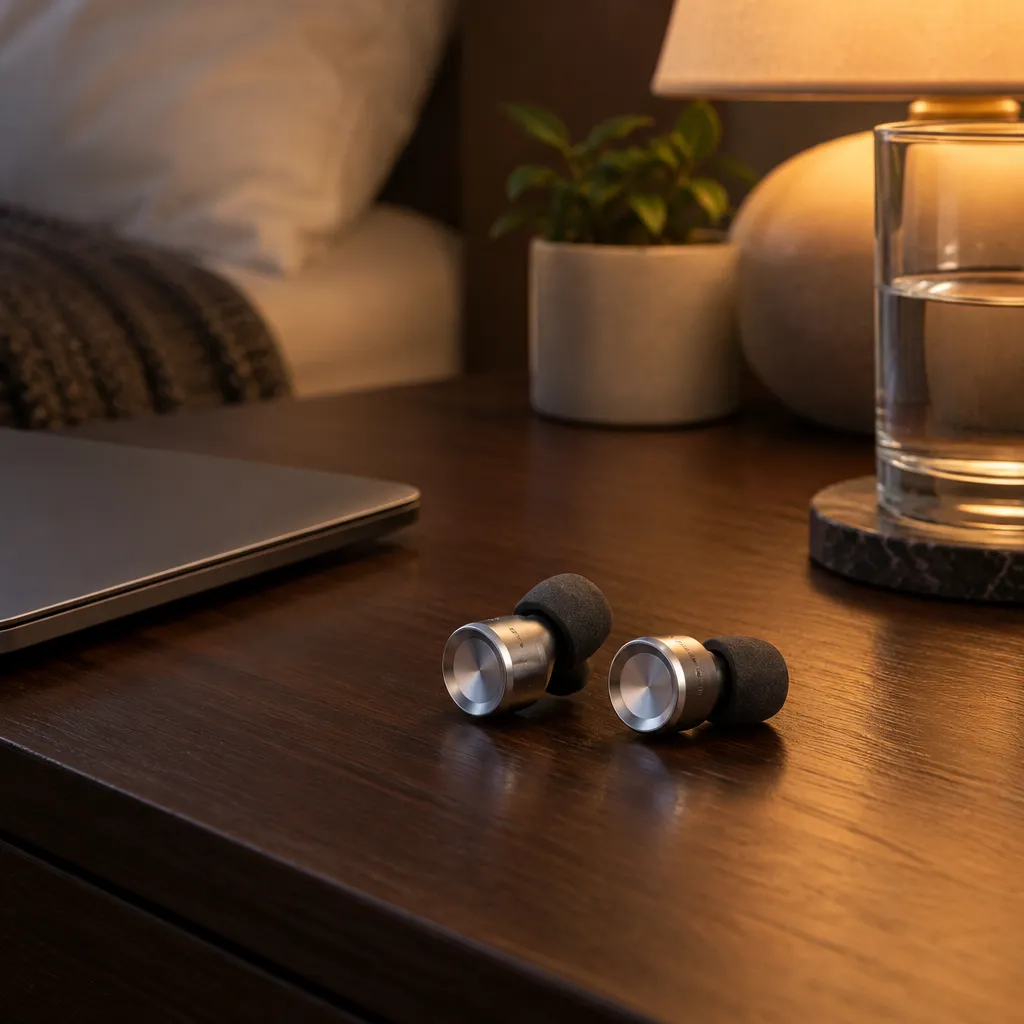
That drift matters because sleep is when the brain consolidates the day’s learning and resets for the next one. When you shorten sleep to keep up, the cost shows up in the work itself: slower reading, more small errors and harder decisions made with less patience. Many people blame themselves for losing focus when the real cause is a sleep budget that has been quietly overdrawn.
In practice, the most damaging habit is not the long shift itself. It is the quick check at 11 p.m. that turns into twenty minutes of drafting replies. The alert raises your alertness, your mind keeps working on the problem, and falling asleep becomes a negotiation you lose more often than you win.
Teams often accept a late reply as normal because nobody has said otherwise. A single fixed cutoff, communicated at the start of a deadline push, usually removes the expectation faster than most people expect.
Pressure compounds. The first week of a push is manageable, but the last few days before a submission, launch or audit are when people cut sleep most aggressively. Those are also the nights when a noisy street, a dripping tap or a partner’s snoring has the most power to wake you.
Pro tip: Pick one fixed time to stop work messages and say it out loud to your team on day one of the push. Colleagues adapt faster than you expect when the boundary is stated once and held consistently, and you avoid re-negotiating it every evening.
Sleep research on environmental noise is clearer than most workplace advice on productivity. A 2014 review titled “Environmental noise and sleep disturbances: A threat to health?” in the journal Sleep Science summarises how nocturnal noise affects the body and the next day. The review reports that noise provokes a measurable stress response at night and clearly affects sleep architecture as well as how restful people feel sleep was.
The same review notes that people who struggle with nighttime noise often also suffer from daytime sleepiness and tiredness, annoyance, mood changes and decreased cognitive performance the following day. For someone trying to hit a deadline, those are exactly the symptoms that make a good plan fall apart. A tired brain is slower to read a contract, slower to catch a bug and quicker to snap at a colleague.
Many people assume that if they do not remember waking, noise has not affected them. The research points the other way. Noise can trigger a stress response even when you stay asleep, which means you may finish the night with less recovery than your sleep duration suggests.
A 2024 review in the journal Sleep, by M. Basner, states that countless studies have shown exposure to traffic noise disturbs sleep and impairs sleep recuperation. That finding matters for anyone working late in a city flat, because the noise you tune out is still doing its work underneath.
When sleep is disturbed, the symptoms tend to appear at work, not in bed. You feel flat in the afternoon, you reread the same paragraph three times and your patience with colleagues shortens. Managers and individuals alike often respond by pushing harder, which adds more late hours and more noise exposure to the next night.
Noise you stop noticing while you are awake can still change how you sleep, and the cost of that change usually arrives the next morning in the form of slower thinking and lower mood.
Recognising this loop is the first step. Once you see that a poor afternoon may be a noise problem from the night before, the solution becomes practical rather than a question of willpower.
Year-end noise is different from ordinary background noise. It comes from holiday gatherings next door, extra deliveries, longer hours at home and the general rhythm of a season when many people are awake later than usual. Identifying the source is more useful than simply buying the strongest product you can find.

Start by listing the sounds that reach your bedroom during the hours you are trying to sleep. A short notebook entry for a week is enough. Most people find two or three repeat offenders, and those usually tell you whether the solution is better sealing, a sound barrier or hearing protection worn at night.
Traffic and delivery vehicles are often most active when people are trying to settle down. A bedroom facing a main road may be fine for most of the year and then become unbearable during a season when more vans arrive after dark. The noise is not louder in absolute terms, but your tolerance drops when you are already short on sleep.
In practice, opening the window a few centimetres or keeping the door closed can change how much road noise reaches the bed. Sealing gaps around doors and windows, where practical, has a similar effect. These measures help, but they rarely remove every sound, which is why many light sleepers still need hearing protection.
Working from home during a deadline sounds like an advantage until your bedroom doubles as an office. Keyboard clatter, video calls and a housemate making dinner after your shift can all bleed into the rooms where you need quiet. When the bed and the desk share a wall, the working day never fully ends.
A common mistake is trying to solve this with a louder sound in the room rather than less sound reaching your ears. Constant background noise can mask a sudden door slam, but it can also keep some people alert. Reducing exposure at the ear is often the more direct fix when the noise source is outside your control.
No single approach handles every noise pattern. The useful question is which option matches the sound you hear most often, how much you can change in your environment and how comfortable you are wearing something through the night. The table below compares three common approaches and where each one falls short.
| Approach | What It Handles Best | Where It Falls Short |
|---|---|---|
| Reusable metal-bodied ear plugs with memory foam tips (ATTENU8, approximately 32dB reduction) | Steady external noise such as traffic hum, neighbours and a partner’s snoring | Fit depends on choosing the right tip size, and foam tips need replacing every 6-8 weeks |
| Sound or white noise machine | Masking sudden noises with a constant background sound | Does not reduce the volume of the noise itself, and the masking sound may keep some people alert |
| Focus blocks and notification controls during the working day | Reducing the late-night work that drives you to bed later than planned | Does nothing about noise that is already reaching the bedroom after you have stopped working |
The three options are not competitors. A sensible deadline plan uses focus blocks to cut late work, a physical fix for the bedroom where possible and hearing protection for the noise you cannot control. Relying on only one of them usually leaves a gap that shows up within a week.
The goal during a deadline push is to protect both focus and sleep at the same time. That means reducing the noise that reaches your ears at night while keeping the rest of your routine realistic. ATTENU8 ear plugs are designed for that use: a metal body with three sizes of memory foam tips, roughly 32dB of noise reduction and no batteries, filters or extra mechanics to manage.
Fit is the most common reason people give up on hearing protection. A tip that is too large feels tight by midnight, while one that is too small lets sound leak around the edges. Try the XS, S and M tips in turn during the day, when you are awake and can judge the seal, before relying on them for a full night.
The How to Fit page on the ATTENU8 website walks through insertion and sizing. For side sleepers, the bottom foam tips are worth testing, because a fit that does not press against the pillow makes it easier to stay asleep through the night.
Foam tips wear out, and a worn tip seals less well than a fresh one. The ATTENU8 memory foam tips should be changed every 6-8 weeks. If your deadline lasts two months, plan one replacement into the schedule rather than discovering a loss of seal in the middle of the final week.
Keeping a spare pair in the bedside drawer and a note in your calendar for the replacement date avoids the common problem of using worn tips simply because nothing else is to hand.
Testing new sleep equipment during a high-pressure period carries a real risk if the fit does not work. ATTENU8 offers a 15 Days Money Back Guarantee, and the full terms are set out in the Refund Policy and T&Cs linked from the site footer. If you have a question about sizing or returns, the Contact Us page is the quickest route to a human answer.
Pro tip: Test your ear plugs on a quiet evening before the deadline starts, not on the first night you need them most. A fit problem discovered on a calm night is far easier to fix than one discovered at 2 a.m. during the final push.
For more on how noise shapes daytime output, read Sleep and Productivity: How Noise Is Costing You, which looks at the link between disturbed nights and work performance.
Hearing protection works best as part of a routine rather than a standalone fix. A short, repeatable sequence before bed tells your body that the working day is over and makes it easier to fall asleep even when the deadline is still open on your laptop. The routine does not need to be elaborate, but it does need to be consistent for the length of the push.

In practice, the people who keep their performance through a deadline are the ones who stop work at the same point each evening, close the laptop, and do the same few things every night. Sameness matters more than the specific activities you choose.
Write a three-step shutdown and repeat it nightly. A typical version is to save open files, write down the first task for tomorrow and put the phone out of reach. Once the list is written, your mind has less reason to keep rehearsing the work while you are trying to sleep.
Keep the sequence short enough that you will actually do it on the hardest nights. A routine that is abandoned after one bad week does more harm than a simpler one you keep for the whole push.
Before you get into bed, check the room. Close the window if traffic is loud, turn off devices that buzz or light up, and place your ear plugs where you can reach them in the dark. Small friction at bedtime leads to late nights, so remove it wherever you can.
Shift workers face a similar challenge with daytime sleep, which is covered in Ear Plugs for Shift Workers: Sleep Better During the Day. Many of the same bedroom habits apply to deadline sleepers who are awake at unusual hours.
Pro tip: Put your ear plugs in their case on the bedside table each night, next to the glass of water. Keeping them in the same place removes a decision at the point you are most tired, and it makes it far more likely that you use them on a noisy night.
Yes. Research on environmental noise reports that nighttime noise can trigger a stress response and change sleep structure even when people do not fully wake. The effects often show up the next day as sleepiness, lower mood and reduced concentration.
Keep a simple log for a week. Note the time you go to bed, any sounds you notice, and how you feel the following morning. If the disruptions line up with traffic, neighbours or household noise, the noise is a likely cause, and a fix at the ear or in the room is worth trying.
ATTENU8 ear plugs come with memory foam tips in XS, S and M sizes. Test each size while awake during the day and choose the one that seals without feeling tight. The How to Fit page on the website explains the process step by step.
The memory foam tips should be changed every 6-8 weeks. For a deadline push that lasts several weeks, plan the replacement in advance so that worn tips do not reduce the seal on the nights you need them most.
ATTENU8 offers a 15 Days Money Back Guarantee. The Refund Policy and T&Cs are linked from the site footer, and the Contact Us page is the place to ask about sizing or returns before you decide.
For most people, using well-fitting, clean ear plugs at night is a reasonable part of a sleep routine. If you notice ear discomfort, irritation or persistent problems with hearing, speak to a doctor or qualified clinician before continuing.
Have you found a noise fix that actually kept your sleep and focus intact during a busy stretch at work? Share what worked, what failed and what you would change, because your experience may help another reader get through their next deadline.
Most people buy ear plugs and stop there, and that is where the ear plug accessories question starts. The plugs go into a pocket, a bedside drawer or a work bag, and within a few months the case is crushed, the cord is knotted and the tips have lost their shape. The right accessories cost little compared with the plugs, but they decide how long your gear lasts for sleep, travel and shift work. This guide sorts out which accessories earn their place and which ones are wasted money.
| Key Insight | Explanation |
|---|---|
| Buy a hard case first | A rigid case stops the body and tips from being crushed in a bag. Soft pouches are usually the first accessory to fail. |
| Keep a cord for workplace use | A cord matters most when you take plugs in and out several times in one shift. It is not much use for sleep. |
| Carry a spare set of foam tips | Tips are the wear item. ATTENU8 memory foam tips should be changed every 6 to 8 weeks. |
| Clean with mild soap, not alcohol | Harsh chemicals and alcohol degrade the material, so use warm water and mild soap, then dry fully. |
| Never wash foam tips | Water makes foam expand and lose the density it needs to block sound. Replace them on schedule instead. |
| Keep one kit per location | A bedside case and a travel case keep you from carrying the same dirty plugs from room to room. |
The case is the cheapest accessory and the one people skip most often. In practice, most damage to reusable plugs happens in the bag, not in the ear. A metal body can take a knock, but memory foam tips get squashed, pressed against keys and coins, and left in warm pockets where they pick up lint and skin oil.
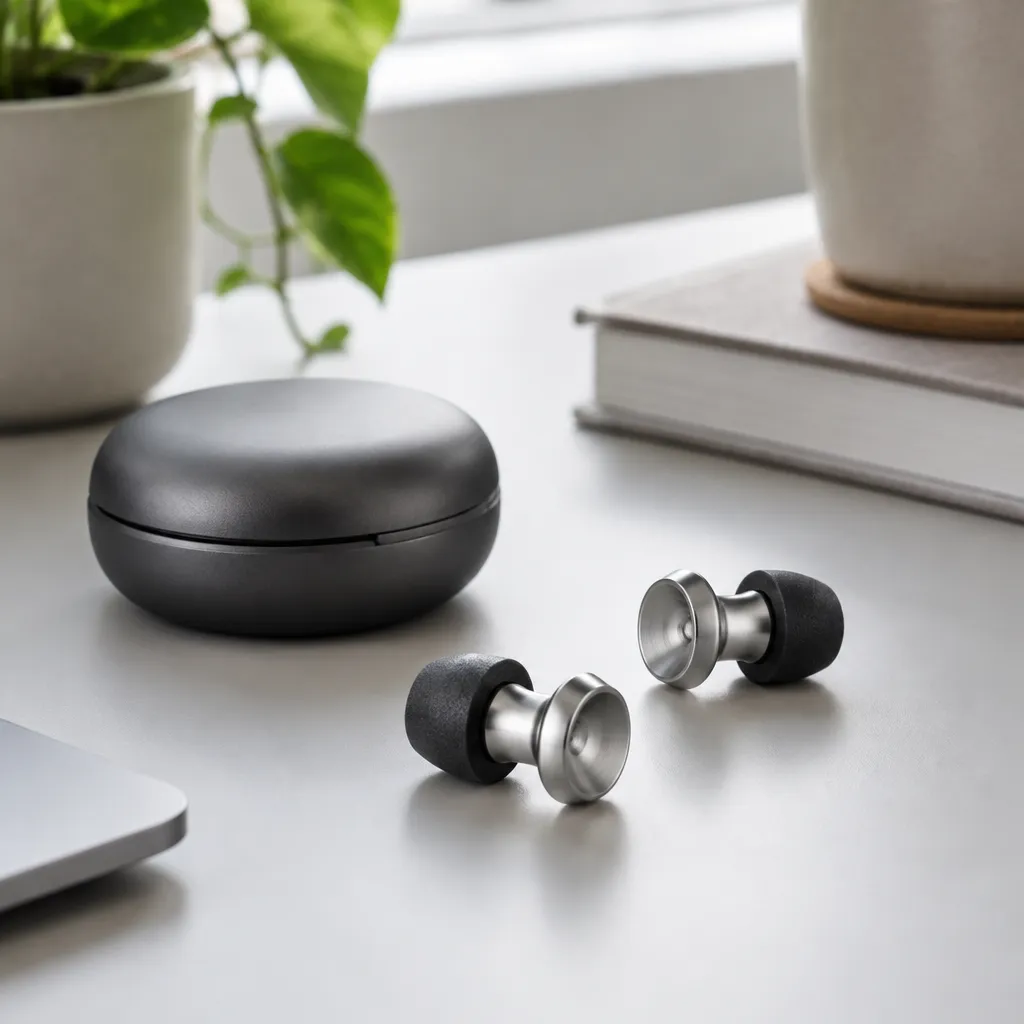
A hard case with a firm snap or screw closure keeps the body rigid and the tips in shape. ATTENU8 includes three pairs of memory foam tips in XS, S and M, plus bottom foam tips for side sleepers. The case needs room for all of that, or the spare tips stay at home and you end up using worn ones.
The vinyl pouch is the usual starting point and the usual failure. A user in a hearing protection discussion group on Facebook asked what aftermarket options people use for carrying molded plugs, after their own vinyl pouch started falling apart. That complaint comes up again and again because soft pouches fold, tear at the seam and let the plugs slide around.
A soft pouch is fine for a single pair that never leaves a drawer. Once plugs go into a work bag or a suitcase, the pouch offers no real protection against compression. If you already own one, keep it as a secondary layer inside a harder case rather than as the only container.
Pick a case that closes firmly but opens with one hand in the dark. You will reach for it half asleep, so a lid that needs two hands or a tight zip is a daily annoyance. A case that is only slightly larger than the plugs is easier to keep track of in a bag, and it leaves less room for the tips to rattle around.
One Wirecutter review of concert earplugs describes a model that stores in a carrying case about the same size as the plugs themselves. That size match is worth looking for regardless of brand, because a case that fits the pocket is a case you actually carry.
Pro tip: Store the plugs in the case with the tips attached only if the tips are dry. Trapped moisture in a closed case is the fastest way to grow mould, so air them out first.
A case only protects your plugs if it is with you every time. The pair that lives loose in a pocket is the pair that gets lost, squashed and ruined.
Cords are a niche accessory, and the marketplace data shows how crowded that niche is. In Amazon’s best seller list for safety ear protection accessories, four of the top ten entries are cords or lanyards for earplugs. That tells you people buy them, but it does not tell you which ones work, so the criteria below matter more than the ranking.
A cord earns its place where you take plugs in and out repeatedly, such as on a factory floor, a construction site or a range. Hanging the plugs around your neck keeps them off the ground and out of a dusty pocket between uses. In that setting, a cord saves you from dropping a pair you then have to inspect and clean.
For sleep, a cord is mostly dead weight. Nobody needs a tether on a pillow, and a cord that runs from your ear to a bedside pocket tends to tangle. Keep the cord for work and skip it at night.
The failure mode to test for is the cord that pulls the plugs out of your ears when it catches on a hood, a helmet strap or a machine guard. Magnetic connectors are common in this category because they release under a sharp tug instead of yanking the plug out of the canal. Before you rely on one, clip it to a jacket, give it a firm pull and check that the plug releases rather than the tip detaching.
Avoid cords that are stiff or very long. A short, flexible cord sits flat against the neck and stays out of the way of safety gear. A long cord hangs into machinery and gets caught, which defeats the reason for having it.
Pro tip: Wipe the cord and connector with a dry cloth at the end of each shift, the same as you would the plugs. Sweat and grit build up on cords faster than most people expect, and a gritty connector wears out quickly.
Of all the accessories in this guide, spare tips are the one most people underrate. The metal body is built to last, but the memory foam tip is the part that wears, and once it loses its shape the seal goes with it. ATTENU8 advises changing the memory foam tip every 6 to 8 weeks, so a spare pair is simply part of the kit.
The practical rule is to keep one spare set in the case at all times, so a swap takes thirty seconds instead of a trip to the shop. Most people who run out of tips do so during a week when they are already short on sleep, not during a planned replacement. A spare set in the case removes that gap.
Within the ATTENU8 kit, the three sizes give you a range to test. Keep the set that fits in your everyday case, and store the unused sizes in the same pocket so you are not hunting for them later. The bottom foam tips for side sleepers belong in the same place, since they are part of the same replacement cycle.
If sound leaks in at a whisper, the tip is usually the cause, not the body. Try the next size up or down before you assume the plug is faulty. The ATTENU8 How to Fit page covers insertion, and the Ear Plug Tip Replacement guide on the site covers when to change tips.
A tip that is too small will feel loose and let noise through. A tip that is too large will feel tight and may be uncomfortable in a side-sleeping position. Test each size in your ear in the same position you will sleep or work in.
Pro tip: Write the date you fitted each new tip on the inside of the case lid with a marker. It takes five seconds and removes the guesswork about whether a pair is past its 6 to 8 week window.
Cleaning supplies are cheap, but using the wrong ones does real damage. The Dreimers Hearing Clinic cleaning guide says mild soap and warm water remove wax and skin oil effectively, while harsh chemicals or alcohol can degrade the material and cause cracking over time. That single rule shapes the whole cleaning kit.
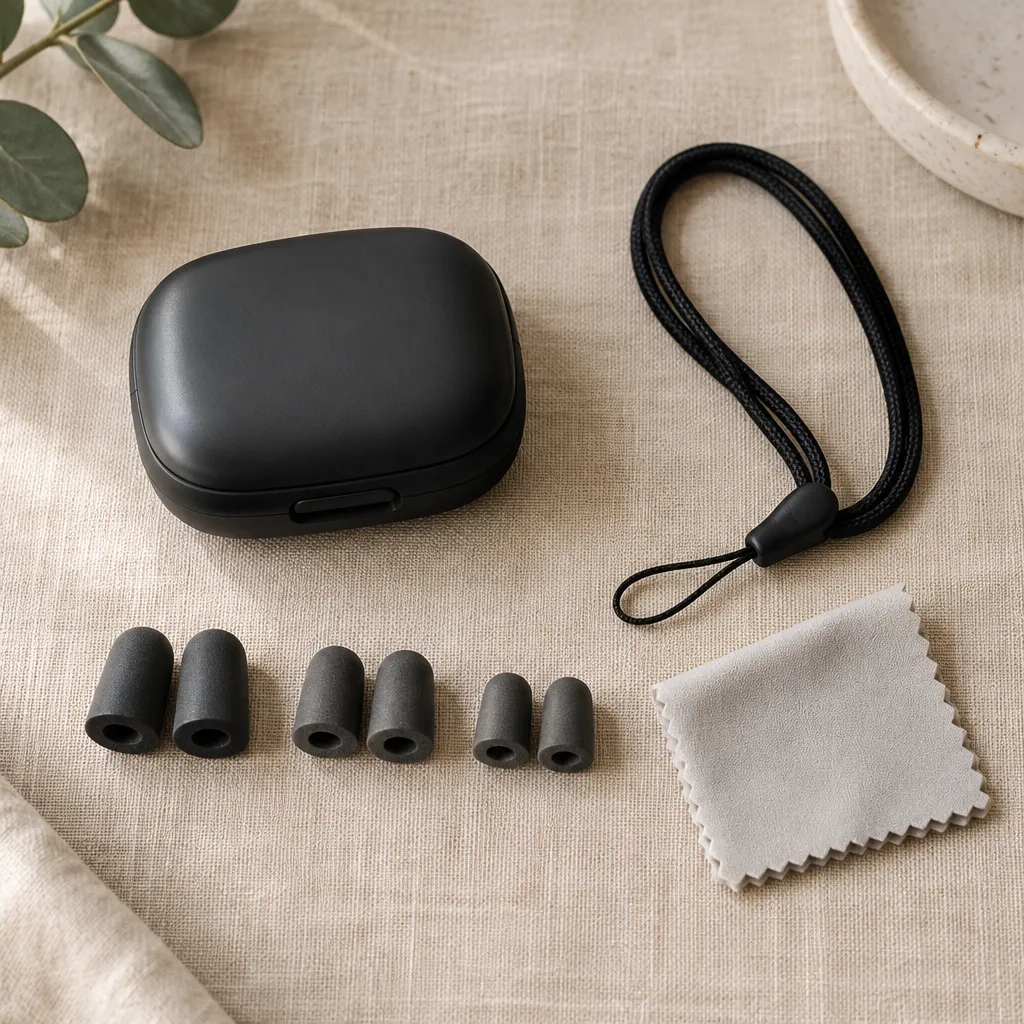
The kit does not need to be specialist. A bottle of mild soap, a soft toothbrush kept only for cleaning, and a clean towel cover almost every case. The toothbrush matters because debris collects between flanges and in the sound bore, and a brush gets into those spaces where a cloth does not.
Use the towel to air dry the body and tips completely before storage. Moisture trapped in a case is what causes mould and bacterial growth, so a damp plug in a closed container is worse than a dirty one left out to dry. Keep the towel clean and dry, and replace it when it starts to look grey.
Alcohol wipes are the most common mistake. They are quick and they feel hygienic, but they dry out the material and can make the body and tips brittle over time. Skip them, and use warm water with mild soap instead.
Foam tips are a different case. Water makes foam expand and lose the density it needs to block sound, so washing foam tips is a false economy. Treat them as replaceable on the 6 to 8 week schedule, and do not try to wash them to make them last longer. For the body, the How to Clean Ear Plugs guide on the ATTENU8 site sets out the steps in full.
Most buyers choose between three storage approaches, and they solve different problems. The table below compares them on the job each one does, the trade-off that comes with it and where it suits you best.
| Accessory | Main job | Trade-off |
|---|---|---|
| Hard shell case with a firm closure | Stops the body and tips being crushed in a bag or pocket | Takes a little more room, but it protects the seal and the shape of the tips |
| Soft vinyl or fabric pouch | Keeps the plugs together on a nightstand or in a drawer | Offers little protection against compression and tends to fail at the seams |
| Magnetic or clip-on cord | Keeps plugs off the floor and out of dusty pockets during a shift | Adds bulk and can catch on equipment if it is long or stiff |
In practice, the best setup for most people is a hard case for everyday carrying and a cord only if the job calls for one. A soft pouch can stay as a second layer at home, but it should not be the only thing protecting your plugs in transit. Choose the accessory that matches where the plugs spend most of their time, not the one that looks most complete on a shelf.
Sleep, travel and work place different demands on storage, so the setup should change with the situation. A bedside routine is about convenience and cleanliness. A travel or work routine is about protection and keeping track of spare tips.
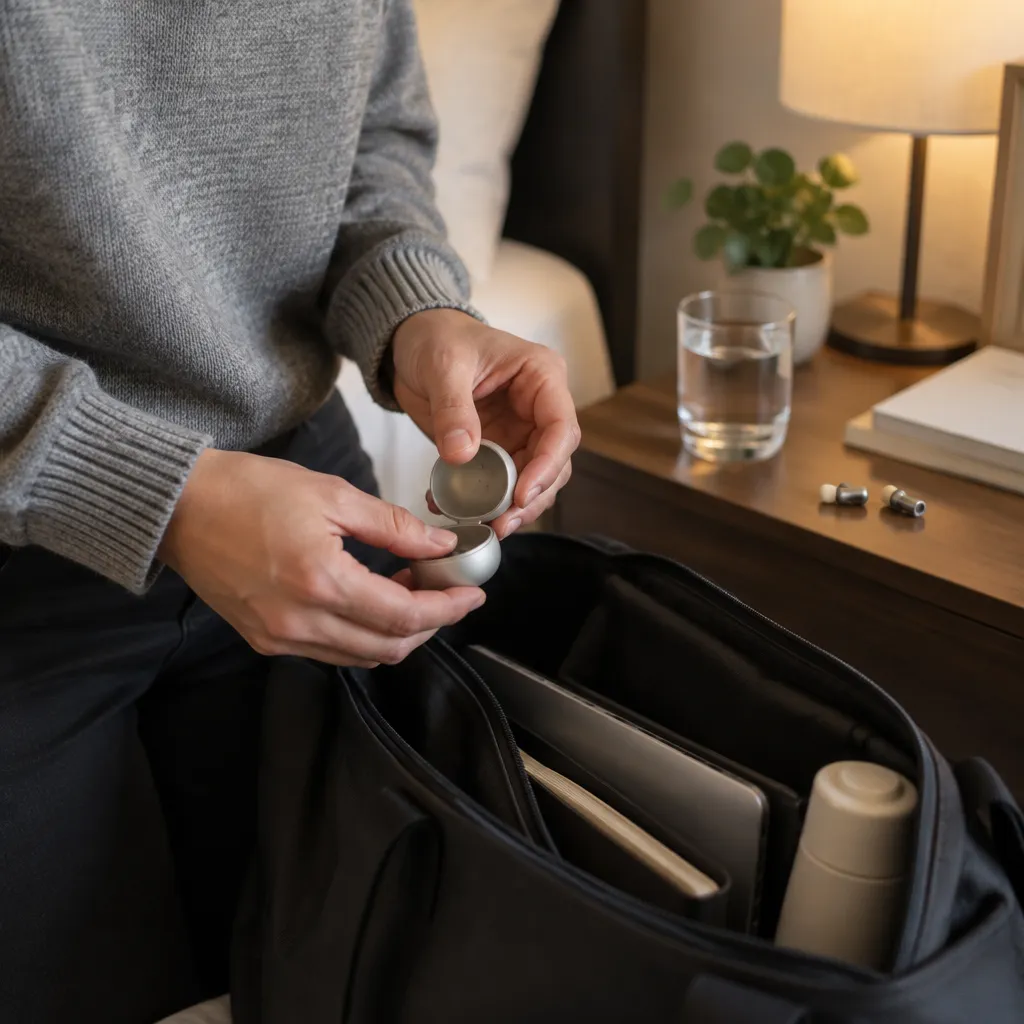
Keep one case on the nightstand with the plugs in it, and a second, smaller case in your travel bag with a spare set of tips. Pack the travel case with the tips you actually use, not the whole stock. Before you pack, check that the plugs and tips are dry, because a case that goes into a suitcase warm and damp will smell by the second day.
When you travel, the spare tips are the item most likely to get lost. Tuck them in a separate pocket of the same case so you know where they are without unpacking everything at the hotel.
On a shift, the routine should be simple enough to follow with gloves on. Put the plugs in the case at the end of the shift, wipe the cord if you use one, and keep the case in the same place every day so you do not hunt for it at the start of the next one. Foam tips used in loud work should be discarded after a single shift or day, according to the Dreimers guide, so keep a fresh pair ready for the next day.
Pro tip: Keep a small zip bag inside your work bag for used tips. Mixing dirty foam with clean sets is how people end up with a tip they cannot trust.
Buying accessories is easier when you know what the seller will stand behind. ATTENU8 offers a 15 Days Money Back Guarantee on its ear plugs. The Refund Policy and Terms and Conditions are linked from the site footer, and the Contact Us page handles enquiries about your order.
Read the Refund Policy in the footer before you assume the 15 Days Money Back Guarantee covers every add-on. The policy sets out the conditions and the process, which matters if you buy replacement tips or other extras alongside the plugs. A quick read now is cheaper than a dispute later.
Do not buy a case, cord and cleaning kit just because they are on the same page. Start with the case and a spare set of tips, because those protect the part of the plug that wears out. Add a cord only if your work requires one, and skip cleaning products that promise to restore the foam, since the foam should be replaced rather than revived.
Yes, if the plugs travel. A pouch is fine for a drawer, but a hard case protects the body and tips from crushing in a bag or pocket. Keep the pouch as a second layer if you like, but do not rely on it alone.
ATTENU8 advises changing the memory foam tips every 6 to 8 weeks. With nightly use, that schedule keeps the seal consistent. Keep a spare set in your case so the swap is quick.
No. Water makes foam expand and lose the density it needs to block sound. Replace foam tips on schedule instead of washing them.
Usually not. A cord is most useful in workplaces where you take plugs in and out during a shift. For sleep, a cord tends to tangle and adds nothing to the seal.
Use warm water and mild soap, then dry the body and tips completely before storing them. Avoid alcohol and harsh chemicals, because they degrade the material over time.
Check the Refund Policy and Terms and Conditions linked from the site footer before you assume it covers every add-on. The policy sets out what applies, and the Contact Us page can answer questions about a specific order.
Which accessory has made the biggest difference to your plugs, and which one did you buy and never use? Tell us in the comments or through the Contact Us page, because your experience with cases, cords and tips is what shows what really works.
Your partner sighs when the dishwasher starts, asks you to turn the TV down, and then tells friends you’re “too sensitive to noise.” If that sounds familiar, you already know the noise is only half the problem. The real strain comes from the conversation: you feel dismissed, they feel criticised, and the next night goes the same way. A healthy noise sensitivity relationship starts with how you talk about sound, not with winning a debate about decibels. This guide covers what to say, what to stop saying, and how to agree on sleep boundaries that work even when your partner doesn’t hear what you hear.
| Key Insight | Explanation |
|---|---|
| Noise sensitivity is a range, not a verdict | Your partner hearing less does not mean you are imagining the noise. People differ in how strongly sound affects them. |
| Stop debating decibels | Describe what the sound does to your sleep, such as waking at 2am, rather than arguing about how loud it is. |
| Choose a calm moment | Raising noise at 11pm, when you are already tired, almost always turns into a fight. Bring it up at a neutral time of day. |
| Ask for one specific change | A agreed time for the TV to go off is far easier to accept than a vague request to “be quieter”. |
| Treat your own gear as part of the plan | Ear plugs cannot fix the relationship, but they cover the part of the problem you control. ATTENU8 offers roughly 32dB of noise reduction. |
| Watch for avoidance | If you or your partner start dreading bedtime or sleeping apart without discussing it, the problem has moved from the room to the relationship. |
Noise sensitivity is not a character flaw or a bid for attention. A study published in the journal Noise & Health in 2015 describes noise sensitivity as an internal state, both physiological and psychological, that increases how reactive a person is to noise in general. The authors, Daniel Shepherd and colleagues, examined how this trait relates to personality, which tells you something useful: people genuinely differ in how much sound bothers them.
In practice, this means your partner can be entirely reasonable and still miss the fridge hum, the ticking clock, or the second snore that keeps you awake. Their not hearing it is not evidence that you are making it up. It only tells you that you are not calibrated the same way.
Most couples treat noise sensitivity as a yes or no question. In reality it runs along a spectrum, and two adults can sit at very different points on it while sharing the same bedroom. Thinking in degrees gives you room to talk about how much a sound costs you instead of defending a label.
A useful test is to ask yourself how long a sound stays with you after it stops. If a neighbour’s door slam is forgotten in seconds but a dripping tap keeps you up for an hour, that tells you something concrete about your threshold, and it gives your partner something specific to understand.
When a partner says you are too sensitive, the phrase implies that your reaction is excessive by default. That shifts the conversation from the noise to your character, and you end up defending yourself instead of solving the problem. A better opening describes what happens to you, such as being unable to fall back asleep after a late-night noise.
The most common mistake is debating volume. Your partner says the snoring isn’t that loud, you say it is unbearable, and now you are arguing about a level neither of you measured. Noise sensitivity is about how a sound interacts with your sleep and your nervous system, not about its position on a scale.
Once you stop competing on volume, the conversation becomes far more practical. You can talk about timing, frequency, and the impact on your day, which are things your partner can actually change.
Instead of “the TV is too loud”, try “I can’t settle into sleep when the TV is on after midnight.” It gives your partner something they can respond to, and it removes the verdict. The statement is about your experience, not a ruling on their behaviour.
A partner rarely resists a complaint about a sound. They resist a complaint that sounds like a judgment about who they are.
Raising noise at bedtime, when you are both tired and irritable, almost guarantees a sharp exchange. Bring it up during a calm part of the day, such as a weekend breakfast or a walk, and frame it as a planning question rather than a complaint. People who feel ambushed defend themselves, and defensive people rarely change their habits.
Pro tip: Keep a short note on your phone listing which sounds bother you most and at what time. Specific examples beat general claims, and the list keeps the discussion from drifting into who is being unfair.
Scripts are not magic, but having a few sentences ready helps you avoid the defensive spiral that usually follows a noise complaint. The three openers below fit different situations, and you can adjust the wording to suit your own relationship. The goal is to make it easy for your partner to say yes.
Try: “I love sleeping next to you, but I’ve been waking up at 2am most nights and I’m running on empty. Can we work out what would help?” It puts the relationship first and treats the snoring as a shared problem. For a deeper look at the snoring side of this, the guide on earplugs for a snoring partner covers practical options in more detail.
Try: “Could we agree on a time after which the TV goes off or stays at a low volume? I’m not asking you to stop watching, just to share the room quietly at night.” A specific time is easier to agree to than a general request for less noise, and it leaves your partner’s evening intact.
Try: “You may not hear it the way I do, and that’s fine. I do hear it, and it affects my day. Let’s find something that works for both of us.” This acknowledges the gap in perception without asking your partner to agree that your experience is valid.
Avoid “you always”, “you never”, and “you’re so sensitive”. Those phrases confirm the story your partner already holds, and they make it harder to move forward.
A sleep boundary is an agreement about the bedroom, not a verdict on your partner. It might cover what time lights go off, whether screens stay in the room, and what each of you does about noise that neither of you can fully control. Written down, even as a note on the fridge, these rules stop being a personal fight and become a shared plan.

Start with the changes that cost neither of you much. Closing the bedroom door, moving phones off the nightstand, and keeping a fan on a steady setting are easy wins. Once your partner sees that you are willing to adjust too, the harder conversations about snoring or late-night television tend to go more smoothly.
Some noise is outside anyone’s control, such as a neighbour’s television or a partner’s snoring at 3am. In those cases your side of the agreement is your own equipment. ATTENU8 ear plugs have a concave aluminium body with three sizes of soft memory foam tips (XS, S, M), and they are rated at approximately 32dB of noise reduction. If you are a light sleeper, the article on why ear plugs work for light sleepers explains the mechanics in plain terms.
Ear plugs do not repair the relationship, but they can take the nightly argument off the table. When your partner sees that you have a workable solution, the conversation shifts from “stop making that noise” to “let’s make both of our nights better.”
When sleep needs clash, couples usually reach for one of three approaches. Each works in some situations and fails in others, so compare them honestly before committing to one.
| Approach | What It Does Well | Where It Falls Short |
|---|---|---|
| Wearing ear plugs in bed | Lowers the noise reaching you without changing anyone’s habits, and it works when you travel too. | It does nothing for a partner who wants a shared quiet room, and foam tips need replacing every 6-8 weeks. |
| Sound masking with a fan or white noise machine | Covers intermittent sounds and can make the room feel calmer. | A constant background sound can bother some light sleepers, and it may not fully hide a sharp snore. |
| Sleeping in separate rooms on some nights | Guarantees uninterrupted sleep for the person who needs it most. | It can feel like rejection if introduced without explanation, so it needs a plan for closeness and routines. |
In practice, the strongest setup usually combines two of these. Ear plugs plus an agreed bedtime for the television is more realistic than asking one partner to change everything at once. Separate rooms work best as an occasional measure, agreed in advance, rather than a permanent surrender.
Pro tip: Test any new arrangement for two weeks before judging it. Most people give up on a change in the first three nights, when the new habit still feels strange.
Sometimes the noise is only the surface. The deeper issue is that one partner feels unheard, and over months repeated dismissals turn into resentment. You may start avoiding bedtime altogether, which makes the problem harder to discuss and harder to solve.
A partner who feels heard will usually work on the noise. A partner who feels dismissed will usually fight about it.
Common signs include sleeping on the sofa without explanation, going quiet every time the topic comes up, or tensing up as bedtime approaches. If you notice these patterns in yourself or your partner, stop treating the problem as purely about sound. It has become a question of connection, and it deserves a direct conversation away from the bedroom.
Your partner’s comments about your sensitivity can spill into family visits and social plans. A useful point from written discussions of noise sensitivity in highly sensitive people is that others often have no idea how much their volume affects you. You can say calmly that you need quieter evenings for sleep and ask for that to be respected, without justifying your nervous system in detail.
Good fit matters more than most people expect. A plug that sits loosely lets sound leak around the edges, and that often leads people to conclude that the product has failed when the real issue is positioning. Taking a few minutes to get the fit right will tell you far more about whether the approach works for you.
ATTENU8 includes three pairs of memory foam tips in XS, S and M, along with bottom foam tips for side sleepers. Test the sizes on a quiet evening, not at midnight when you are already frustrated. Roll the foam into a thin shape, insert it gently, and hold it in place for a few seconds while it expands. The How to Fit page on the website walks through the steps.
Side sleepers should pay particular attention to the bottom foam tips, since pressure against a pillow can push a standard tip out of position. If a plug keeps loosening during the night, try the other size before deciding it doesn’t suit you.
Foam tips should be replaced every 6-8 weeks. Set a calendar reminder the day you start, because worn tips lose their seal and become less comfortable. The metal body needs no batteries, filters or extra mechanics, so the only regular replacement is the foam tip itself.
If the fit still doesn’t work, ATTENU8 offers a 15 Days Money Back Guarantee. The Refund Policy and T&Cs are linked from the site footer, and the Contact Us page handles any questions before you decide.
Pro tip: Wear the plugs for several nights before judging them, and note how you feel in the morning. Comfort usually improves once your ears get used to the fit, so one uncomfortable night is not a reliable test.
Yes, it is common. Partners often label what they don’t experience as an overreaction, especially when they sleep soundly. The label is rarely a precise judgment, so responding to the specific effect on your sleep usually moves the conversation forward.
No, ear plugs cannot repair a relationship on their own. They reduce the noise reaching you, which removes some of the nightly friction. The conversation about shared expectations still needs to happen alongside them.
Choose a calm moment, describe how the snoring affects your sleep, and frame the issue as something you want to solve together. Avoid debating how loud the snoring is, since that turns the discussion into a argument about facts.
Many people use ear plugs nightly without problems, but it is sensible to speak with a doctor or audiologist if you notice ear pain, irritation, discharge, or any change in your hearing. Replace the foam tips every 6-8 weeks to keep the fit comfortable and reliable.
Start with the smallest request you can make, such as closing the bedroom door on a specific night. If nothing shifts after several honest attempts, consider a short conversation with a counsellor who can help both of you talk about sleep and connection.
Give a new arrangement about two weeks before judging it. Early nights often feel awkward, and the real results usually show after the routine starts to feel normal.
Tell us in the comments below what finally helped your partner take your noise sensitivity seriously.
Searching for ear plugs for emergency services usually means you have already noticed the problem. You come off a hard shift with your heart rate still up, lie in bed listening to traffic and neighbours, and wake up after four hours feeling worse than when you lay down. Sleep recovery after a high-stress shift is not the same as sleep after an ordinary day. This guide covers why the body resists rest after a bad call, where daytime noise hits hardest, how to set up a sleep room that works, and where ear plugs fit into a recovery routine for paramedics, firefighters, dispatchers and other first responders.
| Key Insight | Explanation |
|---|---|
| Protect a fixed daytime sleep block | Keep the same wake time on days off so your body clock does not drift further each week. |
| Treat the room as part of recovery | Blackout curtains, a cool room and a quiet space remove the cues that keep you on watch. |
| Set household rules before the shift | A closed door should mean off limits unless the call is on a list you agreed in advance. |
| Fit matters more than the headline number | An approximate 32dB reduction only helps if the seal holds all night, so test sizes from XS to M. |
| Replace memory foam tips every 6-8 weeks | Tips lose their seal with use, so put the replacement date in your calendar. |
| Keep sleep plugs separate from work protection | Plugs for sleep do not replace the hearing protection your safety officer specifies for loud work. |
| Get checked for pain or muffled hearing | Ongoing pain, itching or a blocked feeling is a signal to stop wearing plugs and see a professional. |
A call can end in a few minutes, but the body does not reset on the same timeline. After a crash, a structure fire or a patient you could not save, many crews leave the station with their heart rate still elevated and their mind still replaying the scene. That is why sleep after a hard shift often feels like lying awake in a room that will not go quiet.
Rotating and night shifts push sleep into daylight hours, when your body is primed to be awake. A crew member who sleeps well in theory can find that a morning sleep starts at 8 a.m. and ends mid-afternoon. The fix is not to force sleep harder, but to protect one fixed block and keep it in the same place as often as your roster allows.
Consistency matters more than perfection. Several first responder sleep guides make the same point: keep your wake-up time steady, even on days off. That is hard on variable rosters, but a steady wake time is one of the few levers you control completely.
Light sleep is the complaint we hear most from emergency workers. A noise you would sleep straight through on a normal night can pull you out of bed on a daytime sleep, because your system is still on watch. The alarm response does not switch off just because the shift is over.
In practice, this means the goal is not perfect silence. The goal is to reduce the number of sounds your brain has to classify as possible threats, so it can drop into deeper sleep without an argument.
Daytime sleepers face the neighbourhood at its loudest. Deliveries, roadworks, children at the school gate and lawn mowers all arrive while you are trying to switch off. Sudden noises do more damage to sleep than steady background sound, because they cause brief wake-ups even when you do not fully open your eyes.
Most crews sleeping in the day are not in quiet rural homes. They are in flats near main roads, in towns with night-time operations, or in houses where someone else is working from home. Blocking the peaks, the horn, the reversing truck and the slamming car door, is what makes the difference for most people.
ATTENU8 ear plugs are rated at approximately 32dB noise reduction. That figure is useful for comparing sound control in practice, but it depends on a proper seal, so treat it as a best-case number rather than a guarantee for every ear.
Many first responders sleep in a home where someone is still awake. A partner’s television, a child calling from the next room or a dog barking at the postman can wake a sleeper who has been on shift for twelve hours. Plugs reduce those sounds, but they work best alongside a clear household plan, which we cover later in this guide.
A 2025 study published in the journal Noise and Health examined how nighttime noise reduction with earplugs affected recovery in burn patients after reconstructive surgery. The population is very different from crews, so treat it as supporting evidence rather than a direct answer. Its core question, whether less nighttime noise supports recovery, is the same one you face after a shift.
Your bedroom is the first thing to fix. Ear plugs solve the sound problem, but light and temperature still tell your body whether it is morning or night. A room that is dark, cool and quiet sends a much stronger signal than a bright bedroom with a fan running and a plug in your ear.
Start with blackout curtains or a blackout blind that fits the window frame, not just the top edge. Any gap at the side lets daylight in at exactly the time your body expects to stay asleep. Keep the room cool, and use the bed only for sleep if you can, so the brain links it with rest.
Many crews skip one of the three basics. They fit blackout curtains but leave the room warm, or they keep the room cool but leave a phone lit on the nightstand. Check all three before you blame the ear plugs.
The most common failure is not the equipment, it is the household. A partner who asks a quick question at 11 a.m. can undo three hours of sleep in one sentence. Agree on a simple rule before your shift starts: a closed door means the sleeper is off limits, unless the call is on a short list you both agreed on.
If most of your work is at night, our guide Ear Plugs for Shift Workers: Sleep Better by Day covers the same daytime sleep problem from a broader shift-work angle.
Pro tip: Keep a pair of plugs in a case by the bed and a spare pair in your locker or go bag. Daytime sleep often starts on a tired impulse, and having the plugs already in reach makes it much easier to follow through.
When you search for ear plugs for emergency services, the choice usually comes down to comfort and fit rather than raw numbers. A plug that leaks around the edge gives you much less protection than its rating suggests. A plug that aches after forty minutes will be pulled out before real sleep starts.
ATTENU8 includes three pairs of memory foam tips in XS, S and M, so the seal can match your ear canal rather than forcing your ear to fit one size. Test each size lying on your side and on your back before you rely on the plug for a full day sleep. If a plug works in the evening but slips at 10 a.m., try the next size down or up.

Side sleepers are the group most likely to lose a plug overnight. Pressure from the pillow pushes the plug out of position, and the seal breaks without you noticing. ATTENU8 includes bottom foam tips designed for side sleepers, which are worth trying if your current plugs keep working loose.
Keep the tips on a replacement schedule. Memory foam tips should be changed every 6-8 weeks, because worn tips lose their shape and seal. Reusable metal bodies need no batteries, filters or extra mechanics, so the tips are the only part you swap.
Crews use three main options for daytime sleep. Each has a clear use, and each has a trade-off that matters after a long rotation.
| Option | Strengths | Trade-offs |
|---|---|---|
| Disposable foam plugs | Cheap, widely available and soft for many ears | Fit varies, they are replaced often, and they add waste across a long rotation |
| Reusable metal-bodied plugs with memory foam tips (ATTENU8) | Three tip sizes, tips replaced every 6-8 weeks, no batteries or filters | You need to choose the right tip size, and tips need replacing on schedule |
| White noise or sound machine | Masks steady background sound and needs no fitting | Does little against sudden peaks, needs power and placement, and can still be heard |
Let us be direct. Plugs designed to help you sleep are not a substitute for the hearing protection your service specifies for loud work. Sirens, tools, pumps and fire ground noise need protection chosen by your safety officer, based on the environment you actually work in.
The mistake we see most is wearing a comfortable sleep plug into a loud environment because it feels easy. Comfort is not a measure of protection. A plug you chose for sleep may not have the attenuation profile that a job-specific device provides, and you cannot check that by feel.
Use the job protection for the job and the sleep plugs for sleep. Keeping the two separate avoids the false confidence that comes from assuming one product covers both.
Hearing damage builds slowly across years, and most of the exposure feels harmless at the time. Ask your occupational health team which noise assessments your service runs and whether your role includes measured exposure monitoring. Those answers matter more than any general rule about how loud a siren is.
If you already notice ringing or dullness after shifts, record when it happens. A simple log of shift type, call volume and symptoms gives your occupational health team something concrete to work with.
Protection during a shift and protection during sleep are solving different problems. During a shift, the goal is to limit exposure to noise that could damage your hearing. During sleep, the goal is to reduce interruptions so your brain can recover.
Some crews keep a set of job protection in the truck and a separate set of sleep plugs at home. That split makes it obvious which device belongs in which situation, and it stops a sleep plug from ending up in the wrong place.
Do not go straight to bed with adrenaline still high. A short cooldown makes the transition from work to sleep far smoother. Shower, drink water, eat a meal that is not heavy, and give yourself time before you lie down.
Avoid screens in the half hour before bed. Bright light and scrolling keep the brain engaged, and a news feed after a difficult call can replay the worst moments of the shift. Sit somewhere quiet, let your breathing slow and only then move to the bedroom.
The first thirty minutes also decide how the day goes. If you rush from the station to bed, the plugs and blackout curtains have to fight a body that is still on alert. A small buffer makes the rest of the routine work.
If you need a nap before a commute or a second shift, keep it to around half an hour. Several first responder sleep guides recommend limiting naps to short blocks, and that advice holds up in practice. A long nap eats into the sleep you need that night.
Set your caffeine cutoff from your sleep time, not your shift time. A common mistake is drinking coffee at the start of a night shift and then wondering why sleep is shallow at 9 a.m. Count back from the time you plan to lie down and stop caffeine well before that point.
The shift does not end when you clock out. Recovery starts when the sleep environment is ready, not when your body finally feels tired.
Pro tip: Set a wake-up alarm for your normal wake time on days off as well. A steady wake time does more for your body clock than an extra hour in bed, and it makes the next block of daytime sleep easier to start.
Ear plugs solve noise, but they do not fix every cause of poor sleep. Knowing when to stop using them and when to see a professional protects both your ears and your sleep.
Pain, itching, muffled hearing or a feeling of blockage means you should stop wearing plugs and get your ears checked. Regular plug use can prevent earwax from clearing naturally, which may lead to blockages or discomfort over time. Ear infections are also possible if reusable plugs are not cleaned regularly.
Pro tip: Wash reusable plugs regularly, as a hearing care clinic advises, and do not share them between crew members. Replace tips on schedule, because a worn tip causes both poor sealing and more irritation.
If you have several weeks of broken sleep even with a good room, fitted plugs and a steady routine, speak to your occupational health team or your doctor. Sleep problems can have causes that noise control will not touch. A clinician can check for those causes and give you a plan that fits your role.

Yes, for many firefighters they reduce the sounds that wake you during the day, such as traffic, doors and household noise. They work best when combined with blackout curtains, a cool room and a fixed wake-up time. They do not replace a consistent routine.
Replace memory foam tips every 6-8 weeks. Worn tips lose their shape and seal, which reduces the noise control you get and can cause irritation.
Ear plugs are generally safe for regular use, but they need care. Keep reusable plugs clean, rotate tips, and stop using them if you notice pain, itching or muffled hearing. Those symptoms should be checked by a hearing professional.
No. Sleep plugs are designed to make rest easier, not to replace the hearing protection your safety officer specifies for loud work. Use job-specific protection in noisy environments, and keep sleep plugs for sleep.
Try the other tip sizes first, and check the seal lying on your side and your back. ATTENU8 offers a 15 Days Money Back Guarantee, and the Refund Policy and T&Cs are linked from the site footer. You can also use the Contact Us page if you need help choosing a size.
They can, but side sleepers often need a different setup. ATTENU8 includes bottom foam tips for side sleepers, which help when pressure from the pillow pushes the plug out of position.
What has made the biggest difference to your sleep after hard shifts, and which part of this routine would you like us to cover in more detail?
If your sleep gets worse every December, you are not imagining it. Summer changes the soundscape of Australian homes in ways most people don’t plan for. Windows stay open, cicadas sing through the afternoon, neighbours host barbecues that run past midnight, and fireworks crack over the suburbs at the end of the year. Summer noise sleep Australia problems tend to arrive quietly, usually a few weeks before most people realise they are running on empty. This guide explains what changes outdoors, why heat makes it worse, and which fixes actually work.
| Key Insight | Explanation |
|---|---|
| Summer nights are louder than winter nights | Open windows, longer evenings and outdoor living push noise into the hours when you are trying to wind down. |
| An open window gives almost no sound insulation | If you need airflow, place a fan away from the bed and accept that outside sound will still reach you. |
| Irregular sounds wake light sleepers more than steady hums | Car doors, barking dogs and fireworks are the ones to plan for, not the constant air conditioner hum. |
| Heat makes light sleep shallower | A warm room fragments sleep, so cooling the room and blocking noise work best together. |
| Ear plug fit decides how much noise you actually block | Test the XS, S and M tips before the first heatwave, not during a sleepless night. |
| Foam tips should be replaced every 6-8 weeks | Worn tips lose their seal, so noise leaks in without you noticing the change. |
| Plan for the holiday peak from mid-December to early January | Set up your ear plugs, a cool room and a fixed bedtime before the first fireworks night. |
Most sleep advice assumes a stable soundscape, but summer rewrites it. Daylight lasts longer, so people stay outdoors, socialise later and run noisy appliances in the evening. The background noise that was manageable in July becomes a constant presence at 11 pm in January.

In practice, the biggest change is when the noise happens. Winter nights are sealed and quiet. Summer nights carry the sound of pool pumps, air conditioners cycling on and off, late car doors and people walking home from dinner with their windows open. Each one is small, but together they form a pattern that keeps a light sleeper’s brain on alert.
Air conditioners are a double-edged problem. They keep the bedroom cool enough to sleep, but many units cycle on and off, and the outdoor fan or compressor creates a low, repetitive hum. A steady hum is usually less disruptive than an irregular thud, yet the irregular sounds are what wake people up. A common mistake is to shut the window and assume the problem is solved, when the unit itself may be the source.
Pro tip: Listen to your bedroom for ten minutes with the air conditioner running and the window shut. If you can still hear a rhythmic knock or rattle, the unit or its mounting needs attention before you buy anything else.
Outdoor living is one of the best parts of an Australian summer, and it is also the main source of after-dark noise. Backyard conversations, music from speakers, and kids on trampolines all peak after 9 pm, exactly when your body is trying to wind down. On still, warm nights sound travels further because there is less wind and less background noise to mask it.
If your street is noisy at night, our guide on noisy neighbours in Australia during November covers how to plan for the early part of the season.
Closing the bedroom window is the obvious fix, but in a hot week it often isn’t an option. Many people leave windows open or run a fan that pulls air through the house, and both let outside noise in at full strength. An open window offers almost no sound insulation, so the room becomes a funnel for the whole street.
A ceiling or pedestal fan moves air without covering up sound. Some sleepers find the whoosh soothing, but the sounds from outside still pass through unchanged. People often turn the fan up to mask traffic, then discover that the fan itself keeps them awake. A simple test works well: if you can clearly hear a car or a voice with the fan running, the fan is not masking it.
Heat makes light sleepers more reactive. When the room is warm, sleep tends to be shallower and more broken, so a noise that a sound sleeper would ignore can pull you into a lighter stage. A 2014 review published in the journal Sleep Science summarised evidence that nocturnal environmental noise triggers a stress response and changes sleep architecture. That cost accumulates on hot nights, which is why a summer noise problem often feels worse than it looks on paper.
Noise does not need to wake you to cost you sleep. A night of fragmented, shallow rest often shows up the next day as irritability, tiredness and poor concentration.
For more on keeping a hot bedroom workable, read our piece on ear plugs in hot weather and sleeping comfortably in heat.
From mid-December into early January, noise rises sharply. Christmas gatherings, New Year’s celebrations, school holidays and fireworks all arrive at the same time, and they often arrive late. For light sleepers, the timing is the problem, because the sounds are sudden and unpredictable.

Fireworks are short, sharp and loud, which is exactly the pattern that breaks light sleep. A single bang can pull you to the surface of sleep even if you fall back asleep within minutes. The sensible move is to prepare the night before, not during the first crack. Set your ear plugs out, close the windows, cool the room and keep your phone on silent so an alert doesn’t add to the disruption.
Pro tip: If fireworks are common in your area, do a practice run a few nights earlier. Wearing the plugs for a full evening shows you whether the seal holds when you move, roll over or doze off on the couch.
Holiday visitors change the sleep environment in ways that are easy to underestimate. Guests stay up later, doors open and close, and in apartments or townhouses shared walls carry conversation and television sound into the bedroom. The fix is not to ask everyone to go quiet. It is to set a realistic bedtime routine, choose the quieter room for the light sleeper, and use sealed ear plugs on the nights that matter most.
The research base is strongest on the general pattern: noise disturbs sleep, and the effects extend into the next day. A review on environmental noise and sleep disturbances describes how poor sleep is linked to cardiometabolic, psychiatric and social problems, and how nocturnal noise can change sleep architecture and subjective sleep quality. People who struggle with noise at night often report daytime sleepiness, mood changes and reduced cognitive performance the next day.
Researchers at the Harvard T.H. Chan School of Public Health reported that nighttime and daytime noise from cars, trucks, trains and airplanes was linked with increased cardiovascular disease risk in a group of women in the United States. Their work also highlights that a person can have a stress response to noise without consciously waking. That is an important point for summer sleepers, because you do not have to be fully awake to be affected.
The Sleep Foundation makes a similar practical point. Nighttime noise can fragment sleep and change how rested you feel, even when you think you slept through it. Australian public health guidance on environmental noise also notes that findings on cognitive performance are mixed, so it is best to treat noise as one factor among several rather than a single cause of every bad night. The evidence supports reducing noise where you can, not expecting perfect silence.
Ear plugs are one of the few tools you can control completely from your bed. The difference between a plug that works and one that doesn’t usually comes down to fit, not the number on the packet. Choosing the right approach matters more than buying the most expensive option.
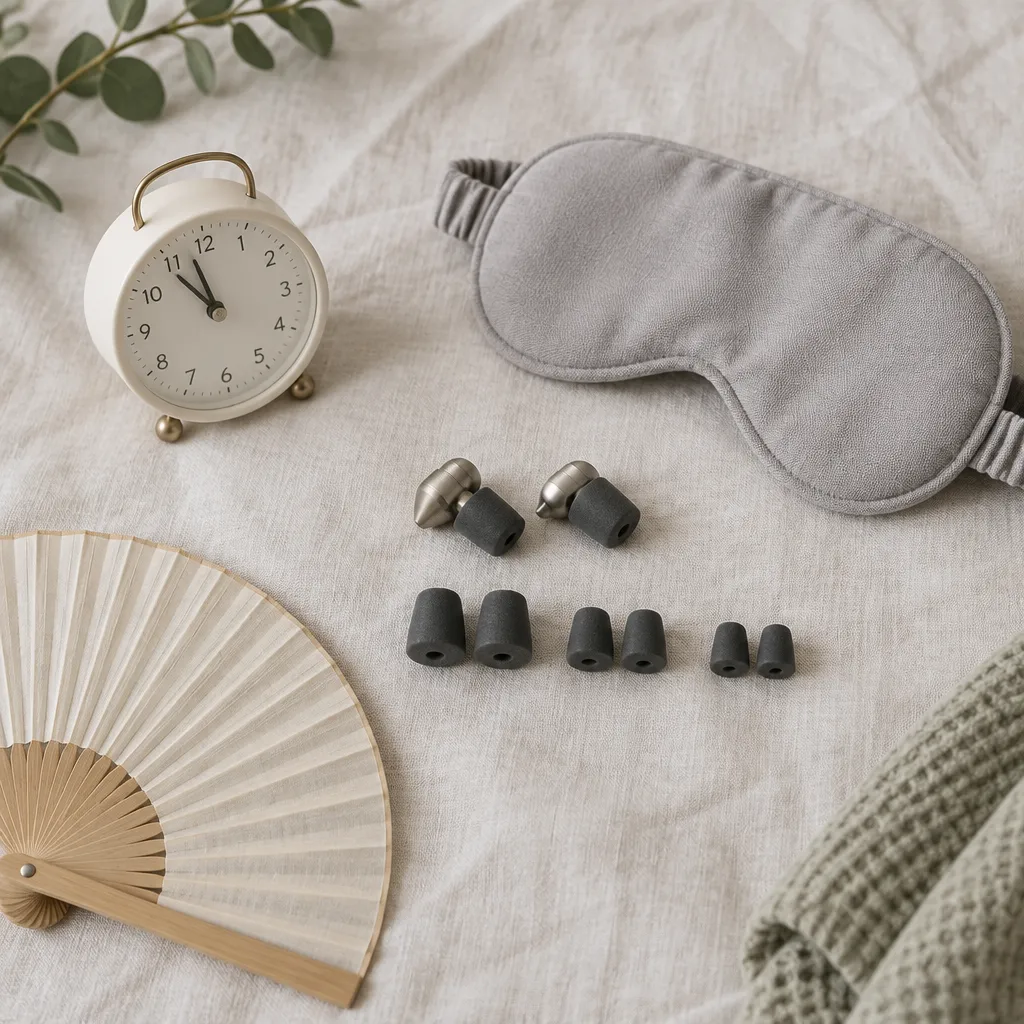
ATTENU8 ear plugs are rated at approximately 32dB noise reduction, and that figure only applies when the seal is right. Each pair includes three pairs of memory foam tips in XS, S and M. In practice, a tip that is too small lets sound leak around the edge, while one that is too large can feel tight and cause you to pull them out. Test all three sizes in daylight, then wear your chosen pair for a short time before you need to sleep in them.
Pro tip: Follow the steps on the How to Fit page on the ATTENU8 website, and check the seal with the palm test: cup your hands over your ears and compare the sound. If the difference is small, reseat the plug before you go to sleep.
Side sleepers often find that pressure from the pillow pushes a plug out of position during the night. This is where the bottom foam tips matter. They are included with the pair and give side sleepers a more comfortable option when the standard tip sits poorly against the pillow. A common mistake is to keep the same tip and blame the plug, when a different tip is the simple solution.
The memory foam tip should be changed every 6-8 weeks. Foam wears, compresses and picks up earwax over time, and once it stops expanding properly the seal weakens. The loss is gradual, so people often notice that the summer is noisier without realising the plugs have changed. Replacing tips on a fixed date, such as the first day of each month during summer, is the most reliable habit.
| Approach | Best for | Limitations |
|---|---|---|
| Reusable metal-bodied ear plugs with memory foam tips | Nightly sleep, travel and daily use where a consistent fit matters | Needs the right tip size and foam tip replacement every 6-8 weeks |
| Disposable foam ear plugs | Occasional use, emergencies and trying ear plugs for the first time | Fit varies from person to person, and they need replacing often |
| White noise machines or fans without ear plugs | Masking steady background hum and making the room feel calmer | Does little against sudden loud sounds such as fireworks or car doors |
The best summer setup layers several small changes rather than relying on one fix. Cooling the room, reducing sound at the source and wearing a sealed plug all work better together than any one of them on its own. The aim is to keep the room comfortable enough that your sleep stays deep, and quiet enough that sudden sounds don’t pull you out of it.
Start with temperature. A cooler room reduces the number of times you surface from sleep, which makes outside noise less likely to wake you. Close blinds during the day to keep heat out, run the fan on a low setting that doesn’t rattle, and keep the bedroom door closed to limit sound from other rooms. Then add ear plugs for the hours when neighbours and traffic are loudest.
If your problem is noise from the street rather than the house, our article on storm noise and sleep in Australia covers how to stay asleep through sudden, unpredictable sounds.
Do not wait for a heatwave to find out whether your plugs work. Wear them for a few evenings during a quieter period, then try them on a noisy night. ATTENU8 offers a 15 Days Money Back Guarantee, which gives you time to test a pair through several real summer nights. Full details are in the Refund Policy and T&Cs linked from the site footer, and the Contact Us page is there if you have questions about fit.
In practice, the sleepers who get the most from ear plugs are the ones who plan the routine: check the seal, replace the tips on schedule, and keep a spare pair within reach. That habit makes the difference between a bad week and a good summer.
Cooling the room helps, but summer also brings more outdoor noise, open windows and later evenings. Those sounds are often irregular, and irregular noise is what pulls light sleepers out of deep sleep. Cooling and noise control work best when you tackle both.
For most people, a well-fitting reusable pair worn at night is a practical option. Keep the foam tips clean, replace them every 6-8 weeks, and stop using them if you notice ear pain, irritation or discharge. If you have an ear condition, ask a doctor before using them regularly.
Start by testing all three memory foam sizes, XS, S and M, in daylight. Choose the one that feels comfortable and seals without pressure. If the seal feels loose after a few minutes, try the next size up or down rather than forcing the fit.
They can reduce the loud, sudden bangs that wake light sleepers, but they work best as part of a plan. Set them out before dark, close the windows, cool the room and keep the bedroom as quiet as possible. A plug that is seated properly is far more effective than one that is merely in your ear.
ATTENU8 offers a 15 Days Money Back Guarantee, so you have that window to test the fit on real nights. Read the Refund Policy and T&Cs linked from the site footer for the full conditions before you start.
What does your summer noise look like, and which sound wakes you first? Share your experience in the comments below.
Meditation is meant to be the part of the day when nothing asks for your attention, yet most people practice in rooms where a neighbour’s television, a ventilation fan or a crowded yoga class keeps pulling them outward. Ear plugs for meditation are a simple way to soften that pull, but they only help if you choose the right level of isolation and fit them so they stay put in seated, standing and lying positions. This guide explains how ear plugs for meditation and yoga change what you hear, when they help a practice and when they get in the way, and how to use them in classes, home sessions and shared studios without losing your teacher’s cues.
| Key Insight | Explanation |
|---|---|
| Match isolation to the room | A home sit in a noisy flat can handle strong reduction. A group class where the teacher speaks softly needs a test run first, because you must still hear quiet cues. |
| Expect your breath and heartbeat to become louder | Blocking outside sound makes internal sounds more noticeable. Many meditators find this helpful for focus, while others need a few sessions to adjust. |
| Test fit in your real postures | Seated, lying and balance poses shift plugs in different ways. Check the seal in the exact position you will hold for the whole practice. |
| Replace foam tips every 6-8 weeks | The aluminium body stays in use, so only the foam tips need replacing. A worn tip loses its seal, which reduces both comfort and noise reduction. |
| Use bottom tips for side-lying rest | ATTENU8 includes bottom foam tips for side sleepers. They are useful for side-lying rest poses where the plug presses against a pillow or mat. |
| Take them out when you need to hear alarms | Outdoor classes near traffic, or any setting where you may need to hear a warning, call for plugs to come out or be used with full awareness. |
Noise matters in meditation because attention is trained through returning. A siren, a car horn or someone coughing gives the mind a new object to chase, and each return to the breath or mantra is a repetition of the skill you are trying to build. A noisy room does not stop practice, but it multiplies the small pulls that happen during every session.
Most noise is not loud enough to cause real discomfort. The problem is that it is unpredictable, so part of your attention stays on the door, the street or the wall for the whole sit. In practice, this means you spend the session guarding against sound instead of settling into it.
A common pattern is that the first ten minutes feel fine, and then a neighbour’s bass or a dog barking pulls you out. Once you notice the distraction, the next few minutes often go to frustration. Reducing the number of sudden sounds is a practical way to make the early part of your sit more productive.
At home, you usually know where the noise comes from, and you can close a window or move a cushion. In a studio, the noise is spread out: mats sliding, people shifting, breath sounds from the class, and a teacher’s voice that carries across the room. Each source is small, but together they make it hard to settle into a steady rhythm.
The studio problem is different because you cannot control the room. That is where ear plugs earn their place, especially for people who find group settings draining. They are not a substitute for a good teacher or a calm class culture, but they can reduce the background noise that you cannot change.
Ear plugs do more than lower the volume. They change which sounds your attention lands on. Once the outside world quiets down, the inner sounds you normally ignore, such as breathing, swallowing and the pulse in your ears, start to stand out.
One meditator described on a public Q&A forum that wearing ear plugs for daily sits helped their inner focus, because they could hear their breathing and heartbeat more clearly. That report matches what many practitioners notice: the sit feels more inward and less like a negotiation with the room. Some people find this immediately calming, while others find it distracting at first.
If you start to notice your heartbeat, treat it as a new anchor rather than a problem. Many people use the rhythm of their breath or pulse as a quiet object of attention, especially in body-scan or breath-counting practices. The sensation fades as your nervous system gets used to the new level of quiet.
If the internal sounds become unpleasant or consistently pull you into anxiety, that is a reason to shorten the session and try again later, not to force yourself through it. A useful rule is to note the sensation, keep the plugs in for a shorter sit, and gradually extend the time as the sound becomes familiar.
Ananda, a meditation organisation, answers the question of when to stop using ear plugs by saying there is no fixed rule. If they help you, there is no reason to remove them, and you can keep using them. Their answer draws a useful parallel with other meditation conditions, such as sitting in a dark room, which you can adjust to suit your practice.
In practice, the right question is not how long you should wear plugs, but whether they support the kind of attention you want to build. If you sit in silence to become more aware of sound, you may choose to use them only on certain days. If your goal is calm and steady focus in a noisy home, they can become a fixed part of the routine.
Choosing ear plugs for meditation is not just about picking the strongest model. The goal is to reduce the noise that breaks your focus while keeping the sounds you need, such as a teacher’s voice, a bell or your own safety cues. Too little reduction leaves the distraction in place, and too much can make a group setting feel isolating.
Reusable ear plugs are often designed with different sizes and filtering options, and a guide published by The Guardian makes the same broad point: choosing the right earplugs is more involved than grabbing a basic pack from a shelf. The ATTENU8 design provides approximately 32dB of noise reduction, which is strong enough for most home sessions in a busy environment. That level of isolation is a good match for seated practice in a noisy flat or a shared house.
For home meditation in a noisy space, higher reduction is usually the better choice, because the goal is to make the room feel quiet enough to settle. For a group class where the teacher uses soft voice cues, you need to test before you commit. If you cannot hear a quiet instruction from across the room, the plugs are cutting too much for that setting.
Take a short test at home by sitting with the plugs in, playing the sounds you usually hear, and then asking a friend to speak at normal and low volume from a few metres away. This quick check tells you more than a rating printed on a package.
Strong isolation can make you feel cut off from the room, and that is not always what you want in a group practice. Some people feel more anxious when their hearing is heavily reduced, especially if they are waiting for a cue or a sound that signals a change. If that happens, moving to a lighter option or wearing plugs only for the meditation portion of a class is a sensible compromise.
Never use ear plugs in a setting where you may need to hear an alarm, a shout or a vehicle. Safety should always come before a quieter sit, and this matters most for outdoor classes near roads.
Yoga classes combine the challenge of focus with the need to listen. The teacher gives cues for alignment, transitions and safety, and those instructions matter most when you are balancing, inverting or moving between poses. The right plugs let you filter out the room without losing the voice that keeps you safe.

Most teachers speak at a steady volume that carries across the room, but cues like “soften your knees” or “check your weight in the back foot” are often delivered quietly. If you rely on these during a class, your plugs should let through enough voice to follow along. Choose a level of reduction that keeps the teacher’s tone clear, even if some background noise remains.
If you regularly miss cues, the solution is usually to adjust the fit or the level of isolation rather than to give up on plugs. Talk to your teacher before class if you plan to wear them, so they know to speak clearly and can check that you are following along.
Standing poses, arm balances and inversions move the head and jaw in ways that can loosen a plug that felt secure while seated. Chewing, swallowing and turning your head to check alignment can also change the seal. A plug that stays put during a seated sit may slip during a vinyasa flow.
Pro tip: Before your first class, wear the plugs through a full standing sequence at home, including forward folds and any inversions you practise. Then check whether you would hear a teacher saying “lift your hips” from across a room, because that is the real test for a studio.
Home practice is where ear plugs often make the biggest difference. You control the lighting, the timing and the setup, but you cannot control the flat next door or the traffic outside. For many people, the plugs become the final piece of a quiet space that makes a daily sit feel possible.
Restorative sessions and sleep-adjacent rest pose a different challenge. Long holds on the floor, lying down and side-lying shapes all press the plug against a pillow or mat. Comfort matters more than in an upright sit, because a plug that hurts will end the session early.
ATTENU8 includes bottom foam tips designed for side sleepers, and the same logic applies to side-lying rest in yoga. If the standard tip feels pressed against the mat or pillow, switching to the bottom tip can reduce pressure and keep the seal steady. Try the change during a short rest before you rely on it for a long session.
A practice that only works in complete silence is a practice you cannot take with you. Ear plugs are most useful when they help you build a steady attention that still works when the room is not perfect.
In a household with children, early-rising partners or a noisy kitchen, the morning sit is often the most vulnerable part of the day. Ear plugs can give you a short window of quiet without requiring anyone else to change their routine. Put them in before you sit, not after the distraction has already started, because the aim is to prevent the pull rather than chase it.
If you are new to inserting plugs, read the step-by-step guide on how to insert ear plugs correctly for maximum noise reduction before your first session. A poor insertion can make even a good design feel uncomfortable, and that discomfort is easy to blame on the practice itself.
Ear plugs are one option among several. Each approach handles noise in a different way, so the right choice depends on whether you need to block sound, mask it or change where and when you practise.
| Approach | Best For | Main Trade-off |
|---|---|---|
| Reusable metal-bodied ear plugs with foam tips | Seated meditation, home sits and side-lying rest in noisy homes or shared flats | Requires a good fit and replacement of foam tips every 6-8 weeks. You must test them against the cues you need in group classes. |
| Single-use foam ear plugs | Occasional sessions, trying out isolation before committing, or travel to a noisy venue | Fit varies from pair to pair, and you discard them after use. Over time, the cost of constant replacement adds up. |
| Background sound or a sound machine | Sessions where you want to mask sound and still hear the room around you | Masking adds a sound your mind can attach to, and it does little to reduce sudden loud noises that cut through. |
In practice, many people combine approaches. They might use plugs for home sits, while choosing a quieter class time or a corner of the studio away from the door. The point is to decide which noise is breaking your focus, then pick the tool that targets that noise.
Fit and hygiene decide whether ear plugs keep working across months of daily practice. A design with a metal body and replaceable foam tips means you can keep the part that holds the shape and replace the part that wears down. That is a more sustainable approach than discarding a full plug after every session.
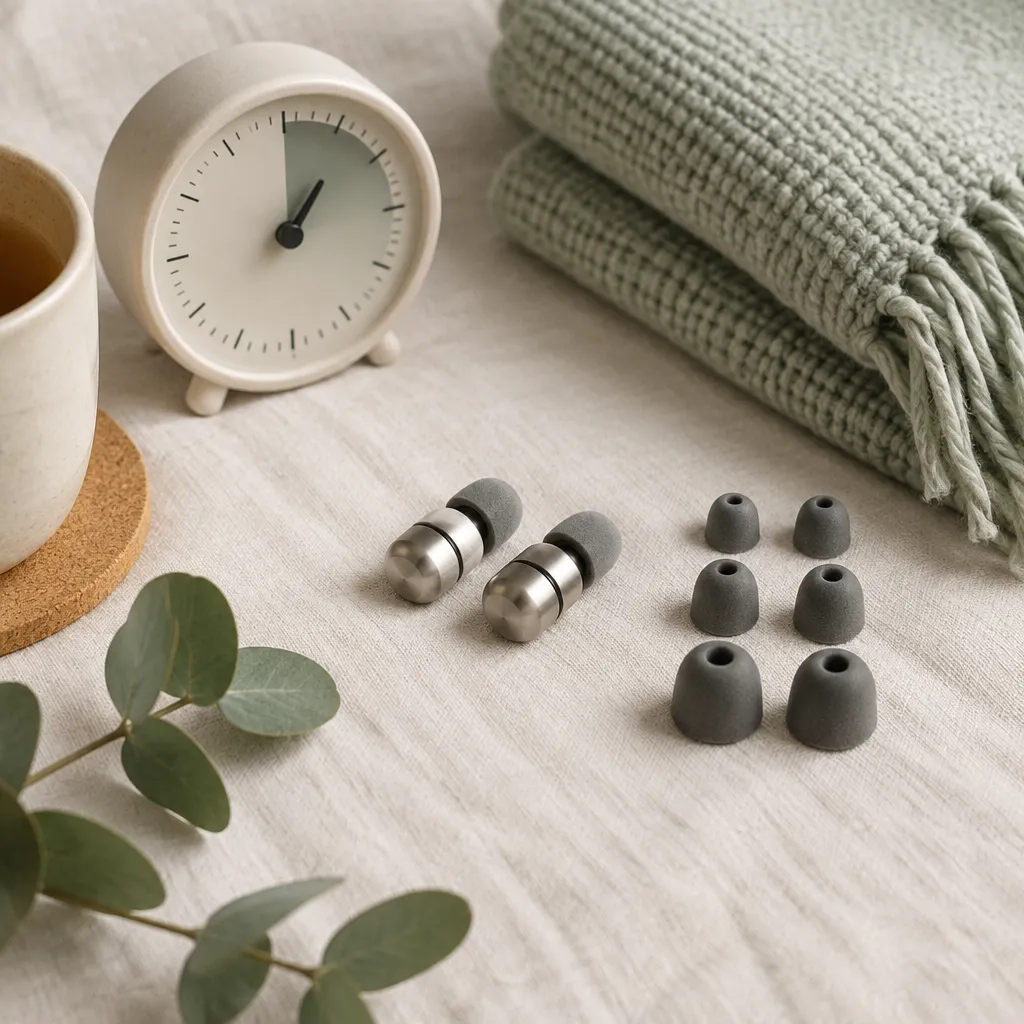
The ATTENU8 memory foam tips should be changed every 6-8 weeks. Frequent daily use, sweat and handling all break down the foam faster, so a practitioner who sits every morning may need to replace tips on the earlier end of that range. When you notice the tip no longer springs back or the seal feels loose, replace it rather than pushing harder.
Pro tip: Mark the date you start a new set of tips on the case or in your phone. A simple reminder keeps you from practising with a tired tip, which is one of the most common reasons plugs suddenly feel less effective.
ATTENU8 ear plugs have no batteries, filters or extra mechanics, so there is little to maintain beyond the tips and a clean body. Wipe the body after use, and let it dry before storing it in a case. Keep the plugs away from damp bathrooms and hot cars, where moisture and heat can shorten the life of foam.
If you find that a particular fit or level of reduction does not suit your practice, ATTENU8 offers a 15 Days Money Back Guarantee. The full terms are in the Refund Policy and T&Cs linked from the site footer, so read them before you start your first session.
Most problems with ear plugs in meditation come from a small set of habits. They are easy to fix once you know what to look for, and they often explain why a practitioner concludes that plugs are not for them.
Forcing a plug deep into the ear canal can cause pressure, soreness and a feeling of being cut off. The plug should sit comfortably with a seal, not feel jammed in place. If the discomfort grows during a sit, remove the plug, reinsert it carefully and try a smaller or different tip size.
The three tip sizes (XS, S and M) exist because ears vary. Choosing the size that feels secure, rather than the one that blocks the most sound, usually gives better results in a long practice.
A single trial in a noisy room can be misleading. The first few sessions often feel strange, because your hearing and attention are adapting to the new level of quiet. Give your practice a fair trial over several sessions in different postures before deciding that plugs do not suit you.
If you have sound sensitivity that causes pain or distress, the plugs are only one part of the picture. Our article on hyperacusis and noise sensitivity explains how plugs fit into a wider approach, and a clinician can advise you on any persistent symptoms.
They can, if the level of reduction is too strong for the room. Test your plugs before a class by asking someone to speak softly from a few metres away, and choose a lighter option if you miss important cues.
Many people do, because blocking outside sound makes internal sounds easier to notice. This can help some practitioners focus, while others find it distracting at first. Shorter sessions and a steady routine usually help the sensation settle.
The ATTENU8 memory foam tips should be changed every 6-8 weeks. If the tip stops springing back or the seal feels loose before that point, replace it sooner.
There is no fixed rule for when to remove them. If they help you settle and feel comfortable, there is no reason to stop, but check for pressure or soreness during longer holds and adjust the fit if needed.
Try the bottom foam tips, which are included for side sleepers, and test them during a short rest first. If discomfort continues, review the insertion steps and check that the plug is not pressed hard against a mat or pillow.
ATTENU8 offers a 15 Days Money Back Guarantee. The Refund Policy and T&Cs are linked from the site footer, and the Contact Us page is available if you have questions about your purchase.
Share your experience through the Contact Us page, especially if you practise in a shared studio or a busy home, because real practice notes help other meditators decide what suits them.
We would love your feedback and any insights you would share with others. What perspective would you add?
Every Australian summer, the same problem shows up in bedrooms across the country. The air conditioner is working through a hot night, the pool pump is humming beyond the bedroom wall, and the light sleeper in the bed is staring at the ceiling at 2 a.m. Air conditioning noise and sleep problems climb with the temperature, because the machines that keep you cool run hardest exactly when you are trying to rest. The good news is that this noise is mechanical and predictable, which means you can fix it. This guide explains why pool pumps and air conditioners disrupt summer sleep, what actually reduces the problem, and where a simple pair of ear plugs fits in.
| Key Insight | Explanation |
|---|---|
| A pool pump is a constant low hum that travels easily | Low, steady sound passes through walls and open windows, and it is most noticeable once the house and street go quiet at night. |
| Sudden changes wake people more than steady sound | A compressor that starts and stops keeps pulling you toward lighter sleep, which is why cycling noise is often harder to live with than a constant drone. |
| A new rattle, squeal, gurgle or hiss means a fault | Unusual sounds from an air conditioner usually point to a loose part or wear. Book a technician rather than trying to live with it. |
| Fix the source first, then the path to your bed | Servicing equipment and adjusting pump run times help everyone in the house. Sealing gaps and adding soft furnishings reduce what reaches the bedroom. |
| Combining fixes beats relying on one | Isolating equipment, reducing window gaps and wearing ear plugs together work better than any single step on a hot night. |
| Ear plug fit matters more than the brand name | A tip that does not seal lets sound leak in. Test the XS, S and M tips before the first heatwave, not during it. |
| Replace foam tips on schedule | Memory foam tips should be changed every 6-8 weeks. Daily summer use wears them out faster than occasional use. |
A pool pump is one of the few household machines designed to run for hours at a time. In many Australian backyards it sits near a side fence, a boundary wall or a bedroom window, because that is where the plumbing and power happen to be. That location is exactly what turns a useful piece of equipment into a nightly problem.

The core issue is the sound profile. A pump produces a low, steady drone, and low frequency noise tends to travel further through building materials than most people expect. A pump running at 10 pm may be easy to ignore while you watch television, then become impossible once the house goes quiet and the rest of the street falls asleep.
During the day, your brain filters out sounds it classifies as background. At night, that filter loosens. The pump you barely register at lunchtime is the one that makes you open your eyes at midnight, because the bedroom is quiet and nothing else is competing with it.
Many people with a pump near the bedroom describe the noise as a pressure rather than a sound. It is a hum you feel in the room more than you hear it. That description explains why a pillow over the head or a closed door often fails to help.
Most households run the pump for long stretches because it was set up that way when the pool was built. A pump that runs through the evening and overnight puts the most noise into your sleep window. A common mistake is leaving the schedule untouched all summer, even when the same filtration job could often be done during daylight hours.
Check the timer first. Your pool service provider can confirm what running time your pool actually needs, and that conversation is far more useful than guessing. Many households find that a small change to the timer removes the hum from the hours when they are trying to sleep.
Air conditioning noise is a different problem from pump noise. The outdoor unit cycles between running hard and easing off, and indoor units produce their own airflow sound. Both change during the night, and both can push a sleeper out of deep rest.
The Sleep Foundation notes that nighttime noise can wake you up or disrupt your sleep stages, even when you do not fully remember waking. It also reports that environmental noise, such as air and vehicle traffic, has been shown to increase stage 1 sleep and decrease slow wave and REM sleep. In plain terms, a noisy night can leave you in lighter sleep with less of the deep rest that makes the next day manageable.
Some air conditioner noise is normal. Fans, airflow and compressors have a sound you can learn to live with. The noises to act on are different. An HVAC service company’s guidance on sleep notes that loud system noises can negatively affect sleep, especially for light sleepers, and lists gurgling, squealing and hissing among the common noises that warrant a call to a technician.
Treat a new sound as a maintenance job, not a nuisance to tolerate. A rattle from the outdoor unit that changes with fan speed often points to a loose panel or debris. A squeal that gets louder through the evening can point to a worn part, which a technician should check before the next heatwave.
Indoor units are usually quieter than outdoor ones, but they sit much closer to your bed. Air moving through ceiling vents or a wall-mounted unit can create a faint hiss that you only register after the lights go off. In practice, light sleepers rarely complain about the loudest sound in the house. They complain about the feeling that the room is never fully still.
The most useful idea for managing summer noise is that predictability often matters more than volume. A steady sound can fade into the background, while an irregular one keeps demanding attention. That is why a constant pump drone can be easier to sleep with than an air conditioner that clicks on and off every few minutes, even if the air conditioner is quieter on paper.
The Sleep Foundation makes a similar point. It says a quiet bedroom is generally best, but steady background sounds, such as a fan or white noise, may help mask unpredictable noises for some sleepers. It also says research on background noise is mixed and that personal preference matters. You may find a fan helps you, or it may keep you awake.
A compressor that starts with a thump and stops with a click creates two sudden changes in your sleep environment. Each change is a chance for your sleep to lighten. You may not remember waking, but the night becomes fragmented, and the next morning feels heavier than the hours in bed suggest.
This is also why a unit that runs without a break can sometimes be more tolerable than one that cycles. Ask whether your system is short cycling or stopping and starting frequently, since a technician can check that as part of a service visit.
Some sleepers respond well to a fan or a low white noise machine at a steady volume. Others find that any added sound becomes one more thing to notice. Run a masking sound over several nights and track how often you wake. If it does not help, stop using it rather than turning it up.
For a deeper look at why some sounds wake you and others fade, read our guide on noise masking and sleep science. It covers the reasons a sound can be soothing for one person and disruptive for another.
The fixes that work fall into two groups: changes at the source and changes along the path between the source and your bed. Start with the source, because it helps everyone in the house and not only the person who complains most. You do not need a renovation to make a real difference.
Book the service before the first hot week, not during it. Technicians are busiest when temperatures spike, and a unit already straining in a heatwave is often the one that becomes loudest. Ask the technician to check the outdoor fan, the mounting, the panels and any loose fixings, since these are common sources of rattles.
Keep the outdoor unit clear of leaves, debris and clutter. Restricted airflow can make a system work harder and sound louder, and it is a free step you can take between service visits.
If filtration can run during daylight hours, move it out of your sleep window. Confirm the right running time with your pool service provider before you change any setting, because water quality depends on it. If the pump sits against a bedroom wall, relocating it is the most permanent fix, though it costs more and may need approval.
Pro tip: Stand in your bedroom at your usual bedtime with the pump and air conditioner both running, then walk slowly around the room. The spot where the noise is strongest is often a window gap or a wall shared with the equipment, and that tells you exactly where to add sealing or soft furnishings.
Sound takes the easiest route. Gaps around window frames, a door that does not seal and a hollow wall all let pump and air conditioner noise into the room. Weather seals, door seals and heavier curtains often help more than people expect, and they cost far less than replacing glazing. The Sleep Foundation lists earplugs, soft furnishings, sealed windows, reduced device alerts and quieter appliances among practical ways to limit disruptive nighttime noise.

A soundproofing company’s guide to pool pumps makes the same point from the equipment side. It notes that many homeowners see the best results by combining methods, such as isolating the pump, enclosing it in a quiet box and addressing window noise indoors. Single fixes rarely solve a summer-long problem.
Each approach solves a different part of the problem. Servicing targets new or unusual noise, enclosures target a fixed pump drone, and personal ear protection targets the sound that is still reaching you after everything else is done. The table below shows where each one earns its place.
| Approach | Best For | Main Limitation |
|---|---|---|
| Servicing the air conditioner | Rattles, squeals, gurgles and hisses caused by loose parts or wear | Does not reduce the normal sound of a healthy, working unit |
| Isolating or enclosing the pool pump | Constant pump drone from a fixed location near the bedroom | Needs space, airflow and a check on local rules and equipment requirements before installation |
| Reusable metal-bodied ear plugs | Immediate personal relief for light sleepers and noise-sensitive sleepers | Reduces sound at your ear only, so the equipment still runs, and results depend on choosing the right tip |
ATTENU8 ear plugs are rated at approximately 32dB noise reduction, which is why we recommend them as the personal layer rather than a replacement for fixing the source. You can read more about what that figure means in our article on 32dB noise reduction for light sleepers. Passive ear plugs generally block higher-pitched sound more effectively than low rumbles, so treat them as one layer in a larger plan.
When the source is outside your control, personal protection is the fastest fix. The real question is whether the ear plugs you choose seal well enough to block the sound at all, because a loose fit blocks very little on a hot night.
ATTENU8 includes three pairs of memory foam tips in XS, S and M, plus bottom foam tips for side sleepers. Roll the foam between your fingers, insert it gently, and hold it in place while it expands. A correct fit feels snug but not painful, and the hum from the pump should drop noticeably. If it does not, try the next size before deciding the product does not work for you.
Our How to Fit page on the website walks through insertion step by step. A common mistake is pushing the tip in too far or too shallowly, which breaks the seal even when the size is right.
ATTENU8 memory foam tips should be changed every 6-8 weeks. There are no batteries, filters or extra mechanics to maintain, so the foam tip is the only part that wears out. Daily summer use shortens the life of the foam because it is compressed, warmed and handled every night, so set a reminder rather than waiting until the seal feels loose.
ATTENU8 offers a 15 Days Money Back Guarantee, so you can test the fit during a real heatwave rather than a mild evening. The Refund Policy and T&Cs are linked from the site footer, and the Contact Us page is the fastest route if you have a question about sizing. Read the conditions before you buy so you know exactly what is covered.
Light sleepers often ask whether ear plugs are enough on their own. In practice, they work best as the last layer, after the equipment has been serviced and the bedroom has been sealed.
A steady hum you can predict is often easier to sleep through than a sound that switches on without warning.
Pro tip: Wear the ear plugs for an hour on a quiet afternoon before your first full night. If you can hear your own pulse or feel pressure building, the tip is either too large or not seated correctly, and it is better to find that out before bedtime.
Where the bed sits matters as much as what you wear in it. A bed pushed against a wall shared with the pump or the outdoor unit puts your head in the loudest spot in the room. Rearranging the furniture costs nothing, and it often delivers the biggest improvement of any step in this guide.
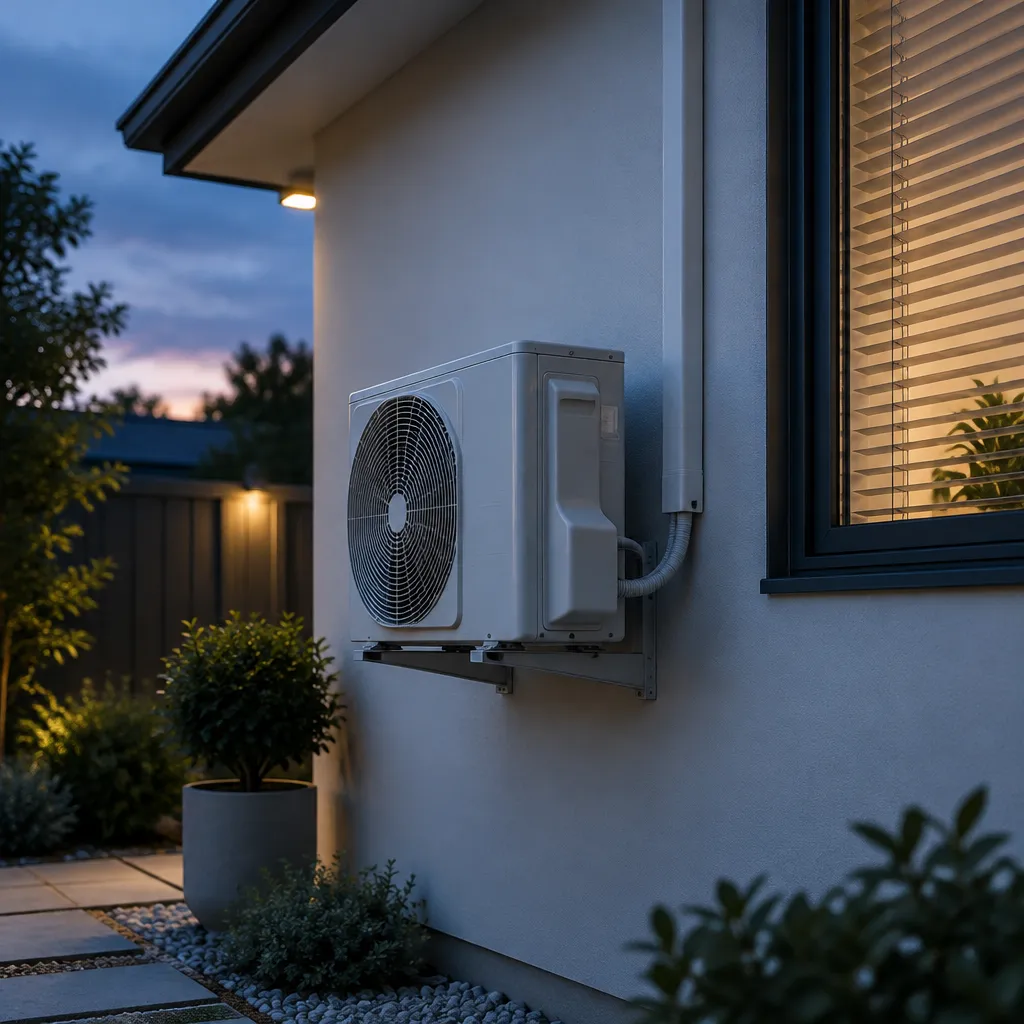
Move the bed to the wall that is furthest from the pump and the outdoor unit. A wardrobe, bookcase or upholstered headboard on the shared wall works as a buffer, because soft, dense furniture absorbs more sound than bare plaster. Keep the door closed at night, since an open door lets the hum travel down the hallway.
If the bed cannot move, try a headboard with a soft fabric face or add a heavy rug on the floor. These changes are modest, but they add up when combined with sealed gaps and a service visit.
Set your air conditioner to a steady temperature before bed rather than letting it cycle from a high setting. Close the windows on the pump side, draw heavy curtains and switch off devices that chime or vibrate. Our article on staying asleep through noisy Australian nights covers how to keep sleep intact when weather and noise hit at the same time.
Sleep Foundation guidance also notes that reducing device alerts and quieter appliances can limit disruptive nighttime noise. Put your phone on a do-not-disturb schedule and check whether any appliance in the room makes a regular click or tick.
The hardest nights are the ones with the highest temperatures, because the air conditioner runs longest and the pump often runs at the same time. Plan for those nights in advance. Keep a spare set of foam tips in the bedside drawer, and make sure you know how to fit them without turning on the light. A plan you can execute half asleep is worth more than a perfect plan you have not tested.
For more on how a well-set bedroom supports sleep through hot weather, see our guide to setting up a sleep-friendly bedroom for noise, light and temperature.
Changes in sound usually matter more than volume. A unit that starts, stops and clicks gives your brain new information all night, which can pull you into lighter sleep. A steady, quieter sound is often easier to ignore.
Yes, especially if the pump produces a low, steady hum. Closed windows help, but gaps in frames and thin glazing let sound through. Sealing those gaps and moving the bed away from the pump side usually makes a noticeable difference.
It depends on the sleeper. The Sleep Foundation notes that research on background noise is mixed and that personal preference matters. Try a steady masking sound for several nights, and stop if it makes you more alert.
Wear them as directed, keep the tips clean and replace the memory foam tips every 6-8 weeks. Stop using them if you feel pain or irritation, and speak to a doctor if you have ongoing ear problems before making them part of a nightly routine.
New gurgling, squealing or hissing sounds are the clearest warning signs. Rattles that change with fan speed can also point to a loose part. Book a technician rather than waiting for the noise to get worse during a heatwave.
ATTENU8 includes XS, S and M memory foam tips plus bottom foam tips for side sleepers, so try a different size first. If it still does not feel right, the 15 Days Money Back Guarantee gives you time to test them, and the Contact Us page can help with sizing questions.
Tell us in the comments which summer noise keeps you awake most, whether it is a pool pump, an air conditioner or a neighbour, and what has or has not helped you so far.
Put ear plugs in at a loud job site and nobody thinks twice. Put them in at a desk, in a quiet open-plan office, or during a team meeting, and the situation gets awkward fast. Good ear plugs at work etiquette is less about rigid rules and more about two questions: when hearing protection is genuinely needed, and how to wear it so you stay protected without missing alarms, instructions, or the colleague who needs your attention.
This guide covers both sides. We look at which settings call for protection, how to check fit, how to handle shared spaces, and how to raise the topic with a manager. The advice reflects the questions we hear most often from construction crews, factory staff, and noise-sensitive office workers who use reusable ear plugs every day.
| Key Insight | Explanation |
|---|---|
| Protection follows the noise level, not your job title | NIOSH sets its recommended exposure limit at 85 dBA. If noise exceeds that for part of your shift and cannot be engineered down, wear protection for the whole loud period. |
| Fit matters more than the number on the box | Printed noise reduction ratings often overstate the protection a real worker gets. Run the hand-cupping check after every fresh insertion. |
| Take plugs out for conversations that need your full attention | Remove them when a supervisor, customer, or colleague is giving instructions, rather than guessing at what you missed. |
| Comfort never overrides safety sounds | If reversing alarms, radio calls, or building alerts cannot reach you, switch to a protector that allows speech and warnings, or remove your plugs in that zone. |
| Replace tips on schedule | ATTENU8 foam tips need replacing every 6 to 8 weeks. Worn tips lose their seal even when they still look fine. |
| Hygiene is part of etiquette | Wash your hands before insertion, store plugs in a case, and never lend or borrow a pair. |
The simplest rule is that hearing protection goes in when noise is too loud to control any other way. NIOSH sets its recommended exposure limit at 85 dBA, and the aim is to give workers protection that keeps their exposure below that level. If your job puts you above that threshold for a meaningful part of the shift, plugs are not optional, and the etiquette question becomes how to wear them well.
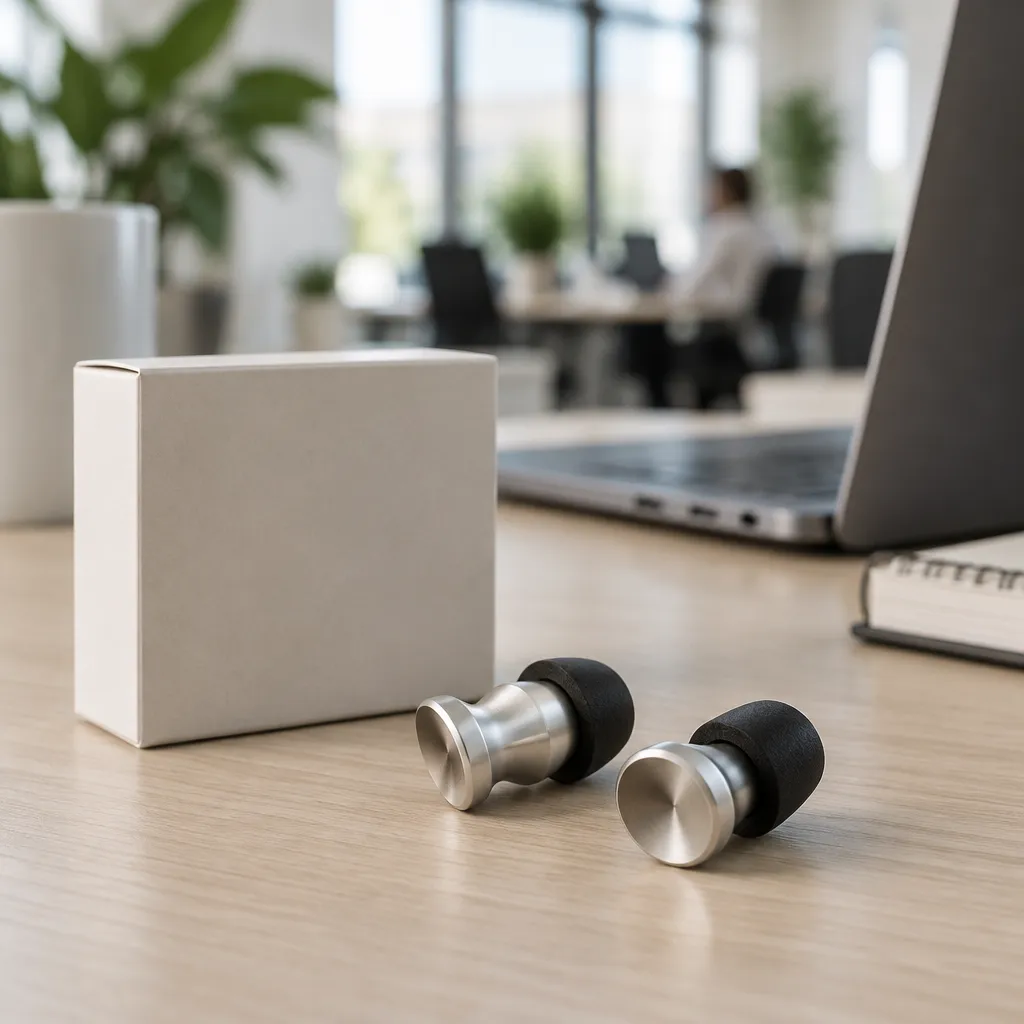
Grinding, jackhammering, power tool work, and machinery on a factory floor are the obvious cases. In practice, a worker who wears plugs for the loudest 40 minutes of a shift but pulls them out during the rest of the loud periods gets far less protection than they think. Treat protection as a condition for the whole noisy period, not a gesture you make when a machine starts up.
Most people who skip hearing protection on site are not refusing it on principle. They forget, they find the plugs uncomfortable, or the tips have gone soft. Those problems are fixable, and they matter more than etiquette because a plug that is not in your ear protects nobody.
Open-plan offices rarely threaten hearing, so wearing plugs there is about focus and comfort rather than safety. That makes etiquette more important, because the people around you cannot see why you are wearing them. A quiet, unexplained pair can read as rudeness, or as a signal that you do not want to be approached.
A practical approach is to tell your immediate team once, in plain words, that you wear plugs for concentration and that you will take them out for anything urgent. After that, you rarely need to explain again. For noise-sensitive people, this matters. Conditions such as hyperacusis and noise sensitivity make ordinary office sound genuinely tiring, and saying so openly costs far less than working around it in silence.
Most hearing protection fails because of fit and habit, not because the product is weak. NIOSH notes that hearing protection is often inadequately chosen, worn incorrectly, or used inconsistently. Those three failures account for most of the gap between what a plug promises and what a worker actually receives.
If your site has no formal fit testing, you can run a quick check yourself. Insert the plugs, count out loud, and slowly cup and uncup your hands over your ears. If the fit is good, your voice should sound about the same both ways. If your voice suddenly sounds booming or hollow, the seal is leaking, and you should reseat or resize before going back to work.
Do this check after every fresh insertion for the first few days with a new pair. It takes seconds and catches the most common problem, which is a plug pushed in at the wrong angle that never forms a seal.
Manufacturers print a noise reduction rating (NRR) on packaging, but NIOSH points out that this figure often does not reflect the protection each worker actually gets, which is why it has recommended derating the NRR. ATTENU8 states that its plugs deliver approximately 32dB of noise reduction, but treat any printed figure as a ceiling for an ideal fit, not a guarantee for your shift.
Individual fit testing remains the most reliable way to confirm protection, and NIOSH identifies it as the best way to check whether each worker is getting the protection they need. If your employer offers it, ask for it. If they do not, the hand-cupping check is the next best option.
Pro tip: Replace foam tips before they flatten or stiffen. Once a tip stops recovering its shape, it stops sealing, even if it still looks fine to the eye.
Shared spaces are where most etiquette problems happen. Your plugs protect you, but they also change how you hear the people around you, and they can change how your voice sounds to others. Good etiquette here means making the adjustment visible and easy for others to work with. If you work in a busy office, our guide to ear plugs for open plan offices covers the layout questions in more detail.

Wearing plugs while someone speaks to you is manageable if you make eye contact, lean in slightly, and ask them to repeat anything you miss. Pretending you heard something you did not is worse than admitting it. The more reliable habit is to remove one plug when a conversation matters, especially when someone is giving you instructions or feedback.
Speak a little more deliberately than usual. Plugs tend to make your own voice sound louder inside your head, which often leads people to speak more quietly than they need to. Keep your volume steady and check with the other person if you are unsure how you are coming across.
Calls are where plugs cause the most trouble. The other person hears you normally, but you may hear yourself strangely and drift toward a louder tone. If you take calls in an open office, ask a trusted colleague to tell you honestly how you sound on the line. Mute yourself before you cough, sigh, or rustle paper, because plugs make it easy to forget how much noise you are making.
Also, do not rely on plugs alone in a meeting room where a fire alarm or building announcement could happen. The rule is simple: if a sound could tell you to leave, you need to be able to hear it.
Etiquette depends on the gear. A pair that is uncomfortable, falls out during conversation, or needs constant fiddling will be removed in front of other people, which damages trust and protection at the same time. Choosing the right type is the first step in making the whole arrangement work.
NIOSH groups earplugs into three families: formable foam plugs that expand to fit the canal, pre-formed plugs shaped to fit most ears, and custom plugs made from an impression of your ear. Each has a different trade-off between cost, comfort, and how often you need to replace them.
Disposable foam is the default on many sites because it is inexpensive and easy to stock. The drawback is that workers often roll them badly, insert them shallowly, and throw away a pair that still works. If foam is what your site issues, the etiquette point is to keep a clean pair in your pocket rather than borrowing one from a coworker.
Reusable plugs make the most sense when you wear them daily, because the upkeep is predictable. ATTENU8 plugs use a concave aluminium body with three sizes of soft memory foam tips (XS, S, and M), and only the tips are replaced, typically every 6 to 8 weeks. In practice, trying all three sizes in the first session matters more than the brand name, because the right size is what seals the ear canal.
My position is straightforward. If you wear plugs for most of a working day, pay for a reusable pair with a fit you trust. If you need them only now and then, disposable foam is fine, provided you replace it as soon as it stops recovering its shape.
| Approach | Best suited for | Etiquette and upkeep trade-off |
|---|---|---|
| Disposable foam plugs | Short tasks, site kits, occasional use | Easy to hand out, but workers tend to reuse them past their best or discard them inconsistently. Keep your own pair rather than sharing. |
| Reusable pre-formed or custom plugs | Daily use in one role, such as a factory line or a noisy workplace | Comfortable for long wear, and custom moulds need a fit appointment. When they seal well, you have less reason to pull them out in front of others. |
| Reusable metal-bodied plugs with replaceable foam tips | Daily wear, travel, sleep, and noise-sensitive workers | Only the tips need replacing, roughly every 6 to 8 weeks. The slim body is easy to keep clean, but tips must be kept clean and seated correctly. |
Hearing protection is only good etiquette when it does not hide the sounds that keep people safe. Reversing alarms, radio calls, crane signals, and building alerts all need to be heard. Wearing protection does not mean you stop listening, and this is where many workers make a judgment error.
On a site with vehicles, you need to know when a machine is backing up. If your protection reduces those sounds to the point where you cannot locate them, take the plugs out when you are working near traffic. The 3M hearing conservation guidance recommends considering protectors that help workers hear important sounds when communication and safety are concerns, so choose gear with that in mind from the start.
In offices, the risk is different. A fire alarm or a colleague calling your name may not register through a sealed plug. A practical habit is to take the plugs out during the first minute of any meeting, so you know what the room sounds like before you settle in. Some workers also keep one ear uncovered during the first hour of a shift to check for alerts.
Pro tip: Test your audibility once a week. Ask a colleague to say your name from across a quiet room while you wear your plugs. If you cannot reliably hear it, the plugs are either too effective for the setting or not seated well.
Hearing protection is personal equipment, and the etiquette around it is partly about hygiene. Ear canals are sensitive, and a plug that has been handled with dirty hands or passed around a team is a problem for whoever uses it next.

Wash your hands before inserting plugs, and keep them in a case rather than a loose pocket where they collect lint and grit. Never lend your plugs or borrow someone else’s, even for a short task. If your site runs a shared kit, issue each worker a personal pair and replace tips on a schedule rather than waiting for someone to complain.
NIOSH recommends that employers provide a variety of hearing protection options, select protectors that are comfortable and compatible with the job, and train both management and workers. That gives you a reasonable basis to ask for a different type if your current plugs fall out or cause pain. Frame the request around fit and consistency, since those are things an employer can measure and improve.
Hearing protection only works when it is chosen well, fitted properly, and worn every time the noise is present. Most etiquette problems at work trace back to one of those three things failing.
When a coworker is not wearing protection in a loud area, speak to them directly and privately rather than in front of the group. Describe what you noticed and point to the site rule or the supervisor. Keep it factual, because people who feel shamed tend to stop listening.
Pro tip: If you are a supervisor, invite workers to try two or three protector types before the first shift. Most fit complaints disappear once someone finds a pair that seals well.
Not in itself. Wearing them for hearing protection on a loud site is expected, and wearing them for focus in an office is reasonable if you tell your team once and take them out for anything urgent.
Use the hand-cupping check: count out loud while you cup and uncup your hands over your ears. If your voice sounds about the same both ways, the seal is working. If your employer offers fit testing, that is the most reliable method.
ATTENU8 foam tips are designed to be replaced every 6 to 8 weeks. Replace them sooner if they stop springing back, become dirty, or start to crumble, because a worn tip loses its seal.
Yes, provided they do not stop you from hearing alarms, announcements, or people who need you. Take them out for meetings where safety information might be shared, and let your team know your routine.
No. They reduce noise, but the printed rating is usually more optimistic than real-world protection. Combine plugs with noise controls where possible, and check your fit regularly.
Keep them in if the call is routine and you can hear the other person clearly. Remove one plug or both if the call is complex, emotional, or needs precise details, and mute yourself before any background noise.
What has worked for you when wearing ear plugs at work, and where did things get awkward, so that others can learn from your experience?
If a hand dryer, a fire alarm or a crowded train can derail an entire morning, you already know that noise is not a minor inconvenience for many autistic people. Noise sensitivity is one of the most common sensory experiences linked to autism, and it can turn classrooms, offices and bedrooms into places of constant strain. This guide explains how sensory processing shapes sound tolerance, how ear plugs can help with autism noise sensitivity in real settings, and how to choose and fit them so they actually work during a normal day.
| Key Insight | Explanation |
|---|---|
| Noise sensitivity is common in autism | A 2021 scientific review, cited by the SPARK autism research community, estimated that 50 to 70 percent of autistic people were hypersensitive to everyday sounds at some point in their lives. |
| Both over- and under-responding matter | Some people flinch at a vacuum cleaner, while others barely react to a name called across a room. Plan protection for both patterns. |
| Fit determines the protection you get | A rating of approximately 32dB assumes a good seal. A shallow or badly seated tip can cut far less noise than the rating suggests. |
| Test all three tip sizes at home first | Try XS, S and M in a quiet room before the first busy day. Choose the size that seals without ache or pressure. |
| Replace foam tips every 6-8 weeks | Fresh tips keep the seal consistent. The reusable metal body stays in use, so you only replace the part that wears out. |
| Use plugs for predictable noise | Ear plugs work best for repeating sounds like open-plan offices, buses and night-time traffic. Pair them with planning for the rest of the day. |
Noise sensitivity in autism rarely looks dramatic from the outside. It looks like a child with hands clamped over their ears at the sound of a hand dryer, an adult who leaves a restaurant before the food arrives, or a teenager who keeps headphones on with nothing playing just to shut the room out. Leo Kanner’s 1943 article, which gave autism its name and first description, already noted that many of the children he saw had an unusual relationship to sound, either ignoring it or fearing it.
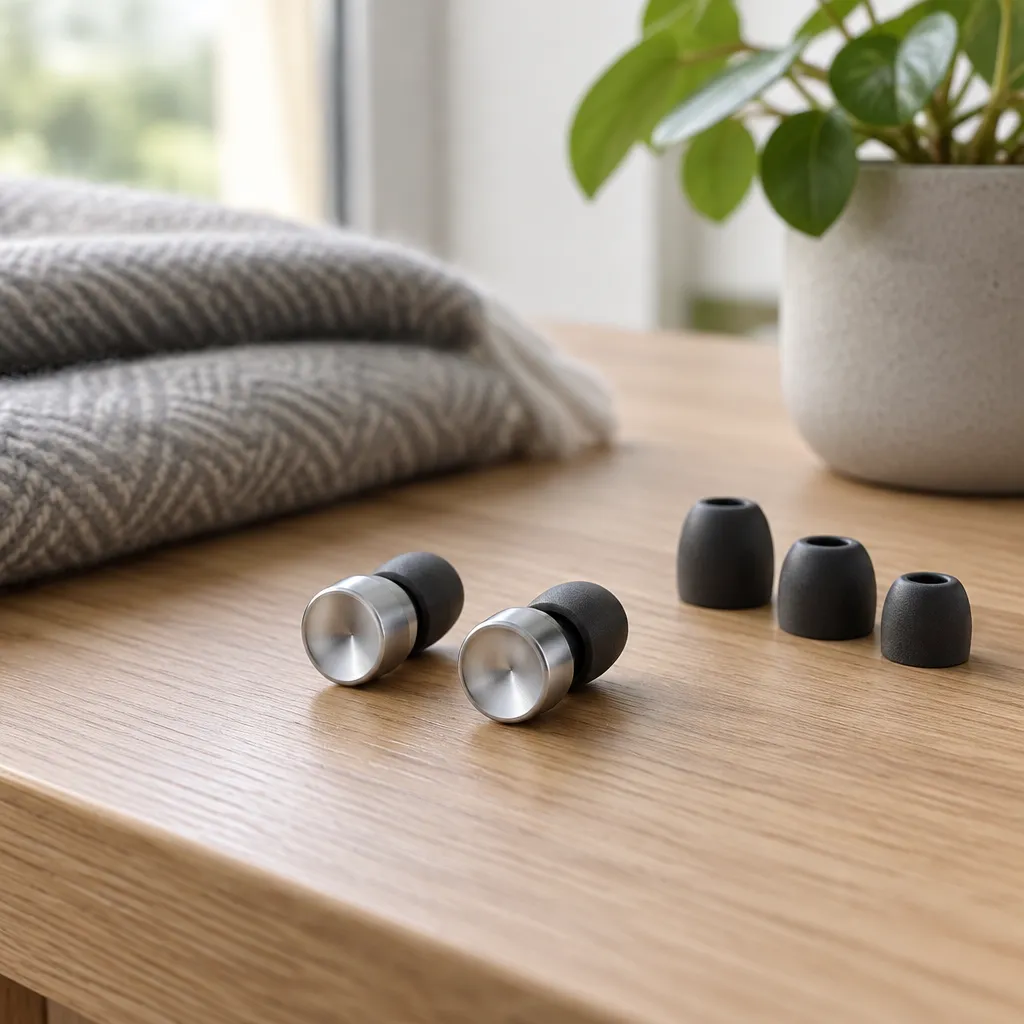
Some autistic people are hyper-responsive, which means everyday sounds arrive too loud, too sharp or too close. The SPARK overview describes a child who was terrified of the vacuum cleaner and would not go near the cupboard where it was kept. In practice, the trigger is often not the loudest sound in the room but a repeating or unpredictable one, such as a fridge compressor cycling on or a tap dripping into a sink.
Others are hypo-responsive and barely seem to register sound. A teacher may conclude that a child cannot hear, when the child simply does not turn toward a voice calling from across the room. This matters for ear plugs because someone who under-responds may not notice noise building until they are already exhausted, so protection has to be planned in advance rather than reacted to.
For many people, hearing is the sensory area where autism becomes most recognisable to others. The SPARK overview notes that American psychiatrists formally recognised under- or over-reacting to the senses as one of several autism signs in 2013. Light, touch and smell can also be difficult, but sound is the trigger that most often disrupts school, work and sleep on the same day.
Think of sensory processing as a filter sitting between the ears and the brain. In many people, that filter quietly drops the fridge hum, the traffic outside and the chatter in the next room, so attention stays on the conversation in front of them. When the filter closes slowly or unevenly, every sound competes for the same attention, and the room feels much louder than it is.
Researchers still have many open questions about how autistic people process information from their senses. The SPARK overview is clear that no single type of sensory symptom is consistently associated with autism, and a 2020 review on decreased sound tolerance in autism focuses on definitions, descriptions and possible mechanisms rather than one universal pattern. What practitioners see is variation. One person handles a busy cafe well but cannot sleep beside a neighbour’s television, while another person has the reverse pattern.
Noise rarely overwhelms all at once. It stacks up, and the person who seems fine at breakfast may be running on empty by mid-afternoon.
Fatigue is the cost that families and employers most often overlook. A morning of fluorescent hum, a bus with squealing brakes and a lunchroom full of cutlery can leave someone unable to answer a simple question at 3pm. Ear plugs will not change a sensory profile, but reducing the number of sounds that reach the brain can lower the load carried through the day. For a deeper look at this pattern, read our guide on how ear plugs help with hyperacusis and noise sensitivity.
Pro tip: Keep a three-day noise log that records the time, place and sound before each meltdown, shutdown or moment of withdrawal. Patterns such as a particular bell, a ceiling fan or a crowded corridor show up quickly and tell you exactly where protection matters most.
Classrooms and open-plan offices are where noise sensitivity most often becomes a daily problem, because the sound is constant and leaving is not always an option. A reusable pair with soft foam tips can take the edge off during lessons, tests or focused work. Ear plugs reduce sound rather than silencing a room, so they work best for steady background noise rather than every sudden shout.
Ask the school or employer before the first day whether a student or staff member can wear ear plugs during tests, assemblies or focused work. Many people find it easier to request a plan in advance than to explain a meltdown after it has already happened. A short written note that names the setting and the reason is often enough to start that conversation.

Construction sites, factories and some military settings require hearing protection, and that protection only works when it is worn for the whole shift. A worker who finds foam plugs itchy or hard to seat often stops wearing them by mid-morning. A reusable plug with three tip sizes gives that person a better chance of wearing protection through a full day, but the workplace’s own noise assessment and approved equipment always come first.
Ear plugs reduce everything you hear, including alarms, radio calls and instructions from a supervisor. Before you rely on any pair on a site, test whether you can still hear the warnings that matter. Where alarms are critical, ask whether a visual or vibrating signal is available, and check the details with occupational health staff.
Sleep is where noise sensitivity does the most damage over time. A light sleeper who wakes at a neighbour’s door or a bin lorry at 5am does not just lose one night, but several days of short and broken rest. Our guide on how ear plugs fix urban rest covers this problem in more depth for city living.
Side sleepers often find that a plug pressing against the pillow becomes uncomfortable. Check that the tip sits flush in the canal and does not push outward toward the jaw or the pillow. If a foam tip stays compressed after you release it, replace it, because a tired tip loses its seal and can feel more intrusive than a fresh one.
Trains, aircraft and hotel corridors produce a steady drone followed by sudden announcements. Ear plugs handle the constant drone well, but they do less for a sharp announcement at close range. Some people combine a pair of plugs with headphones on long journeys, which gives them control over both the steady hum and the sudden sounds.
The biggest mistake we see is choosing ear plugs by their rating alone. A 32dB figure is a useful benchmark, but it assumes a good seal. For sensitive ears, the gap between a comfortable pair that gets worn all day and one that is abandoned after an hour usually comes down to fit.
A tip that sits shallow or a canal that has not been opened properly can cut far less noise than the rating suggests. The difference is often most obvious in the first minute after insertion, when the sound seems to fall away and then creeps back. Our article on why fit beats decibel ratings explains the reasoning in more detail.
Three tip sizes cover most ear canals, but the right size is the one that seals without ache or pressure. Insert each size in a quiet room, wait a minute and check for tightness, pain or a hollow feeling. If the tip pushes on the canal wall, step down a size, and if the seal feels loose, step up.
Pull the top of the ear up and back to straighten the ear canal, then roll the foam tip into a thin shape and push it in gently. Hold it in place for a few seconds while it expands to fill the canal. Our step-by-step guide on how to insert ear plugs correctly shows the full process, and a second guide on finding comfortable ear plugs for sensitive ears covers comfort problems.
Pro tip: Do a quick seal check before you leave the house. Cover the ear with your palm and notice how much the room quiets. If the change is small, reseat the plug and test again before you rely on it.
No single tool suits every setting, and it helps to compare options by where they actually work. The table below sets out three common approaches, based on how they perform in daily situations rather than on marketing claims.
| Option | Where It Helps Most | Main Drawback |
|---|---|---|
| Disposable foam ear plugs | Short-term protection, such as a single event or a one-off shift | Costs add up over time, and fit depends heavily on how carefully each one is rolled and inserted |
| Reusable metal-bodied ear plugs with foam tips | Daily use at school, work, sleep and travel, with three tip sizes for fit | Needs a fit check at the start, and foam tips must be replaced every 6-8 weeks |
| Noise-cancelling headphones | Commutes and steady low-frequency noise such as engines or air conditioning, without an in-ear seal | Less effective against sudden sounds and voices, and some people find them heavy or uncomfortable for long periods |
Disposable foam plugs suit occasional use, but they are rarely the best choice for someone who needs protection every day. Reusable plugs make more sense when the same noise recurs, such as a daily bus route or a classroom that never goes quiet. Headphones handle steady sound well, but they often fail in the situations that matter most, such as a fire drill or a sudden shout.
Many people end up combining tools. A common pattern is reusable plugs for sleep and workdays, with headphones kept for a long commute. The right mix depends on whether the main problem is steady noise, sudden noise or both, so start by identifying which one causes the most strain.
Ear plugs work best when they are part of a routine rather than a last-minute fix. A routine starts with knowing which hours of the day are loudest and which places drain you fastest. Once those are clear, protection becomes predictable, and so does the energy you have left for everything else.
Use your noise log to identify the three loudest parts of a typical day. For many people these are the school run, lunch in a shared room and the commute home. Put plugs in before the first of those moments rather than after the noise has already built up. Waiting until you feel overwhelmed makes the protection feel less effective than it really is.

Keep one pair in your work bag, one in your coat pocket and one by the bed. Losing a single pair should not leave you unprotected for a week. Wipe the metal body with a dry cloth, store the plugs in a case, and keep a spare set of foam tips in the same pouch so a worn tip never becomes the reason you give up on a busy day.
Yes, for many people they reduce the sound level in predictable environments such as classrooms, offices, buses and bedrooms. They do not change how the brain processes sound, so they work best as one part of a wider plan that includes planning ahead and choosing quieter spaces where possible.
They can be, provided the child is comfortable, the fit has been checked with an adult and the plug is never pushed deep into the ear. If a child reports pain, discharge or hearing changes, stop using the plug and speak to a GP or audiologist before continuing.
Replace the foam tips every 6-8 weeks. Replace them sooner if they stay compressed after release, look worn, or stop feeling comfortable, because a tired tip loses its seal even if it still looks fine.
No. A rating of approximately 32dB reduces noise significantly, but it does not silence a room. Steady background sound is usually reduced more than sudden, sharp sounds, so plan for the sounds that still come through.
Not always, which is why you should test them before relying on them at work or in an emergency. Where warnings matter, ask whether visual or vibrating alerts are available and confirm the approach with occupational health staff.
Try a smaller tip size and check the insertion steps. If pain continues, stop using the plugs and speak to an audiologist or GP, because pain can be a sign that something else needs attention.
Have you found a fit, routine or workplace arrangement that makes noise easier to manage for you or someone you support? Share your experience in the comments so other readers can learn from it.

